
TL;DR:
- You can keep your UK landline number when switching providers by requesting porting through One Touch Switch.
- Number portability is a protected right, and the process is straightforward, requiring accurate details and no contact with the old provider.
You can keep your UK landline number when you switch providers. Sign up with the new provider, tell them you want to retain your existing number, and they will arrange the transfer via One Touch Switch (OTS). You do not need to contact your old provider at all. Number portability is a protected consumer right under Ofcom rules, so your current provider cannot block or withhold the transfer unfairly. If you are searching for a memorable replacement number rather than porting an existing one, Phonenumbers holds a searchable database of 01, 02, and 07 UK numbers and can advise on your options.
Table of Contents
- What to have ready before you start a landline port
- How landline number porting works in the UK
- What does porting a landline number cost?
- What changes when you port a landline number to VoIP?
- Why might a port fail, and how do you fix it?
- When porting is not possible: what are your alternatives?
- Key takeaways
- The part most guides skip
- Phonenumbers: memorable UK numbers and porting support
- Useful sources
- FAQ
What to have ready before you start a landline port
Getting the details right at sign-up prevents the most common delays. Have the following to hand before you contact the new provider.
- Your existing landline number in full, including the area code.
- The registered address for the line, exactly as it appears on your current bill.
- Your current provider’s name (e.g. BT, Virgin Media, Sky, Vodafone).
- Account or billing reference and the date of your last bill if available — these help the OTS identity match run cleanly.
- Whether the line is bundled with broadband or is a standalone analogue line. Bundled lines follow a slightly different migration path and may involve Digital Voice migration.
- Ex-directory or silent number status. Note this separately — it will not carry over automatically and must be re-applied with the new provider.
- Voicemail and call-log records you want to keep. These do not transfer during a port; save anything important before activation day.
One important distinction: PAC and STAC codes are used only for mobile number porting. Landline transfers work entirely through the OTS workflow — no code is required from you.
Pro Tip: If you cancelled your landline recently, you may still be able to reclaim and port the number. Ofcom guidance gives you up to one month from cancellation to act — tell the new provider immediately at sign-up.

How landline number porting works in the UK
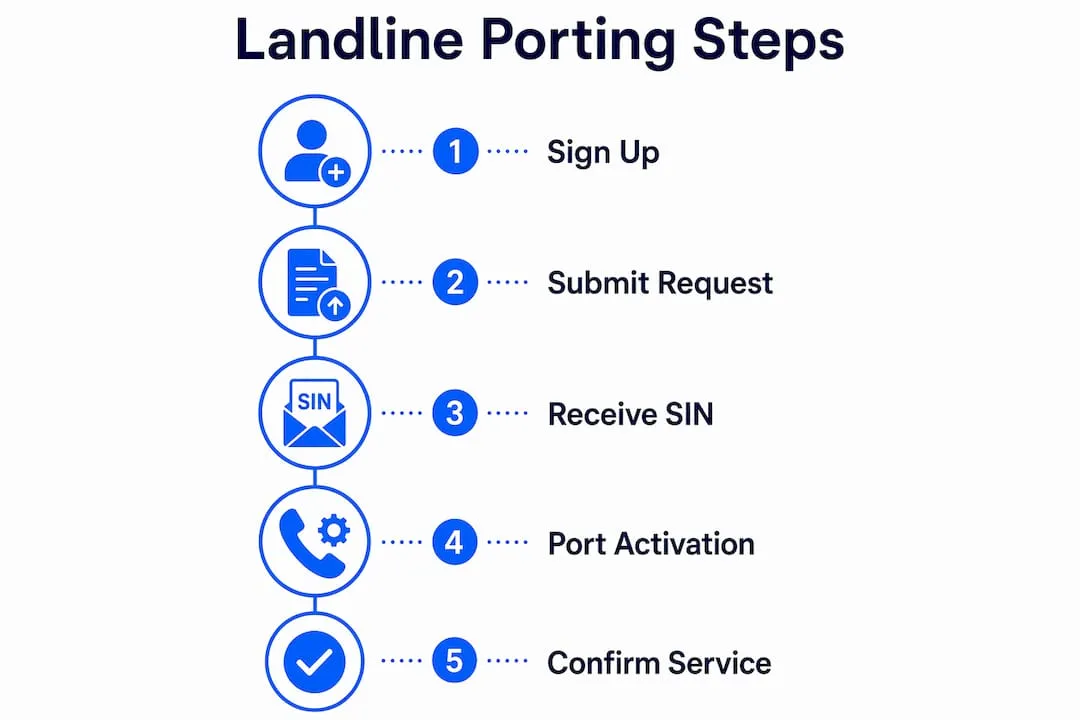
The OTS process is straightforward. Here is what happens at each stage.
- Sign up with the new provider. Provide your existing number, registered address, and current provider name. The gaining provider submits an OTS match request via the TOTSCo Hub. You do not need to call your old provider.
- Match response. The losing provider confirms your identity and technical details. Under OTS this typically happens within seconds of the request being submitted.
- Switching Information Notification (SIN). You receive a SIN within 1–5 working days confirming your activation date and whether the port is included. Read it carefully. If the SIN does not mention the port, raise the query with the gaining provider before you consent.
- Activation day. Broadband and Digital Voice go live. Calls begin routing via the new provider. The technical port usually completes within 10–15 working days overall, though the number may finish porting a day or two after broadband activation.
- Post-activation checks. Make and receive test calls, confirm caller ID is displaying correctly, set up voicemail from scratch, and re-apply ex-directory status if needed.
For a detailed walkthrough of the porting workflow, Phonenumbers has a dedicated guide covering each stage.
Pro Tip: Keep a copy of the SIN and note the activation date. It is your primary reference if anything goes wrong.
What does porting a landline number cost?
Many providers include the port at no charge as part of the switching package. Some charge a modest administration fee; check your SIN and order terms before you confirm. Ofcom’s number portability rules mean providers cannot use fees to obstruct a legitimate transfer.
On timing: the SIN arrives within a few working days, and the full port typically completes within a couple of weeks. Downtime is usually minimal. Brief routing issues can appear on activation day, so test immediately and report any problems to the gaining provider rather than waiting.
Timeline at a glance: SIN within 1–5 working days. Activation and port completion within 10–15 working days. If problems persist beyond the provider’s resolution window, escalate to Ofcom.
If a port is delayed or mishandled, contact the gaining provider first with your SIN and order reference. Ofcom is the escalation route if the provider fails to resolve the issue within their stated service level.
What changes when you port a landline number to VoIP?
You can port a landline number to many VoIP or hosted phone services. The gaining provider arranges this in the same way as a standard landline port, but the service becomes dependent on your broadband connection and router.
Key implications to consider:
- Broadband dependency. If your internet goes down, so does your phone. Providers have obligations to supply battery backup for emergency calls under Digital Voice migration rules, but check what your specific provider offers.
- Telecare and security alarms. Some devices are not compatible with VoIP lines and may need a replacement adapter or a specialist connection. Check compatibility before you switch.
- Ongoing subscription. Keeping a number active on a hosted VoIP service requires a monthly fee. Compare that against the cost of retaining a traditional line.
- Voicemail and call features must be reconfigured after the port; nothing carries over automatically.
Pro Tip: If you want to keep a number active without a broadband line, ask about porting to a low-cost hosted VoIP mailbox before cancelling the old service. This preserves the number while you decide on a long-term solution.
Why might a port fail, and how do you fix it?
Most port failures trace back to a handful of causes: mismatched address or account details, a recently cancelled service outside the one-month reclaim window, or a SIN that does not include the port at all.
If your port stalls or fails, work through these steps:
- Check the SIN confirms the port is included and note the activation date.
- Verify the details you provided at sign-up: full number, registered address, and provider name must match exactly.
- Contact the gaining provider with your SIN and order reference and ask them to raise a port investigation via the OTS/TOTSCo workflow.
- Collect evidence: SIN, order reference, any cancellation date for the old service, and screenshots of failed call behaviour.
- Escalate to Ofcom if the provider does not resolve the issue within their stated service level. Ofcom maintains consumer rights on number portability and provides dispute routes for exactly this situation.
For business-specific continuity planning, the UK number portability tips guide at Phonenumbers covers escalation scenarios in more detail.
When porting is not possible: what are your alternatives?
There are situations where a port simply cannot happen: the number was permanently cancelled beyond the one-month reclaim window, it is attached to a legacy non-portable service, or a complex corporate PBX setup requires specialist migration work.
Practical alternatives:
- Obtain a new memorable number and set up call forwarding from the old number while it remains active. This preserves continuity without requiring a port.
- Port to a hosted VoIP mailbox before cancelling the old service, buying time to arrange a permanent solution.
- Use a call-forwarding or redirect service to maintain brand continuity while the new number beds in.
Phonenumbers can supply a memorable 01, 02, or 07 replacement number from its searchable database, advise on redirection options, and recommend hosted solutions to keep your business reachable. Numbers are no longer tied to local areas, so you can use any area code anywhere in the UK. If you need to understand the differences between mobile and landline numbers before choosing a replacement, that guide is a useful starting point.
Key takeaways
Porting a UK landline number requires accurate details at sign-up, a reviewed SIN, and a post-activation check of voicemail and ex-directory settings to complete the transfer correctly.
| Point | Details |
|---|---|
| Start with the new provider | Sign up and request the port; OTS means you never need to contact the old provider yourself. |
| Accurate details matter | Provide the full number, registered address, and current provider name exactly — mismatches are the top cause of failed ports. |
| Expect 10–15 working days | The SIN arrives within 1–5 working days; full port completion typically takes 10–15 working days. |
| Settings do not transfer | Voicemail, call logs, and ex-directory status must be reconfigured with the new provider after activation. |
| Phonenumbers for alternatives | If porting is impossible, Phonenumbers supplies memorable 01, 02, and 07 UK replacement numbers with redirection support. |
The part most guides skip
There is a detail that catches people out every time: the Switching Information Notification is not just an admin email to file away. It is the document that confirms whether your number is actually being ported. Plenty of switches complete without the number port because the customer did not notice the SIN was silent on the subject, consented anyway, and only discovered the problem on activation day when the old number stopped working.
Read the SIN before you confirm. If the port is not mentioned, call the gaining provider and get it added in writing. That one step saves the majority of escalations.
The other thing worth saying: if your number has real value — a memorable sequence, a well-known local number, a number your customers have dialled for years — treat it as an asset. Retaining existing numbers has a measurable effect on business continuity. A new number, however cheap to acquire, costs real money in reprinted materials, updated listings, and lost calls from customers who did not get the memo.
Phonenumbers: memorable UK numbers and porting support
If your existing number cannot be ported, or you want to upgrade to something more memorable, Phonenumbers is the place to start. The database covers thousands of 01 and 02 landline numbers and 07 mobile numbers across every UK area code. Because numbers are no longer tied to local areas, you can pick a London 020 number and use it from anywhere in the country.
Beyond number supply, Phonenumbers offers guidance on the OTS workflow, help preparing the details your new provider needs, and recommendations for hosted VoIP options when a traditional line is not the right fit. Whether you are porting, replacing, or simply browsing for a number that is easier to remember, search the full database to find the right number for your situation.
Useful sources
- Ofcom: Number Portability — the regulatory framework governing landline and mobile number portability in the UK.
- Ofcom: Switching landline provider — consumer guidance including the one-month reclaim window for recently cancelled numbers.
- Ofcom: Future of landline calls — explains Digital Voice migration and what does not transfer automatically during a port.
- One Touch Switching overview (Zen) — practical explanation of how OTS coordinates the switch end-to-end.
- Broadband Switch: what happens to your number — SIN timing, activation timelines, and Digital Voice implications.
- Answer-4u: number porting and PAC codes — clarifies why PAC/STAC codes apply to mobile only, not landlines.
FAQ
Can I keep my landline number when I switch providers?
Yes. Number portability is a protected right under Ofcom rules. Sign up with the new provider, request the port, and One Touch Switch handles the rest.
Do I need a PAC code to port a landline number?
No. PAC and STAC codes are for mobile porting only. Landline transfers are arranged directly by the gaining provider through the OTS workflow, with no code required from you.
How long does a landline port take?
You receive a Switching Information Notification within 1–5 working days, and the full port typically completes within 10–15 working days. A brief delay of a day or two around activation day is normal.
What if I already cancelled my old landline?
You can still reclaim and port the number if you act within one month of cancellation. Contact the new provider immediately and inform them of the cancellation date.
Can I port a landline number to a VoIP service?
Yes, most hosted VoIP providers accept landline ports via the same OTS process. The service then runs over broadband, so check device compatibility for telecare or alarm systems before switching.