
TL;DR:
- Phone number security treats your number as a sensitive credential to prevent identity theft and account takeovers. Protect against SIM swapping by activating carrier locks, using strong device security, and replacing SMS-based two-factor authentication with app or hardware tokens. A three-tier number strategy separates private, authentication, and public lines to contain potential breaches effectively.
Phone number security basics define the practice of treating your phone number as a sensitive credential, not merely a contact detail, to prevent identity theft, account takeover, and fraud. SIM swapping now represents the single most dangerous phone-based attack, capable of bypassing SMS two-factor authentication in minutes. Tools like Google Authenticator and hardware keys such as YubiKey offer far stronger protection than SMS codes. Carriers including EE, Vodafone, and O2 have introduced account lock features, but most users never activate them. This guide covers every layer of protection, from carrier settings to multi-number strategies, for both individuals and businesses.
What are the main threats to phone number security?
Your phone number is the master key to your digital identity. Attackers know this, which is why phone-targeted fraud has grown into one of the most lucrative forms of cybercrime.
SIM swapping is the most severe phone-based threat. An attacker convinces your carrier to transfer your number to a SIM card they control. Once they hold your number, every SMS verification code for your bank, email, or social media account routes directly to them. The entire attack can succeed in under an hour.
“Your phone number is increasingly the skeleton key to your digital life. Lose control of it, and you lose control of everything tied to it.”
Phishing and spoofing attacks compound the problem. Fraudsters send texts or make calls that appear to come from legitimate organisations, tricking you into revealing personal data. That data then fuels more targeted SIM swap attempts. Breached personal information sold on dark web marketplaces gives attackers the details they need to impersonate you convincingly to your carrier.
The threat hierarchy looks like this:
- SIM swapping: Highest severity. Bypasses SMS 2FA entirely and grants full account access.
- Phone number phishing: High severity. Tricks users into surrendering credentials or personal data via fake messages.
- SMS interception: Medium severity. Exploits weaknesses in the SS7 signalling protocol to intercept text messages in transit.
- Number spoofing: Medium severity. Criminals fake your caller ID to defraud your contacts or build trust before an attack.
- Data broker exposure: Lower severity but persistent. Your number appearing in public databases increases your attack surface over time.
Each threat feeds the next. A spoofed call harvests data that enables a SIM swap. A SIM swap enables account takeover. Understanding this chain is the first step towards breaking it.
How can you protect your phone number effectively?
Protecting your phone number requires action at three levels: your carrier, your devices, and your authentication methods. Most people address only one. Addressing all three closes the gaps attackers rely on.
Carrier-level protections
Major carriers offer free account protection features such as Wireless Account Lock and Number Lock that block unauthorised SIM ports. These features require manual activation. Log into your carrier account today and enable every available lock. Some carriers also build in a 15-minute delay when you disable port lock settings, giving you a window to detect and reverse any unauthorised change. That grace period is only useful if you act immediately, so set up account activity alerts too.
SIM PIN and device security
Setting a SIM PIN is a fundamental yet frequently overlooked step. It prevents anyone from inserting your SIM into a different device and using it without the correct code. On an iPhone, find it under Settings > Mobile Service > SIM PIN. On Android, the path varies by manufacturer but sits within Security settings. Use a PIN that differs from your device unlock code.
Keep your phone locked with a strong PIN or biometric authentication. Apply software updates promptly. Outdated operating systems carry known vulnerabilities that attackers exploit to intercept data passing through your device.
Replacing SMS two-factor authentication
- Audit every account that currently uses SMS for two-factor authentication.
- Switch each account to an app-based authenticator such as Google Authenticator, Microsoft Authenticator, or Authy.
- For your highest-value accounts, such as banking and primary email, consider a hardware key like YubiKey.
- Store backup codes for each account in an encrypted password manager such as Bitwarden or 1Password.
- Remove your phone number as a recovery option wherever the service permits it.
App-based and hardware-based MFA ties authentication codes to a physical device, not your phone number. A SIM swap becomes irrelevant when your codes never travel via SMS.
Pro Tip: Avoid using public Wi-Fi when accessing accounts linked to your phone number. Unsecured networks allow attackers to intercept traffic and harvest session tokens, which can be used to bypass authentication entirely.
What is the best phone number management strategy?
Security experts recommend a three-tier phone number strategy that separates your numbers by risk level. The logic is straightforward: if one number is compromised, the damage stays contained.
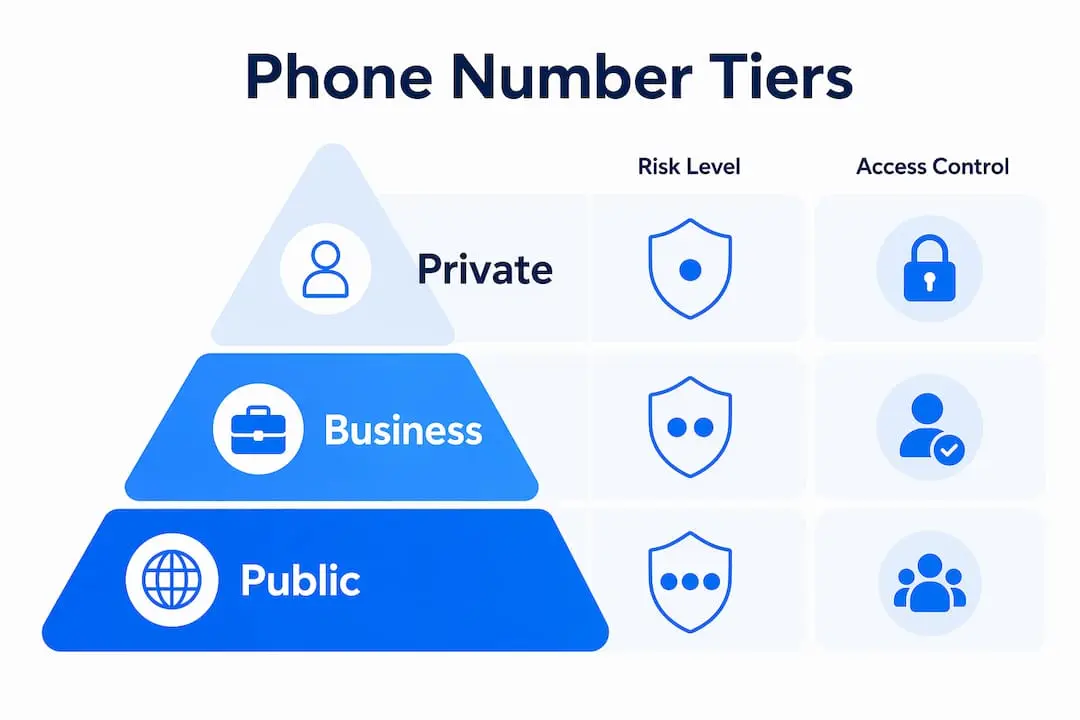
| Tier | Purpose | Who Gets It |
|---|---|---|
| Private number | Banking, tax, legal, close family | Trusted individuals and institutions only |
| Secondary number | 2FA and account recovery | Authentication apps and account services |
| Public number | E-commerce, subscriptions, general enquiries | Websites, shops, and low-trust contacts |
Your private number should never appear online. It goes to your bank, your accountant, HMRC, and your immediate family. Nothing else. The secondary number exists purely to receive authentication codes. It never gets shared publicly, so it never appears in data breaches from retail sites or subscription services. The public number absorbs all the noise: marketing calls, online forms, delivery notifications, and anything else that carries risk.
VoIP services and eSIM lines fit naturally into this framework. A VoIP number from a provider such as Google Voice or a UK-based service gives you a disposable public number that you can replace without affecting your primary line. An eSIM lets you run two numbers on a single device without carrying a second handset.
Pro Tip: When signing up for any online service, ask yourself which tier that service belongs to. If you would not give it your bank details, do not give it your private number either.
The business case for this strategy is equally strong. A company that uses one number for customer-facing calls, a separate number for internal authentication, and a third for marketing campaigns dramatically reduces the risk of a single breach cascading across all operations. Phonenumbers makes it straightforward to secure business phone numbers by sourcing dedicated lines for each purpose.
What should you do if your phone number is compromised?
Speed determines the outcome of a SIM swap attack. Every minute of delay gives the attacker more time to change passwords, drain accounts, and lock you out permanently.
- Call your carrier’s fraud department directly. Do not use general customer service. Escalate immediately to the fraud team and request a port-out reversal and SIM reactivation. General agents may lack the authority or urgency to act fast enough.
- Freeze your credit reports. Contact Experian, Equifax, and TransUnion UK immediately. A credit freeze prevents attackers from opening new accounts or taking out loans in your name.
- Secure your connected accounts from a trusted device. Change passwords on your email, banking, and social media accounts. Switch all SMS-based 2FA to an authenticator app right now.
- Monitor for unauthorised activity. Check bank statements, email sent folders, and account login histories. Attackers often act within the first 30 minutes.
- Alert your contacts if necessary. If attackers have accessed your messaging apps, they may impersonate you to request money or sensitive information from people you know.
Recovery can take minutes to days depending on how quickly your carrier responds. The financial and reputational damage can extend far beyond that window. Acting within the first hour gives you the best chance of limiting the fallout.
Pro Tip: Save your carrier’s fraud department number in a secondary device or written down somewhere secure. When your primary phone is compromised, you may not be able to look it up.
Key takeaways
Effective phone number security requires treating your number as a sensitive credential, activating carrier protections, and replacing SMS two-factor authentication with app-based or hardware alternatives.
| Point | Details |
|---|---|
| SIM swapping is the top threat | It bypasses SMS 2FA entirely; switch to Google Authenticator or YubiKey immediately. |
| Activate carrier locks | Enable Wireless Account Lock or Number Lock manually through your carrier account settings. |
| Use a three-tier number strategy | Separate private, authentication, and public numbers to contain the damage from any single breach. |
| Set a SIM PIN | This prevents your SIM being used in another device if your phone is lost or stolen. |
| Act within the first hour | Contact your carrier’s fraud department and freeze credit reports the moment you suspect a compromise. |
Why most people get phone security completely wrong
I have spent years watching people treat password hygiene as the gold standard of digital security while leaving their phone number completely exposed. The honest truth is that your phone number is often more dangerous to lose control of than your password. A password reset almost always goes to your phone. Your phone number is the recovery route for everything.
The misconception runs deep. People see their number as a way to receive calls, not as a credential that unlocks their entire digital life. That mental model is the real vulnerability. Attackers understood this years before most users did.
What I have found genuinely works is the three-tier strategy combined with carrier locks. It sounds like extra effort, but setting it up takes under an hour and the protection is substantial. The shift to app-based authentication is equally non-negotiable. SMS codes feel convenient right up until the moment they are not your codes anymore.
Businesses are often worse than individuals on this front. A single company number used for customer calls, staff authentication, and public marketing is a single point of failure. Separating those functions is not paranoia. It is basic operational hygiene. The demand for dedicated business numbers has grown precisely because more organisations are waking up to this reality.
The carriers are improving. The 15-minute port lock delay and account lock features represent genuine progress. But they only work if you activate them. Most people never do.
— Rob
Secure your identity with the right phone number
Implementing a three-tier number strategy starts with having the right numbers available. Phonenumbers is the UK’s leading provider of memorable 01, 02, and 07 numbers, giving individuals and businesses the tools to separate their private, authentication, and public contact lines cleanly. Whether you need a memorable Leeds number for your business front line or a dedicated Nottingham number for a specific purpose, Phonenumbers lets you search by area code, town, or number sequence. Numbers are no longer tied to a local area, so you can use them anywhere in the UK. Browse the full catalogue at Phonenumbers and take the first practical step towards a more secure contact strategy today.
FAQ
What is SIM swapping and why is it so dangerous?
SIM swapping is when an attacker convinces your carrier to transfer your phone number to a SIM they control. It is the most severe phone-based threat because it bypasses SMS two-factor authentication entirely, granting access to any account that uses your number for verification.
Is SMS two-factor authentication safe to use?
SMS-based 2FA is significantly weaker than app-based alternatives. A SIM swap attack renders it useless. Switch to Google Authenticator, Microsoft Authenticator, or a hardware key like YubiKey for accounts where security matters.
How do i stop my number being ported without my permission?
Enable your carrier’s account lock or Number Lock feature through your online account settings. Some carriers also apply a 15-minute delay when disabling port locks, which gives you time to detect and block unauthorised porting attempts.
What is a three-tier phone number strategy?
It is a privacy framework that assigns separate numbers to three distinct uses: a private number for banking and legal matters, a secondary number solely for 2FA, and a public number for general online use. Keeping these separate limits the damage if any one number is compromised.
How quickly do i need to act after a suspected SIM swap?
Act within the first hour. Contact your carrier’s fraud department directly, freeze your credit reports with Experian, Equifax, and TransUnion UK, and change passwords on all connected accounts from a trusted device immediately.