
The quickest way to get a working business phone number in 2026 is to sign up with a VoIP or virtual-number provider and either choose a fresh 01, 02, 03, 0800, or 07 number or port your existing one across. Do it now rather than later: the UK’s old copper phone network is being switched off in stages, and providers are already steering every new business line towards VoIP.
TL;DR:
- Choosing a UK business number type (local, national, freephone, or mobile) impacts credibility, caller charges, and operating costs, with 03/0330 numbers offering a good balance for regional and national reach.
- Porting an existing number can take up to ten business days and should be confirmed with your provider, but starting with a new number offers immediate setup benefits.
- Setting up call routing, auto-attendants, and voicemail professionally enhances customer experience and requires careful configuration, testing, and clear greetings.
- The typical monthly cost for virtual numbers ranges from £5 to £15, while full-feature VoIP plans start around £7 per user, with charges varying based on features and call volume.
- Selecting a memorable or regional number based on your trust-building strategy and securing it with proper security practices can significantly boost your business’s credibility and operational reliability.
Table of Contents
- How do I set up a business phone number?
- Which type of UK business number should you choose?
- What should you check before choosing a provider?
- How long does porting a business number take?
- How do you set up call routing, voicemail and devices?
- What does a business phone number cost?
- How do you choose a number that’s actually memorable?
- What are the legal requirements for a UK business number?
- How do you connect a business number to your CRM?
- How do you keep a business phone system secure?
- Why the “just get a number” advice misses the point
- Get a memorable UK number live today
- Where this information comes from
- Sources
- FAQ
How do I set up a business phone number?
You can be taking calls on a proper business number very quickly if you’re starting fresh, or within a reasonable timeframe if you’re porting an existing line. Here’s the order that actually works, based on how UK VoIP providers structure onboarding.
- Pick your number type first. Decide whether you need a local 01/02 code for regional trust, a national 03/0330 number, a freephone 0800, or a mobile-style 07 line. This decision shapes everything else, so don’t skip it.
- Choose a provider that supports UK porting. Not every VoIP outfit handles number portability smoothly, so check this before you sign anything.
- Select a new number or start the port. If you’re keeping your existing number, you’ll need to authorise the port with your current provider, which industry guidance suggests can complete within days for a new setup, or take longer if you’re transferring.
- Configure routing, hours and voicemail. Set who answers, when, and what happens when nobody picks up. Install the provider’s app on your phone and any desk handsets.
- Test it, then publish the number everywhere. Ring it from another mobile, check the greeting sounds right, then update your website, Google Business Profile, invoices and van signage.
If you’re picking a brand-new number rather than porting, most providers activate it the moment payment clears, according to industry setup guides. That’s the appeal of starting fresh: no waiting on a previous carrier to release your line. Porting takes longer but means your existing customers and marketing material don’t need updating.
Pro Tip: If you’re not in a rush, run the new number alongside your old one for a fortnight before switching your marketing over. It catches routing mistakes before customers do.
Which type of UK business number should you choose?
The number type you pick affects the trust you signal, what your callers pay, and the line costs you to run. Get this wrong and you’ll either look less credible than a competitor or end up paying more than you need to.
- 01/02 geographic numbers anchor you to a place. A Manchester plumber with a 0161 number reads as local and established, even if the calls actually route to a mobile in another city. Numbers are no longer physically tied to exchanges, so you can hold a Bristol code while working from Leeds.
- 03/0330 national numbers signal a UK-wide operation without the local flavour. They’re charged at standard rates and, crucially, usually included in mobile and landline bundles, so callers rarely think twice about dialling one. This makes 0330 a sensible middle ground for service businesses that operate across several regions.
- 0800 freephone numbers cost the caller nothing, which is powerful for inbound-heavy operations like support desks or sales lines, but the business absorbs the inbound cost. That trade-off only makes sense if the extra call volume pays for itself.
- 07 mobile-style virtual numbers support SMS and feel personally reachable, which suits sole traders. The catch: mobile-format numbers are more commonly associated with spam by wary callers, so conversion rates on cold outreach can suffer slightly compared with a landline-format number.
The National Telephone Numbering Plan sets out these ranges formally, and understanding them helps you avoid picking a number type that quietly signals the wrong thing to your market. A tradesperson using an 0800 number, for instance, often looks like a call centre rather than a local specialist, even though the intention was to appear more accessible.
What should you check before choosing a provider?
Most VoIP contracts look similar on the surface. The differences that matter show up in the features list and the small print, not the homepage.
Before committing, confirm the provider offers:
- Number porting support, with a named timeline rather than a vague promise
- Extensions or direct-dial numbers for each team member
- An auto-attendant that lets callers reach the right person without a human answering first
- Voicemail-to-email, ideally with transcription
- Apps for both mobile and desktop, so calls follow you rather than a desk
- Call queues and basic analytics if you’re handling more than a handful of calls a day
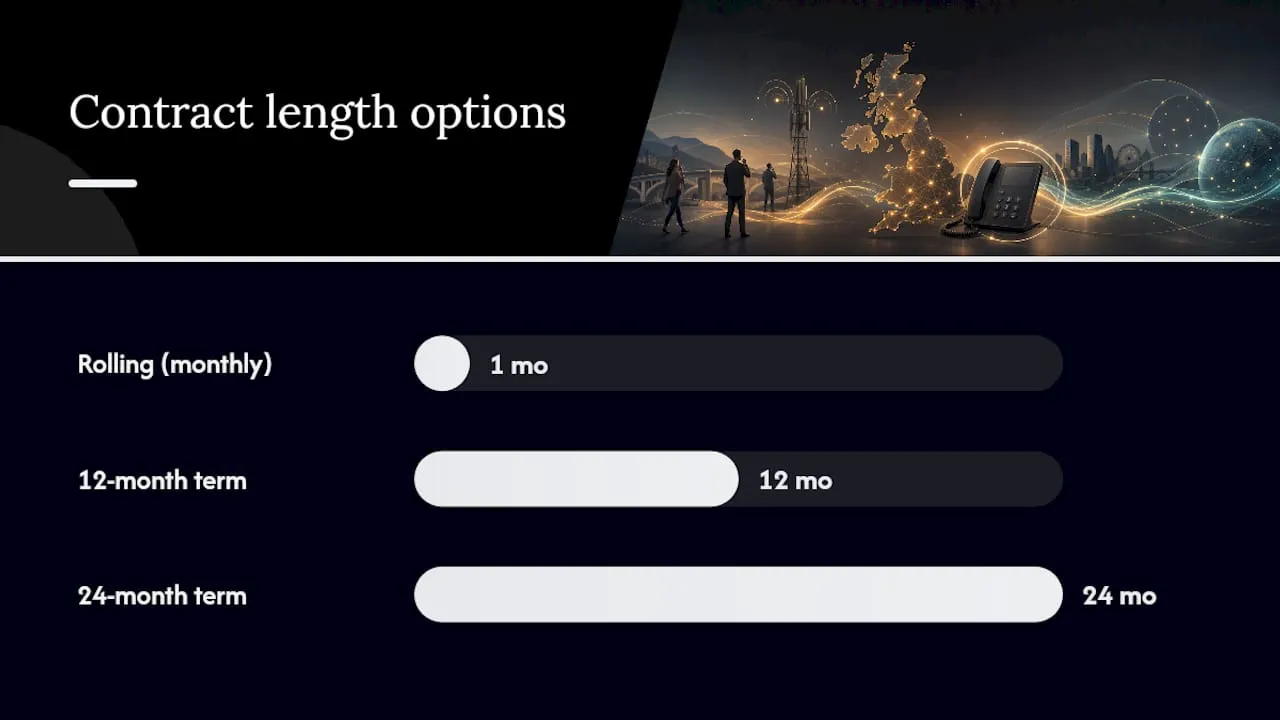
On the commercial side, ask about the monthly fee per user, any setup or porting charges, how many minutes are inclusive, and what happens per minute once you exceed them. Contract length matters too. Many providers push 12 or 24-month terms with better headline pricing, but a rolling monthly contract is worth the extra cost if you’re not certain the business will still need that exact setup in a year.
Pro Tip: Ask any shortlisted provider what happens to your number if you leave them. A provider that makes porting out difficult or slow is telling you something about how they’ll treat you generally.
Also check support hours and whether there’s a backup routing option if your broadband drops. A VoIP line is only as reliable as your internet connection, so a provider offering automatic failover to mobile forwarding during an outage is worth paying slightly more for. A VoIP PBX system explains how this routing infrastructure typically works behind the scenes.
How long does porting a business number take?
Porting makes sense when your number is already printed on vehicles, invoices, or many years of Google reviews. Taking a fresh number makes sense when speed matters more than continuity, or when you’re deliberately choosing a more memorable sequence for brand recall.
- Contact your new provider and request the port. They’ll need your current number, account details, and sometimes a recent bill for verification.
- Sign the Letter of Authority. This authorises the new provider to request the transfer from your current carrier. It sounds bureaucratic because it is, but it’s a one-page form in most cases.
- Wait for confirmation of the transfer date. Straightforward mobile-style ports can complete in a few days; landline ports through the older network sometimes stretch closer to ten business days, particularly if paperwork needs correcting.
- Keep your old service active until the port completes. Cancelling early is the single most common cause of businesses losing calls mid-transfer.
- Confirm the port with a test call once you get the completion notice, before you tell customers or update marketing.
Delays usually come down to mismatched account names, an old address on file, or a previous provider dragging its heels. If you want the full paperwork breakdown, how to port a landline number walks through what each carrier typically asks for.
How do you set up call routing, voicemail and devices?
A number that just rings and rings, or dumps every caller into a generic voicemail box, undoes the professional impression you were trying to create. This is the part worth spending an extra half hour getting right.
Start with people and hours. Assign each team member an extension, set your business hours in the provider’s dashboard, and decide what callers hear outside those hours. Bank holiday routing is easy to forget and embarrassing to get wrong, so set it once and it stays sorted.
Build a simple auto-attendant, not a maze. “Press 1 for sales, 2 for support” works. Five nested menus do not. Always include a fallback rule so a call that isn’t answered within a set number of rings overflows to a mobile or a second team member rather than disappearing.
For voicemail, three things separate a professional setup from an amateur one:
- A recorded greeting that states the business name clearly, not a default robotic message
- Voicemail-to-email so messages reach you even when you can’t check the app
- Transcription, where the provider offers it, so you can scan a message without listening to it
A full walkthrough of recording and configuring this sits in how to set up voicemail for business if you want the exact steps.
On devices, you have three realistic options: a softphone app on your existing mobile, a dedicated desk phone connected over the internet, or a SIM-based setup where the business number rides on a physical SIM. Sole traders typically do fine with the app alone. Teams handling higher call volumes benefit from a proper desk handset for call quality and reliability. Whichever you choose, make several test calls, checking clarity, hold music, and that transfers between extensions actually work, before you publish the number anywhere.
What does a business phone number cost?
Pricing varies more by feature set than by number type, though the type you choose does affect who pays for the call.
Representative monthly ranges for UK setups:
- Simple virtual numbers: roughly £5 to £15 a month for basic call forwarding and voicemail, according to small business telecoms guidance
- Per-user VoIP plans with full features: commonly from around £7 per user per month upwards, startup guides note, scaling with extensions, analytics and integrations
- 0800 freephone hosting: typically costs more to run because the business absorbs inbound call charges rather than the caller
Most plans include a bundle of inclusive minutes, with per-minute charges kicking in once you exceed them, particularly for forwarding calls onward to a mobile. Outbound calls, especially international ones, are usually billed separately from your monthly fee.
If caller cost is a concern, 03/0330 numbers are the cheapest for the people ringing you, since they’re billed at standard rates and often bundled into mobile plans already. 0800 numbers cost callers nothing but shift that cost onto you, so they only pay off when the extra enquiries justify it. Before signing up anywhere, check three things on the invoice: whether forwarding is charged per minute, whether there’s a separate porting or setup fee, and what the minimum contract term actually is. Virtual numbers can also cut costs compared with maintaining a physical second line, particularly for businesses expanding into new regions without opening a local office.
How do you choose a number that’s actually memorable?
A working number is the baseline. A memorable one does extra work for you, and this is where most setup guides stop short.
The rule Phonenumbers applies when helping businesses select a number is straightforward: match the area code to where trust needs to be built, then look for a sequence that’s easy to repeat back over the phone. A local trade, say a Nottingham electrician, benefits from a 0115 code paired with a repeating or ascending suffix, something a customer can recall without writing it down. A national service business is usually better served by an 0330 number with a short, patterned sequence, since the area code itself carries less weight nationally.
On security, a few habits are worth building in from day one:
- Set up port-out authorisation with your provider, so a number can’t be transferred away without your explicit confirmation
- Use two-factor verification on your provider account, not just a password
- If you suspect a number has been compromised or ported without authorisation, contact your provider immediately and request an emergency freeze
For solo traders, the simplest reliable setup is one main number with mobile forwarding and a clear voicemail fallback. Small teams benefit from extensions per person and an overflow rule so calls never dead-end. Either way, keep a backup contact method, an email address or a secondary number, listed somewhere customers can find it if the main line ever has an outage.
What are the legal requirements for a UK business number?
Setting up a business phone number doesn’t require a licence, but a handful of regulatory points matter once you’re actually taking calls.
If your business records calls, whether for training or dispute resolution, you need to tell callers this is happening, typically through an automated message at the start of the call. This falls under UK data protection rules, since call recordings containing personal data are subject to the same principles as any other personal data you hold.
Ofcom’s rules on number allocation mean you can’t simply invent a number. It has to be assigned through a licensed provider drawing from the official numbering plan, which is why choosing a legitimate VoIP provider matters rather than an unregulated reseller.
If you’re using your business number for outbound marketing calls, the Privacy and Electronic Communications Regulations (PECR) govern what’s permitted, particularly around cold calling and consent. This matters more for outbound sales operations than for a plumber taking inbound enquiries, but it’s worth knowing before you scale up call volume.
Finally, if your business is VAT registered or operates as a limited company, your phone number often appears alongside other contact details in formal correspondence, so keep it consistent with what’s registered at Companies House and on your website’s contact page.
How do you connect a business number to your CRM?
Most modern VoIP providers offer integrations with common customer relationship management tools, and setting this up properly saves hours of manual logging every week.
The core benefit is call popping: when a customer rings, their record opens automatically on screen, showing previous interactions before you’ve even said hello. This alone transforms how a small team handles repeat customers, since nobody has to ask “sorry, what was this about again?”
Look for a provider that logs call duration, timestamps and, where available, recordings directly against the customer record. This creates a usable history without anyone typing notes after every call. Missed calls should also generate a task or alert automatically, so a lead never falls through simply because nobody was at their desk.
Before committing to a provider on CRM grounds alone, confirm the integration is a genuine two-way sync rather than a one-off import. Some providers advertise “CRM integration” that only pushes call logs one direction, which is far less useful than a system where clicking a customer’s name also dials them.
How do you keep a business phone system secure?
Business phone systems get targeted by fraud in ways that catch small operators off guard, particularly toll fraud, where criminals hijack your system to route expensive international calls at your expense.
The most effective safeguard is restricting international and premium-rate dialling by default, then opening it selectively only for staff who genuinely need it. Most VoIP providers let you set this at account level in a few clicks, yet it’s rarely switched on unless you ask.
Call encryption matters more than most business owners realise. Reputable VoIP providers encrypt calls in transit, but it’s worth confirming this explicitly rather than assuming it, particularly if your calls involve sensitive customer information such as payment details or medical information.
Two-factor authentication on your provider’s admin portal is a simple step that stops the most common attack vector: someone guessing or phishing a password and then reconfiguring your call routing to intercept business calls. Pair this with port-out protection, discussed earlier, and you’ve closed off the two easiest ways a number gets stolen or misused.
Why the “just get a number” advice misses the point
Most guides treat a business phone number as a box to tick: pick a provider, get a number, done. That undersells what’s actually at stake here. The number you choose is doing marketing work every single time someone reads it off a van, a website footer, or a search result, and a forgettable sequence quietly costs you calls that a memorable one would have caught.
The PSTN switch-off gets framed as a compliance deadline, and technically it is. But the more useful way to see it is as a forced decision point that most businesses would otherwise put off for years. If you’re being pushed to change systems anyway, that’s the moment to also fix a number that never suited the business, rather than porting the same underwhelming digits into a shinier system.
My honest view: spend less time comparing provider feature lists, which are mostly identical, and more time on the number itself and the routing logic behind it. A well-chosen 0330 number with clean overflow rules will outperform a locally flavoured 01 number with a confusing auto-attendant every time.
— Rob
Get a memorable UK number live today
Everything above assumes you’re starting from a blank slate, choosing between a generic new number or the slow grind of porting. Phonenumbers gives you a third option: search a live database of available 01, 02 and 07 numbers, filtered by area code, sequence pattern or town, and buy or rent one that’s already memorable rather than settling for whatever your VoIP provider assigns you by default.
Numbers on Phonenumbers aren’t tied to a physical location either, so a Nottingham-pattern sequence works just as well for a business trading nationally as one rooted in that city. Every number supports call forwarding and can be configured to work with your existing VoIP setup or a SIM, and the team helps with porting if you’re bringing a memorable number into a new phone system rather than starting fresh.
If you’ve read this far and still don’t have a number that does you justice, browse the 01159 333666 listing or search the full database for a sequence that fits your business, and get it configured before the next customer tries to remember your current one and can’t.
Where this information comes from
The facts and timelines in this guide draw on a small set of primary and industry sources worth bookmarking:
- UK transition from analogue to digital landlines, the official gov.uk page confirming the PSTN retirement date and what it means for business phone lines
- Guide to business phone numbers for your company, used for setup steps, typical pricing and porting sequencing
- How to identify telephone numbers and their costs, BT Business’s breakdown of UK number ranges and caller costs
Sources
- UK transition from analogue to digital landlines
- How to get a business phone number: guide to business phone numbers for your company
- How To Get a Business Phone Number in the UK: 2026 Guide
- How to identify telephone numbers and their costs — BT Business
FAQ
Can I set up a business phone number for free?
Genuinely free options exist but tend to be limited to basic call forwarding with no routing or voicemail features. Most guides note that paid plans from around £7 per user per month are where business-grade features like extensions and auto-attendants actually appear.
How do I get a telephone number for my business?
Sign up with a VoIP or virtual-number provider, choose whether you want a new number or to port an existing one, then configure routing and voicemail before publishing it. The whole process can be live within minutes for a new number.
How do I get a mobile number for my business?
VoIP and virtual-number providers offer 07 mobile-style numbers alongside landline formats, activated the same way as any other business number through their signup process. These support SMS and forward to your existing phone, so no separate SIM is strictly required.
Is Google Voice free for business?
Google Voice is primarily built for US numbers and personal or small-team use, not full UK business telephony with local geographic or 0330 ranges. UK businesses generally need a dedicated VoIP provider that supports the full range of British number types and porting.