
TL;DR:
- Alternate contact numbers provide a vital backup to ensure continuous communication when primary lines are unavailable or busy. Businesses should regularly verify, maintain, and record these numbers across systems to prevent communication failures and improve customer trust. Using diverse types of alternate numbers, such as virtual, geographic, or toll-free, enhances operational resilience and regional credibility.
An alternate contact number is a secondary phone number that keeps you reachable when your primary line is unavailable, busy, or unreachable. The role of alternate contact numbers extends far beyond simple backup. Businesses, emergency services, and institutions such as the University of Washington all rely on secondary numbers to maintain communication continuity when it matters most. Platforms like Pulse describe alternate numbers as the mechanism that keeps communication flowing when primary lines fail. Whether you run a small UK business or manage enterprise-level contact systems, understanding how secondary numbers function is the foundation of reliable, professional communication.
How do alternate contact numbers improve business communication?
Alternate numbers reduce missed calls and customer frustration by providing a second route to your team when the primary line is engaged or experiencing an outage. This matters because a missed call is rarely just a missed call. It is often a missed sale, a frustrated customer, or a support request that escalates unnecessarily.

Businesses use secondary numbers to segment communication by function. A sales line, a support line, and a billing enquiry number each serve a distinct purpose. Routing calls to the correct department from the outset reduces handling time and improves the customer experience. For UK businesses, geographic local numbers add a layer of regional trust. A Leeds-based customer is more likely to call a 0113 number than a generic 0800 line, even if both reach the same team.
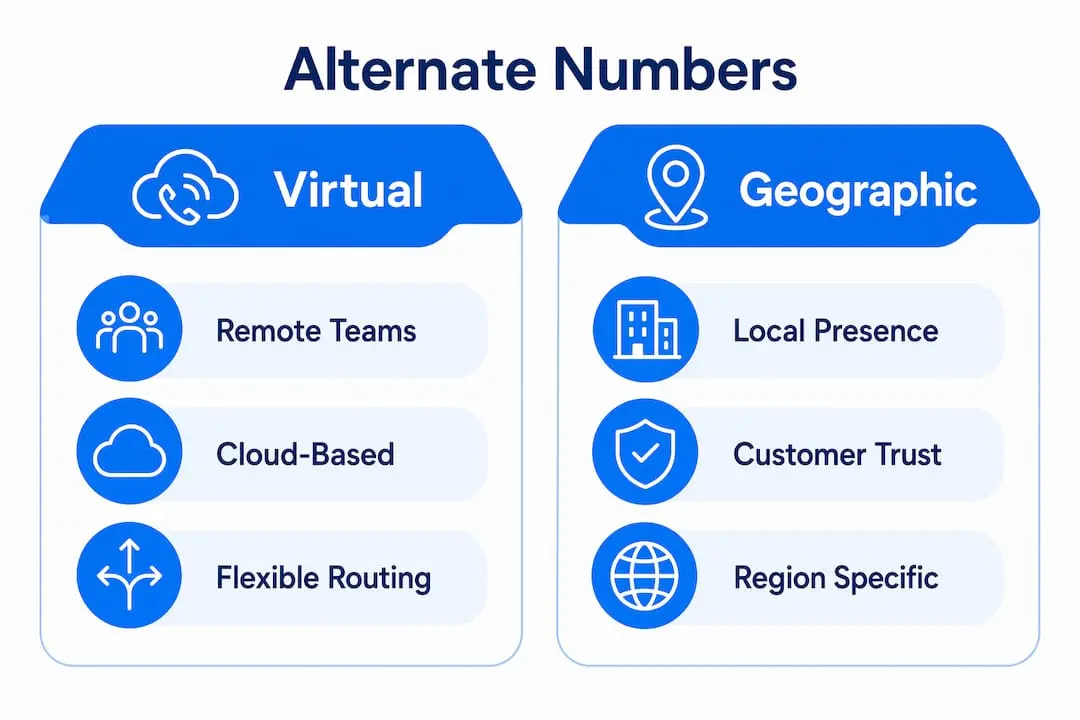
Virtual alternate numbers operate via the cloud, meaning they are accessible from any device without a physical SIM. This gives businesses the flexibility to route calls to remote workers, satellite offices, or overflow teams without any infrastructure changes. The practical result is that no call goes unanswered, even during peak periods or technical disruptions.
| Feature | Primary number | Alternate number |
|---|---|---|
| Purpose | Main point of contact | Backup or specialist route |
| Availability | Standard business hours | Can be routed 24/7 |
| Flexibility | Fixed to one device or line | Cloud-based, device-agnostic |
| Use case | General enquiries | Department-specific or emergency |
| Customer trust | Established brand number | Local or memorable number |
- Use toll-free numbers for national customer access without call cost barriers
- Use geographic local numbers to build regional credibility and trust
- Use virtual numbers to separate personal and business communications cleanly
- Use departmental numbers to route calls directly without manual transfer
Pro Tip: Set up call forwarding on your alternate number so that unanswered calls roll over to a voicemail with a clear callback message. This alone recovers a significant proportion of calls that would otherwise be lost.
What systems support alternate contact number management?
System-level design for managing multiple contact numbers is more deliberate than most people realise. Oracle’s HCM documentation uses a dedicated field called EMERGENCY_CONTACT2 to record additional phone numbers such as work or mobile numbers for each emergency contact. This separate field approach is not cosmetic. It enables the system to manage call attempt priority logically, trying the primary number first and then moving to the alternate without confusion or duplication.
The principle behind this design applies equally to customer support systems. The Crisis-Proof Live Support Continuity Playbook recommends documented fallback routes beyond the primary communication channel, treating phone redundancy the same way IT teams treat server redundancy. A single point of failure in your contact infrastructure carries the same risk as a single server with no backup.
For IT and operations teams, the distinction between primary and alternate numbers must be explicit in every system that stores contact data. CRM platforms, HR systems, and customer support tools should all carry separate fields for each number type, with clear labelling. Mixing all contact numbers into a single free-text field removes the ability to automate priority attempts and makes auditing nearly impossible.
- Assign distinct fields for primary and alternate numbers in every contact record
- Label each number by type: mobile, landline, work, or emergency
- Set automated call attempt logic to try primary before alternate
- Review and audit contact records at least twice per year
- Avoid storing multiple numbers in a single field to preserve call routing logic
Pro Tip: After any significant system migration or CRM update, run a spot-check audit on 10% of contact records to confirm that alternate number fields have migrated correctly. Data loss during migrations is far more common than most teams expect.
For UK businesses managing phone number continuity, the operational risk of relying on a single number is well documented. A line fault, a porting delay, or a provider outage can leave customers with no way to reach you. A second number on a separate provider removes that single point of failure entirely.
What are the key differences between alternate number types?
Not all secondary numbers serve the same purpose. The type of alternate number you choose determines how it functions, who can reach you, and what impression it creates.
| Number type | Best use case | Key benefit |
|---|---|---|
| Virtual cloud number | Remote teams, flexible routing | No SIM required, device-agnostic |
| Geographic local number | Regional businesses, local trust | Builds credibility with local customers |
| Toll-free number | National customer access | Removes cost barrier for callers |
| Mobile forwarding number | Field workers, sole traders | Keeps personal number private |
| International number | Global client base | Local presence in overseas markets |
Virtual and cloud-based numbers are the most flexible option for businesses. They require no physical infrastructure and can be reassigned, forwarded, or scaled instantly. A UK business using a business phone system built on cloud telephony can add a new alternate number in minutes and route it to any team member anywhere in the country.
Geographic local numbers carry a distinct advantage in customer perception. Research consistently shows that callers are more likely to trust and respond to a number that matches their own area code. For a business operating nationally but wanting to maintain a local presence in specific regions, a memorable 0113 or 0115 number achieves exactly that without requiring a physical office in that location. Numbers are no longer tied to local areas in the UK, which means you can use any geographic number from anywhere.
Mobile forwarding numbers serve a different purpose. They allow sole traders and field-based workers to publish a separate business number while keeping their personal mobile private. The call forwards to their mobile, but the published number remains professional and distinct. This separation protects personal privacy and makes it straightforward to switch providers or numbers without disrupting client communications.
How can you optimise the use of secondary contact numbers?
The benefits of alternate phone numbers only materialise if the numbers are accurate, discoverable, and actively maintained. A secondary number that is out of date or stored in only one location provides no real protection.
- Verify all alternate numbers at least twice per year. Contact details change. Staff leave, numbers are ported, and providers change. A number that was valid six months ago may no longer reach anyone.
- Store alternate contact details in multiple locations. A single CRM record is not sufficient. Keep copies in your phone’s emergency contacts, a printed list, and a secure cloud document. Multi-location storage is standard guidance for emergency contact management.
- Enable emergency access settings on mobile devices. ICE features can fail if emergency accessibility is not enabled on a locked phone. An alternate number stored in your contacts is useless if a responder cannot access it.
- Notify the people or teams associated with each alternate number. A number that rings through to someone who does not know they are listed as an alternate contact creates confusion rather than continuity.
- Test your alternate numbers regularly. Call them from an external phone to confirm they connect, route correctly, and reach the intended person or department.
The University of Washington requires students to designate two emergency contacts and keep that data current. This institutional requirement reflects a broader truth: alternate contacts are only useful if they exist, are accurate, and are well maintained. The same logic applies to every business that depends on phone communication.
Updating your business phone numbers is not a one-time task. It is an ongoing operational responsibility that directly affects whether customers and colleagues can reach you when it counts.
Pro Tip: Choose a memorable alternate number rather than a randomly assigned one. A number with a recognisable pattern, such as repeating digits or a familiar sequence, is easier for customers to recall and reduces the friction of making contact.
Key takeaways
Alternate contact numbers are only effective when they are accurate, well-structured, and actively maintained across every system that stores them.
| Point | Details |
|---|---|
| Core purpose | Alternate numbers provide a second reachable path when the primary line is unavailable or busy. |
| Business benefit | Segmenting numbers by department reduces call handling time and improves customer experience. |
| System design | Separate fields for primary and alternate numbers enable priority call attempt logic in CRM and HR platforms. |
| Number types | Virtual, geographic, toll-free, and mobile forwarding numbers each serve distinct use cases. |
| Maintenance | Regular audits, multi-location storage, and device emergency settings determine whether alternate numbers actually work. |
Why I think most businesses underestimate this
I have watched businesses invest heavily in CRM platforms, marketing automation, and customer service training, only to lose clients because a single phone line went down for four hours. The irony is that the fix costs almost nothing compared to the systems already in place.
The real problem is not that businesses lack alternate numbers. It is that they treat contact data as static. A number gets added to a system during onboarding and nobody checks it again. When the primary line fails, the alternate number either rings out, reaches the wrong person, or has been disconnected entirely. The redundancy that was supposed to protect communication becomes the thing that exposes how fragile the setup always was.
What I have seen work consistently is treating alternate contact numbers the same way a good IT team treats backup systems. You document them, you test them, and you schedule reviews. You do not wait for a failure to discover the backup was broken. For UK businesses in particular, having a second number on a separate provider is the single most cost-effective communication resilience measure available. The strategic case for multiple numbers is not complicated. It is simply a matter of whether you act before or after the outage.
— Rob
Get a memorable alternate number for your business
If you are ready to add a reliable second number to your communication setup, Phonenumbers is the UK’s leading provider of memorable 01, 02, and 07 numbers. Every number in the database is searchable by area code, town, city, or number sequence, and none of them are tied to a physical location. You can use them anywhere.
Browse available numbers including 0113 255 0000 and 0113 273 2222 for a Leeds presence, or 0115 928 8888 for Nottingham. A memorable alternate number builds regional trust, keeps your primary line free, and gives customers a reliable second route to your team. Search the full database at Phonenumbers and find the number that fits your business.
FAQ
What is the role of alternate contact numbers?
Alternate contact numbers are secondary phone numbers that maintain communication when a primary line is busy, unavailable, or experiencing an outage. They serve as a redundancy mechanism for both businesses and individuals, ensuring calls are never permanently lost.
Why should a business have more than one phone number?
A second number allows businesses to segment calls by department, maintain service during outages, and build regional trust with local geographic numbers. It also removes the single point of failure that leaves customers with no way to make contact.
What is the difference between a virtual number and a geographic number?
A virtual number operates via the cloud and requires no physical SIM, making it device-agnostic and flexible for remote teams. A geographic number carries a specific area code, such as 0113 for Leeds, and builds local credibility with customers in that region.
How often should alternate contact details be updated?
Best practice guidance recommends reviewing and verifying alternate contact details at least twice per year, and after any significant change such as a staff departure, provider switch, or system migration.
What happens if emergency contact settings are not enabled on a mobile phone?
If emergency accessibility settings are not active on a locked device, responders cannot access stored alternate contact numbers. This means the backup contact information exists but is effectively unreachable in a real emergency.