
Many UK businesses assume all phone numbers serve identical purposes, but geographic numbers offer distinct advantages that directly impact customer trust and regional marketing effectiveness. Geographic numbers, identifiable by their 01 and 02 area codes, signal local presence and professional credibility in ways that mobile or non-geographic alternatives cannot match. This guide explains what geographic numbers are, how Ofcom regulates them, and why selecting the right area code can transform your customer engagement and brand perception across targeted UK regions.
Table of Contents
- What Are Geographic Numbers And How Are They Regulated In The UK?
- Why Geographic Numbers Build Trust And Credibility For UK Businesses
- Technical Details And Practical Considerations For Using Geographic Numbers
- Choosing And Managing Geographic Numbers For Maximum Business Impact
- Explore UK Geographic Phone Numbers With PhoneNumbers.store
Key takeaways
| Point | Details |
|---|---|
| Definition and regulation | UK geographic numbers use 01 and 02 area codes, allocated by Ofcom in blocks of 10,000 or 1,000 numbers with full porting rights. |
| Marketing advantage | Local area codes build customer trust faster, enhance local SEO rankings, and improve credibility on business directories. |
| Technical flexibility | Numbers route via PSTN or VoIP, can be ported between providers, and must maintain tariff equivalence if used outside assigned areas. |
| Recent protections | Ofcom now restricts number spoofing to combat scam calls, verifying caller IDs and blocking fraudulent international traffic. |
| Strategic selection | Choosing area codes familiar to your target market maximises regional impact and avoids customer confusion. |
What are geographic numbers and how are they regulated in the UK?
Geographic numbers in the UK use 01 and 02 area codes that correspond to specific towns, cities, or regions. These numbers differ fundamentally from non-geographic alternatives like 03, 08, or 09 ranges because they signal physical location and local presence. Ofcom’s Number Management System administers allocation, allowing communications providers to apply for number blocks in standardised quantities.
Typical allocations come in blocks of 10,000 numbers, though conservation areas receive smaller blocks of 1,000 to preserve limited numbering resources. Businesses acquire these numbers through licensed providers who manage the technical routing and compliance requirements. The allocation process ensures numbers remain tied to geographic areas, though actual physical presence requirements have evolved significantly.
Geographic numbers (01 and 02 ranges) have full porting rights in the UK, meaning businesses can switch service providers without losing their established contact details. This portability protects brand continuity and customer relationships during infrastructure changes. Subscribers must either operate within the relevant geographic area or maintain tariff equivalence, ensuring callers pay standard local rates regardless of actual call routing.
Ofcom enforces these regulations through centralised oversight, monitoring compliance and investigating misuse. The regulatory framework balances consumer protection with business flexibility, allowing innovative uses whilst preventing deceptive practices. This structured approach maintains the integrity of geographic numbering as a trusted communication channel.
Key regulatory requirements include:
- Allocation only to licensed communications providers, not directly to end users
- Maintenance of accurate number databases for emergency services routing
- Compliance with tariff transparency rules for consumer protection
- Regular audits of number usage to prevent warehousing or speculative holding
Pro Tip: Before selecting a geographic number, review the complete list of UK area codes to identify which regions align best with your target customer demographics and marketing strategy.
Why geographic numbers build trust and credibility for UK businesses
Customers instinctively recognise area codes and associate them with established local presence. This recognition creates immediate psychological comfort, particularly for services requiring face-to-face interaction or local expertise. Local numbers build trust quickly, with examples like 01254 in Blackburn or 0161 in Greater Manchester instantly signalling regional familiarity.

The trust differential becomes especially pronounced when customers compare local numbers against mobile alternatives or toll-free options. Mobile numbers suggest temporary operations or sole traders, whilst geographic numbers project permanence and professional infrastructure. This perception influences customer decisions during initial contact, affecting conversion rates across marketing channels.
Local numbers improve credibility on business listings like Google Business Profile, where consistent NAP (name, address, phone) data strengthens local search rankings. Search algorithms favour businesses demonstrating genuine regional ties, and matching area codes to physical locations reinforces this authenticity. The SEO benefit compounds over time as directories index and cross-reference your contact information.
Marketing materials gain additional authority when featuring recognisable local numbers. Business cards, website headers, and print advertisements all benefit from the instant credibility that familiar area codes provide. This advantage extends across all customer touchpoints, creating cohesive regional brand identity.
Geographic numbers also facilitate targeted marketing campaigns by allowing businesses to segment communications by region. Multiple area codes enable tracking campaign performance across different markets whilst maintaining consistent brand messaging. This granular approach helps optimise advertising spend and refine regional strategies.
Key trust-building advantages:
- Immediate recognition reduces caller hesitation and increases contact rates
- Professional appearance distinguishes established businesses from temporary operators
- Consistency across directories strengthens SEO and prevents customer confusion
- Regional alignment builds community connections and local loyalty
Exploring the broader advantages of local numbers reveals how geographic numbering supports long-term customer relationship strategies beyond initial contact credibility.
Technical details and practical considerations for using geographic numbers
Geographic numbers route calls through traditional PSTN infrastructure or modern VoIP systems, with routing determined by National Destination Codes embedded in the area code structure. Routing uses National Destination Codes directing calls via PSTN or VoIP, affecting call quality and costs depending on chosen infrastructure. PSTN typically offers superior reliability and voice quality, whilst VoIP provides cost advantages and advanced features like call recording and analytics.
VoIP implementations require careful quality management to avoid latency, jitter, or packet loss that degrades customer experience. Businesses must balance cost savings against potential service quality trade-offs, particularly for customer-facing operations where call clarity directly impacts satisfaction. Network infrastructure, bandwidth allocation, and provider selection all influence VoIP performance outcomes.
Porting rights enable businesses to retain geographic numbers when changing providers, protecting established customer contact channels. The number portability UK business process typically completes within one working day for single numbers, though larger block transfers may require coordination. Businesses must maintain continuous service during porting to avoid customer disruption or missed opportunities.
Tariff equivalence rules require businesses using geographic numbers outside their designated areas to ensure callers pay standard local rates. This protection prevents consumer confusion and unexpected charges, maintaining trust in the geographic numbering system. Providers manage tariff compliance through routing configurations and transparent pricing structures.
Ofcom has implemented measures to restrict number spoofing and block scam calls from abroad, requiring verification of caller IDs for roaming mobiles and international traffic. These protections enhance customer confidence in answering calls from geographic numbers, reducing the erosion of trust caused by spoofing attacks. Businesses benefit indirectly as legitimate calls face less screening and rejection.
| Technical Factor | PSTN Implementation | VoIP Implementation |
|---|---|---|
| Call Quality | Consistently high, minimal latency | Variable, depends on bandwidth and provider |
| Cost Structure | Higher per-minute charges | Lower operational costs, potential setup investment |
| Feature Set | Basic call routing | Advanced analytics, recording, integration options |
| Reliability | Excellent uptime, weather-resistant | Requires stable internet, backup systems advisable |
| Scalability | Limited by physical infrastructure | Easily scales with business growth |
Pro Tip: When implementing VoIP for geographic numbers, conduct thorough call quality testing across different times and network conditions before fully transitioning customer-facing operations to identify and resolve potential issues proactively.
Choosing and managing geographic numbers for maximum business impact
Selecting area codes requires strategic analysis of your primary customer demographics and geographic market focus. Codes familiar to your target audience create instant recognition and reduce psychological barriers to contact. Choosing the correct phone number affects brand image, trust, and growth by signalling commitment to specific communities.
Comparing geographic numbers against alternatives reveals distinct use cases. Non-geographic numbers suit national brands seeking location-neutral presence, whilst mobile numbers work for highly mobile service providers. Geographic numbers excel when regional identity strengthens market position or customer relationships depend on perceived local expertise.
Number block management requires planning around allocation sizes and anticipated growth. Standard 10,000-number blocks provide ample capacity for most businesses, whilst conservation area allocations of 1,000 numbers suit smaller operations or testing new markets. Efficient block utilisation prevents wasteful holding of unused numbers whilst ensuring availability for expansion.
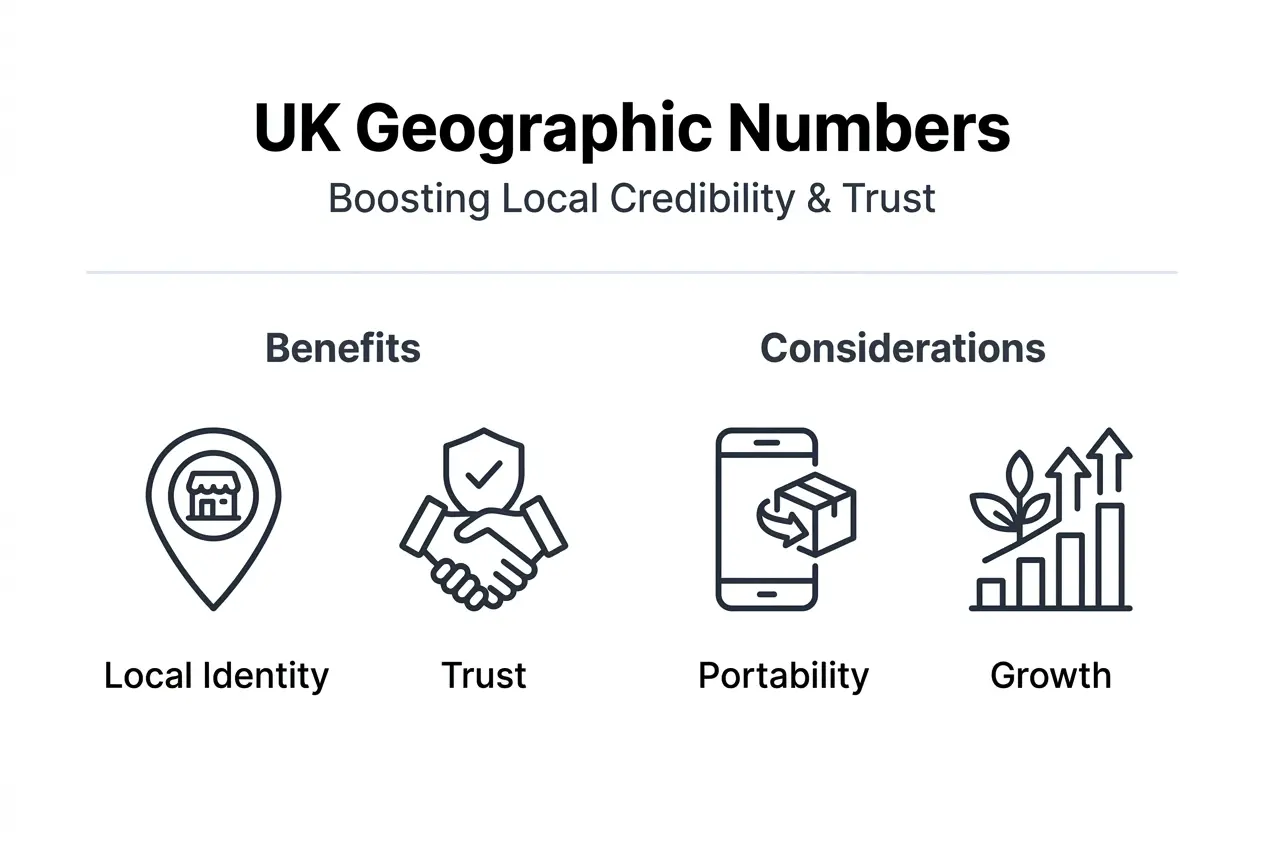
Portability planning prevents service disruption during provider transitions. Businesses should verify porting procedures, timeline expectations, and technical requirements well before switching to ensure seamless continuity. Documentation of existing configurations and customer communication about potential brief interruptions manages expectations effectively.
A common pitfall is not optimising the area code to match the target customer base, creating confusion or suggesting misaligned geographic presence. Mismatched codes undermine trust-building benefits and may trigger customer scepticism about business legitimacy. Thorough market research prevents these strategic errors.
Strategic selection process:
- Analyse customer distribution data to identify primary geographic markets and concentration areas
- Research area code recognition and associations within target demographics using surveys or focus groups
- Evaluate competitive landscape to identify gaps or opportunities in regional numbering strategies
- Plan for multi-location operations by selecting complementary area codes that support expansion paths
- Test selected numbers with sample customers to gauge recognition and trust responses before full deployment
- Implement tracking systems to measure performance differences across geographic numbers and marketing channels
| Consideration | Geographic Numbers | Mobile Numbers | Non-Geographic Numbers |
|---|---|---|---|
| Trust Signal | Strong local credibility | Suggests sole trader | Neutral, national presence |
| SEO Benefit | Enhances local search | Minimal impact | No local advantage |
| Portability | Full rights protected | Limited in some cases | Varies by number type |
| Cost to Caller | Standard local rates | Often higher charges | Depends on prefix |
| Marketing Flexibility | Regional targeting | Personal accessibility | Nationwide campaigns |
Exploring detailed guidance on choosing numbers for local presence provides additional frameworks for optimising number selection across different business models and growth stages.
Explore UK geographic phone numbers with PhoneNumbers.store
Now that you understand how geographic numbers build trust and enhance marketing effectiveness, acquiring the right number for your business becomes the next practical step. PhoneNumbers.store specialises in UK memorable phone numbers, offering extensive 01 and 02 landline options alongside 07 mobile alternatives.
Our searchable database allows filtering by number sequence, area code, or specific town, city, or county, making it simple to find numbers that align perfectly with your target markets. Remember that numbers are no longer tied to physical locations, giving you flexibility to use them anywhere whilst maintaining regional marketing advantages. Whether you need a single memorable number or multiple codes for different campaigns, buy a phone number UK through our streamlined online process.
Explore the complete selection at PhoneNumbers.store and discover how the right geographic number transforms customer engagement. Our platform simplifies acquisition, letting you focus on leveraging the advantages of local numbers rather than navigating complex procurement processes.
FAQ
What is the difference between geographic and non-geographic numbers?
Geographic numbers use 01 and 02 area codes linked to specific UK locations, whilst non-geographic numbers like 03, 08, or 09 ranges have no regional association. Geographic numbers enhance local presence and customer trust through familiar area codes, whereas non-geographic options serve national brands or special service functions like helplines.
Can I keep my geographic number if I change service providers?
Yes, UK geographic numbers have full porting rights allowing switching without changing the number. This protects customer relationships and brand continuity during provider transitions. The porting process typically completes within one working day for individual numbers, and detailed guidance on number portability UK business procedures ensures smooth transitions.
How do geographic numbers improve my business marketing?
Geographic numbers build regional trust and enhance credibility with customers who recognise familiar area codes. They strengthen local SEO by providing consistent location signals across directories and Google Business Profile listings. Research shows local numbers increase lead generation by 25% compared to generic alternatives, and exploring marketing benefits of local numbers reveals additional conversion advantages across customer touchpoints.
What recent regulations affect the use of geographic numbers?
Ofcom restricts number spoofing to tackle scam calls, requiring verification of caller IDs for roaming mobiles and blocking fraudulent international traffic. These 2026 measures improve customer trust in answering calls from legitimate geographic numbers. The regulations protect both businesses and consumers by reducing spoofing attacks that previously undermined confidence in caller ID accuracy.