
TL;DR:
- UK business phone numbers are owned through contracts with Communications Providers, not government registries.
- Proper documentation and consistent NAP listings are essential for ownership proof and local SEO trust.
- Number portability is protected by Ofcom rules, allowing businesses to retain control during provider changes.
Most UK business owners assume their phone provider owns their number. That assumption is wrong, and it costs businesses dearly when they switch providers, face disputes, or try to build a credible local presence. Phone numbers in the UK are allocated to the end-user, meaning your business holds the rights through its contract with a Communications Provider. Understanding this distinction is not just a legal nicety. It shapes how customers find you, how much they trust you, and whether your number survives a provider change intact. This guide walks through what ownership actually means, how to prove it, and how to use it to strengthen your local presence.
Table of Contents
- How phone number ownership works in the UK
- Regulatory requirements for verifying business phone number ownership
- Establishing local presence and trust: The role of NAP consistency
- Common challenges and solutions for SMEs and sole traders
- A fresh perspective: Rethinking phone number ownership in a digital-first world
- Connect your business with verified phone numbers
- Frequently asked questions
Key Takeaways
| Point | Details |
|---|---|
| Ownership proof methods | UK businesses must use contracts and billing records to establish phone number ownership. |
| Regulatory requirements | Providers need legal and address documentation for verifying business numbers, especially for VoIP services. |
| NAP consistency | Ensuring your phone number is listed identically across platforms builds trust and local SEO strength. |
| Porting and legal rights | UK numbers are portable between providers when Ofcom rules are followed. |
| Solutions for sole traders | Sole traders can secure phone numbers by providing alternative proof even without Companies House registration. |
How phone number ownership works in the UK
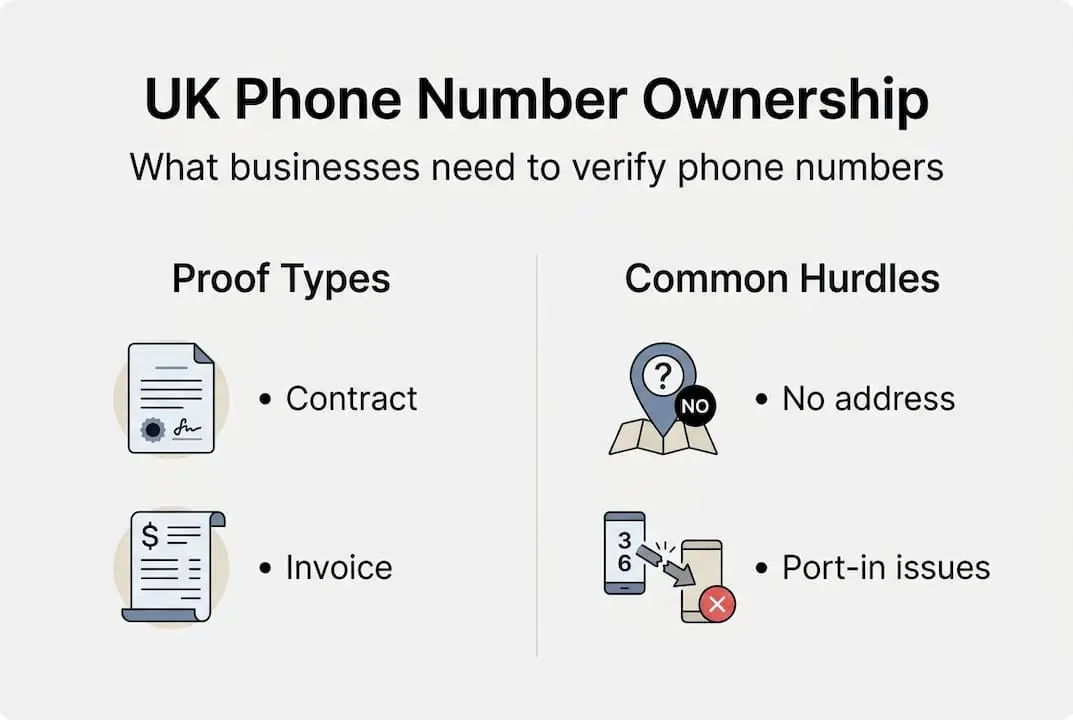
Ownership of a phone number in the UK is not registered in any central government database. There is no equivalent of the Land Registry for telephone numbers. Instead, ownership is demonstrated through CP contracts and billing records, with the number remaining portable under Ofcom rules. Your Communications Provider (CP) is the company that allocates the number to you, but the number belongs to your business through the contractual relationship you hold with them.
This matters enormously in practice. If you close an account without securing your number, you risk losing it permanently. If you dispute a bill, your number could be at risk. Knowing what constitutes proof of ownership gives you real leverage.
Here is what counts as valid ownership evidence for a UK business:
- Signed contract with your Communications Provider, showing your business name and the specific number
- Billing invoices that list the number and your registered business address
- Regulatory submissions made to Ofcom or your provider on behalf of the number
- Correspondence records between your business and the CP referencing the number
- PAC or STAC codes requested in your name, confirming your right to port or cancel
“There is no central phone number registry in the UK. Verification of ownership relies entirely on billing records and the contractual relationship between the end-user and their Communications Provider.”
Numbers are portable under Ofcom General Condition B3/C7, and businesses can request PAC codes (for mobile transfers) or STAC codes (for cancellations) to exercise those rights. This is why porting your number between providers is not only possible but legally protected. The process is designed to ensure businesses retain control, not providers.
The practical takeaway: treat your phone number like a business asset. File your contracts. Keep invoices. If you are serious about protecting business numbers, documentation is your first line of defence. Understanding number portability for businesses is equally important before you sign any new provider agreement.
Regulatory requirements for verifying business phone number ownership
When you move to a VoIP or cloud-based phone service, the verification bar rises. Traditional landline providers often rely on existing account history. VoIP and cloud providers, however, must comply with Ofcom guidelines and typically require a fuller set of documents upfront.
VoIP and cloud providers require regulatory documentation including Companies House registration, your business name and address, a working website, and details of a legal representative. This is not bureaucracy for its own sake. It is designed to prevent fraud and ensure numbers are assigned to legitimate UK businesses.
| Requirement | Traditional providers | VoIP/cloud providers |
|---|---|---|
| Signed contract | Yes | Yes |
| Companies House registration | Sometimes | Usually required |
| UK business address | Yes | Yes, strictly verified |
| Working website | Rarely | Often required |
| Legal representative details | Rarely | Commonly required |
| Billing history as proof | Yes | Yes, plus additional docs |
Here is a straightforward process for submitting regulatory evidence when establishing ownership with a new provider:
- Gather your Companies House registration number and a copy of your certificate of incorporation.
- Confirm your registered UK business address, which must match the address on your application.
- Prepare a recent utility bill or bank statement showing the business address, dated within the last three months.
- Identify your legal representative, the person authorised to sign contracts on behalf of the business.
- Compile your existing number documentation, including any previous contracts or invoices referencing the number you wish to transfer or register.
- Submit via the provider’s official process, referencing the number porting guide for porting-specific steps.
Pro Tip: Always retain physical and digital copies of every document you submit. Providers occasionally lose records, and your copies are your only fallback if a dispute arises.
Sole traders and businesses without a registered address face additional hurdles, covered in the next section. For now, focus on securing business numbers by treating documentation as an ongoing responsibility, not a one-time task. Revisiting business number basics can also help you avoid common gaps before they become problems.
Establishing local presence and trust: The role of NAP consistency
Documenting ownership is crucial for legal compliance, but in practice, trust and local SEO build on consistency over proof. NAP stands for Name, Address, and Phone number. It is the combination of details that search engines and customers use to verify your business is real, local, and legitimate.
NAP consistency across directories builds trust and is a key factor in Google Business Profile (GBP) verification, which often happens by postcard or phone call if your number is publicly listed. You do not need to formally prove phone ownership to Google. What you need is for your number to appear identically across every platform where your business is listed.
Here are the core actions every business owner should take:
- Update your website with the correct phone number in the header, footer, and contact page
- Claim and update your Google Business Profile with the exact same number
- List your business on major UK directories such as Yell, Thomson Local, and Bing Places
- Check social media profiles to ensure the number matches your other listings
- Audit third-party mentions using a tool like BrightLocal or Moz Local to catch inconsistencies
Businesses with consistent NAP listings see improved local search rankings and stronger customer trust, with porting success rates near 100% under Ofcom rules when documentation is in order. That combination of regulatory reliability and digital consistency is what separates businesses that dominate local search from those that struggle to appear at all.
Pro Tip: Set a quarterly reminder to audit your NAP listings. A single outdated directory entry can quietly undermine months of local SEO work without you noticing.
For businesses focused on building trust for SMEs, a consistent phone number is one of the simplest and most powerful signals you can send. If you are considering retaining existing numbers when switching providers, this is precisely why it matters so much.
Common challenges and solutions for SMEs and sole traders
Even when following best practices, many SMEs and sole traders encounter unique obstacles. Imported or port-in numbers, non-UK addresses, and missing Companies House registration can all create friction when trying to establish or verify ownership.
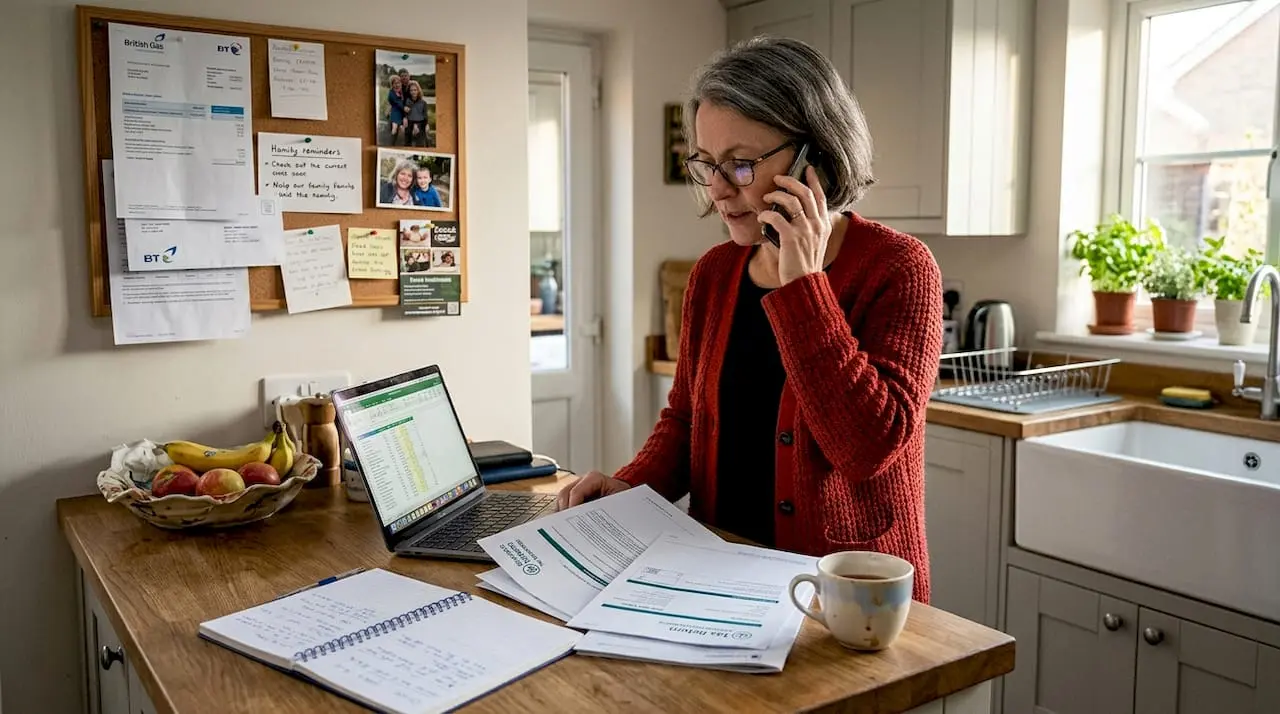
Imported and port-in numbers may have lower answer rates without full regulatory documentation, and sole traders without Companies House registration may face provisioning issues with certain providers. These are not dead ends, but they do require a more considered approach.
| Challenge | Common cause | Practical solution |
|---|---|---|
| No Companies House registration | Sole trader structure | Provide HMRC self-assessment reference and utility bill |
| Non-UK business address | Remote or overseas operation | A UK registered office address service resolves this |
| Port-in number rejected | Incomplete documentation | Request full account history from previous provider |
| Low answer rates on new number | Number not yet established | Build NAP listings and increase outbound call volume |
| Provider disputes ownership | Missing contract copies | Escalate to Ofcom with billing evidence |
If you cannot provide the full documentation a provider requires, here are practical steps to take:
- Request a letter from HMRC confirming your self-assessment registration as an alternative to Companies House documents
- Use a UK registered office address service if your business operates remotely or from outside the UK
- Ask your previous provider for a full account history before initiating a port-in request
- Keep a dedicated folder for all number-related correspondence, contracts, and invoices
A UK address is always required, without exception. No provider operating under Ofcom regulations can assign or port a number to a business without a verifiable UK address. This is a hard rule, not a guideline. For detailed local number acquisition steps, it is worth reviewing the full process before approaching a provider. Sole traders in particular should read up on business number basics for sole traders to understand what alternatives are available.
A fresh perspective: Rethinking phone number ownership in a digital-first world
The conversation around phone number ownership tends to get stuck on paperwork. Contracts, invoices, regulatory submissions. These matter, but they are not what actually builds your business reputation with customers.
We have seen businesses with impeccable documentation struggle to attract local enquiries, while competitors with a well-listed, consistently branded number dominate their area. The difference is not legal standing. It is visibility and trust.
Conventional wisdom says: get the paperwork right, then you own your number. Our view is different. Ownership without visibility is worthless. A number that appears correctly on your website, your Google Business Profile, and every relevant directory is doing more for your business than a filing cabinet full of contracts ever will.
Number portability, online reputation, and direct communication are the three pillars that shape how customers perceive your business. Documentation supports the first. The other two depend entirely on how consistently and professionally you present your contact details across every touchpoint.
Pro Tip: Prioritise getting your phone number visible and consistent on all platforms before worrying about formal verification processes. Visibility builds trust faster than documentation.
If you want to see how this plays out in practice, the secure business numbers guide covers the full picture from a business outcomes perspective.
Connect your business with verified phone numbers
With a clear grasp of ownership and trust, securing a memorable, properly verified phone number is the logical next step.
At PhoneNumbers.store, we specialise in memorable UK 01, 02, and 07 numbers that are ready to use anywhere in the country, not tied to a specific location. Whether you want a number that reflects your local area or one that simply stands out, our searchable database lets you find the right fit by sequence, area code, or town. Every number comes with the documentation support you need to establish ownership from day one. Visit Phonenumbers Store to browse available numbers and take the first step towards a stronger, more trustworthy business presence.
Frequently asked questions
How can a UK business prove ownership of a phone number?
Ownership is established via contractual relationship and billing records from your Communications Provider. Keep signed contracts and invoices as your primary evidence.
Do sole traders need Companies House registration to get a business phone number?
Sole traders may face provisioning issues without Companies House registration, but alternatives such as HMRC self-assessment references and UK address verification are often accepted.
Why is NAP consistency important for business phone numbers?
NAP consistency is a key trust signal for local SEO, helping search engines and customers verify your business is legitimate and improving your rankings in local search results.
Can I transfer my business phone number between providers?
Numbers are portable under Ofcom General Condition B3/C7, and you can request PAC or STAC codes from your current provider to initiate a transfer or cancellation.
Is it necessary to submit proof of phone ownership for Google Business Profile?
GBP verification often occurs by postcard or phone when your number is publicly listed. No formal ownership proof is required, but your number must be consistent across all platforms.