
TL;DR:
- A loyalty phone number is a unique customer ID used in loyalty programs to track points and build profiles without a physical card or app. It enables cross-channel identity resolution and simplifies enrolment, supporting quick, GDPR-compliant implementation in UK businesses. Normalising phone formats and obtaining explicit consent are crucial to harnessing its full operational and legal benefits.
A loyalty phone number is a unique customer identifier used within loyalty programmes to track points, redeem rewards, and build a persistent customer profile, all without a physical card or app. The concept is straightforward: a customer provides their phone number at checkout, and the system links that number to their loyalty account instantly. Programmes like Nectar use this approach to serve tens of millions of members across the UK. The loyalty number definition covers any unique ID that replaces a card, but the phone number has become the most practical format because every customer already carries one. For UK businesses, this means zero-friction enrolment, higher participation rates, and a single customer identity that works across every channel.
What is a loyalty phone number and how does it work?
A loyalty phone number functions as an Alternate ID in CRM and point-of-sale systems, replacing the barcode on a physical card with a number the customer already knows by heart. When a customer gives their number at the till, the POS system queries the loyalty database, matches the number to a profile, and applies points or discounts in real time. The entire process takes seconds and requires no hardware beyond the existing terminal.

The real power comes from cross-channel identity resolution. A customer who orders online, collects in-store, and contacts support via WhatsApp can be recognised as the same individual every time, provided the phone number is captured consistently. Phone numbers unify fragmented loyalty accounts across ordering channels, which means your marketing team can build a complete picture of each customer rather than three disconnected records.
The four-week implementation timeline
A typical implementation follows a structured four-week cycle that most UK businesses can manage without specialist consultants.
- Week one: database build. Capture phone numbers at every touchpoint, including the till, your website sign-up form, and any delivery platform. Obtain explicit consent at each point.
- Week two: define earn-and-burn rules. Decide how many points equal one pound spent, what rewards trigger redemption, and whether you offer a welcome bonus for new sign-ups.
- Week three: initial outreach. Send your first SMS or WhatsApp message to enrolled members. Keep it transactional at this stage: a confirmation of points balance and a clear opt-out instruction.
- Week four: optimise. Review open rates, redemption rates, and opt-out rates. Adjust reward thresholds and message frequency based on real data.
Data normalisation: the technical detail most businesses miss
Multi-channel brands must normalise phone number input by stripping spaces, dashes, and country code prefixes before storing records. A customer who types “07700 900123” online and says “07700900123” in-store should resolve to one profile, not two. Duplicate profiles inflate your member count, distort your analytics, and mean customers lose points they legitimately earned. Build a normalisation rule into your CRM from day one.
| Channel | Input format risk | Normalisation fix |
|---|---|---|
| In-store POS | Staff type spaces or dashes | Strip non-numeric characters on save |
| Website sign-up | Users add +44 prefix | Convert +44 to leading 0 automatically |
| WhatsApp ordering | International format default | Map +44 to 07 prefix in your CRM |
| Delivery platform | Third-party format varies | API mapping layer before database write |
What are the benefits of loyalty phone numbers vs cards or apps?
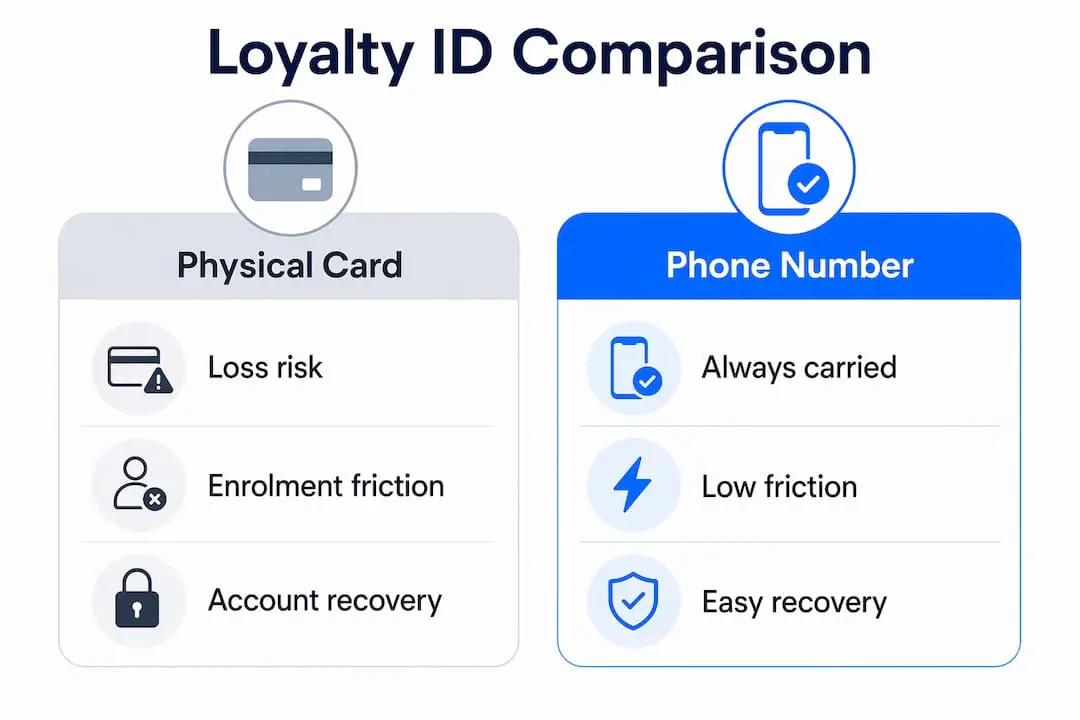
The core advantage of a customer loyalty phone contact over physical cards is the complete removal of the “I forgot my card” problem. Cards get lost, damaged, or left at home. Apps require a download, a password, and ongoing storage on the customer’s device. A phone number requires none of that. Avoiding app installation friction leads directly to higher adoption rates and wider programme participation.
Account recovery is another area where phone numbers win decisively. If a customer loses their card or forgets their app login, your support team faces a time-consuming verification process. With a phone number as the primary ID, instant account lookups reduce lost account issues significantly and cut the average handling time for support calls.
Pro Tip: When a customer calls your loyalty programme contact number for support, train your team to verify identity using the registered phone number plus one secondary detail, such as a postcode. This keeps the process fast without compromising security.
The table below compares the three main loyalty identification methods across the criteria that matter most to UK businesses.
| Criteria | Physical card | Mobile app | Phone number |
|---|---|---|---|
| Enrolment friction | Low (card issue) | High (download + login) | Zero |
| Customer forgets ID | Common | Occasional | Rare |
| Cross-channel use | Limited | Moderate | High |
| Account recovery | Slow | Moderate | Fast |
| Data collection depth | Low | Very high | Moderate |
| GDPR consent complexity | Low | Moderate | Moderate |
The one area where apps hold a genuine advantage is behavioural data depth. Apps track browsing, dwell time, and in-app actions that a phone number alone cannot capture. For most UK SMEs, however, that level of granularity is unnecessary. The operational benefits of phone-based loyalty far outweigh the data gap for businesses with fewer than 50,000 active members.
How do UK data protection rules affect loyalty phone numbers?
UK GDPR and the Privacy and Electronic Communications Regulations (PECR) set clear rules for any business using phone numbers in a loyalty context. The most important rule is this: explicit, recorded consent is required before you send any marketing message to a customer’s phone number. Transactional messages, such as a points balance confirmation, sit in a different category, but the line between transactional and marketing is narrower than most businesses assume.
Customers expect transparency about how their phone number will be used. Failing to communicate this clearly causes high opt-out rates and lasting damage to brand sentiment. The consent statement at enrolment must specify whether the number will be used for marketing, account tracking, or both.
Key compliance requirements for UK businesses:
- Explicit consent at capture. The enrolment form or till script must state clearly that the customer’s number will be used for loyalty tracking and, separately, for marketing if applicable.
- Separate consent for marketing. Do not bundle marketing consent into the loyalty sign-up. The Information Commissioner’s Office (ICO) treats bundled consent as invalid.
- Right to withdraw. Every SMS or WhatsApp message must include a clear opt-out mechanism. “Reply STOP to unsubscribe” is the standard format.
- Data retention limits. Delete or anonymise records for customers who have not engaged with the programme within a defined period, typically 24 months.
- Support line cost transparency. If you operate a loyalty programme contact number for customer queries, use a 0344 number so calls are included in standard UK mobile bundles. This removes a barrier to contact and signals good faith to customers.
Pro Tip: Store your consent records in the same CRM field as the phone number itself. If the ICO ever requests evidence of consent, you need to produce a timestamped record tied to the specific number, not a generic sign-up log.
What steps should UK businesses take to implement a loyalty phone number programme?
The foundation of any successful loyalty programme is a clean, consented database. Start by auditing your existing customer records. Identify which contacts already have a phone number attached, which have consented to marketing, and which records are duplicates. This audit typically reveals that 20–40% of existing records need remediation before you can use them in a loyalty context.
Once your database is clean, follow these implementation steps:
- Define your reward structure. Set a points-per-pound ratio that is generous enough to motivate behaviour but sustainable for your margins. A common starting point for UK retail is one point per pound spent, with 100 points equalling a £1 reward.
- Integrate with your POS or CRM. Most modern UK POS systems, including those built on platforms compatible with Shift4 or Toast, support phone number as an Alternate ID natively. Check your provider’s documentation before building a custom integration.
- Train your staff. The till-side script matters enormously. Staff should ask “Can I take your phone number for our loyalty scheme?” not “Do you have a loyalty card?” The first question captures new members; the second only serves existing ones.
- Launch with a welcome incentive. Offer double points or a small immediate reward for the first transaction after enrolment. This drives immediate redemption behaviour and confirms to the customer that the system works.
- Monitor and adjust monthly. Track enrolment rate, active member rate (members who transact at least once per month), and redemption rate. A redemption rate below 15% usually signals that rewards are too hard to reach.
For businesses using SMS as the primary engagement channel, keep message frequency to a maximum of two per month outside of transactional triggers. Memorable phone numbers boost revenue when customers can recall your contact number easily, which reinforces the value of choosing a distinctive number for your loyalty support line from the outset.
Key takeaways
A loyalty phone number is the most practical universal customer ID available to UK businesses, combining zero-friction enrolment with cross-channel identity resolution and straightforward GDPR compliance when implemented correctly.
| Point | Details |
|---|---|
| Core definition | A loyalty phone number is a unique ID in CRM and POS systems, replacing physical cards and apps. |
| Cross-channel value | Phone numbers unify customer profiles across in-store, online, and WhatsApp channels into one record. |
| Compliance requirement | UK GDPR and PECR require explicit, separately recorded consent before any marketing use of a phone number. |
| Implementation priority | Normalise phone number formats from day one to prevent duplicate profiles and lost loyalty points. |
| Support line choice | Use a 0344 number for your loyalty contact line so customer calls are included in standard mobile bundles. |
Why I think most UK businesses are underusing this tool
I have watched UK businesses spend thousands on loyalty app development only to see adoption rates stall below 10% of their customer base. The app feels like the modern answer, but the friction of downloading, registering, and remembering a password defeats the purpose of a loyalty scheme, which is to make repeat purchase effortless.
The phone number approach is not new. Nectar has used it for years. What is new is the availability of affordable CRM and POS integrations that make it accessible to independent retailers and regional chains, not just supermarket groups. A business with 500 regular customers can build a functioning phone-number loyalty programme in four weeks with no custom software.
The privacy dimension is where I see the most avoidable mistakes. Businesses collect phone numbers enthusiastically at the till and then send weekly promotional SMS messages without clear consent records. That behaviour is what triggers ICO investigations and erodes the customer trust that the loyalty scheme was designed to build. Consent architecture is not a legal formality. It is the foundation of the entire relationship.
My honest view is that the businesses winning at loyalty in 2026 are not the ones with the most sophisticated apps. They are the ones with the cleanest data, the clearest consent records, and a reward structure simple enough that customers understand it without reading a FAQ. The phone number is the right starting point. Build the rest around it.
— Rob
Find a memorable number for your loyalty programme
A loyalty programme is only as strong as the contact number customers associate with it. If your support line is a forgettable string of digits, customers will not call when they have a query, and unresolved queries become lost members. Phonenumbers is the UK’s leading provider of memorable 01, 02, and 07 numbers, and the right number can make your loyalty contact line as recognisable as the programme itself. Browse distinctive options like this memorable Leeds number or this standout Nottingham number, both available to buy or rent and usable anywhere in the UK regardless of area code. Search the Phonenumbers database by number sequence, area code, or town to find the right fit for your brand.
FAQ
What is a loyalty phone number in simple terms?
A loyalty phone number is a customer’s mobile or landline number used as their unique ID in a loyalty programme. It replaces a physical card or app login, allowing points to be tracked and rewards redeemed at the till simply by providing the number.
How do I use a loyalty phone number at checkout?
Give your registered phone number to the cashier or enter it on the payment terminal when prompted. The POS system matches the number to your loyalty account and applies points or discounts automatically.
Are loyalty phone numbers covered by GDPR in the UK?
Yes. UK GDPR and PECR require businesses to obtain explicit, recorded consent before using a customer’s phone number for marketing. Transactional messages such as points confirmations are treated differently but still require a lawful basis for processing.
What is the difference between a loyalty programme contact number and a loyalty phone number?
A loyalty programme contact number is the phone number customers call to reach your support team. A loyalty phone number is the customer’s own number used as their account identifier. Both are part of a loyalty programme but serve entirely different functions.
Can a loyalty phone number work across multiple channels?
Yes. Because the phone number is a universal identifier, it can link a customer’s in-store purchases, online orders, and WhatsApp interactions into a single profile, provided your CRM normalises the number format consistently across all input sources.