
TL;DR:
- UK businesses do not obtain direct phone number licenses but acquire ranges through regulated providers under Ofcom’s allocation system. Proper legal use of business numbers for marketing requires compliance with PECR, TPS/CTPS screening, and data protection laws, regardless of ownership. Ongoing management, training, and lawful practices are essential to maintain reputation and prevent ICO fines, turning the number into a trusted long-term asset.
Many UK business owners assume that once they have a phone number, they are free to use it however they wish. That assumption is wrong, and it can be costly. Obtaining a business phone number and having the legal right to use it for marketing and customer outreach are two entirely separate matters. Between Ofcom’s numbering framework, the Privacy and Electronic Communications Regulations (PECR), the Telephone Preference Service (TPS), and data protection law, there are multiple overlapping rules that businesses must navigate. This guide cuts through the confusion so you can use your business number confidently and lawfully.
Table of Contents
- How phone number licensing works in the UK
- Key rules and restrictions for using business phone numbers
- Data protection: What every business must consider
- Common scenarios and edge cases for phone number licensing
- Why “licensing” is only half the story: A perspective
- Find your business number with full peace of mind
- Frequently asked questions
Key Takeaways
| Point | Details |
|---|---|
| Ofcom indirect licensing | Businesses access numbers via providers who are authorised by Ofcom, not through direct licensing. |
| PECR applies to marketing | The right to use a number does not mean you can freely make marketing calls—PECR rules always apply. |
| Data protection is mandatory | Businesses must respect individuals’ data rights and objections during any marketing activity. |
| Practical compliance steps | Regularly check TPS/CTPS, secure permissions, and keep records to stay compliant. |
| Provider choice matters | Selecting a reputable phone number provider helps ensure ongoing compliance and continuity. |
How phone number licensing works in the UK
The first thing to understand is that there is no such thing as a direct “phone number licence” that a business applies for. The system is indirect, and most business owners never realise this. Numbering “licensing” for businesses is usually indirect: businesses buy a service, often VoIP or hosted telephony, from a communications provider, while Ofcom allocates number ranges to those providers under the national numbering plan.
This means Ofcom sits at the top of the chain, allocating blocks of numbers to authorised communications providers. Those providers then supply individual numbers to businesses and consumers as part of their service. When you take on a business phone number, you are effectively a sub-user within a regulated chain, not a direct licence holder.
Here is how the allocation chain works in practice:
| Level | Organisation | Role |
|---|---|---|
| 1 | Ofcom | Sets the national numbering plan and allocates ranges |
| 2 | Communications provider | Receives allocated ranges; bound by Ofcom conditions |
| 3 | Business (you) | Acquires number via provider; must comply with provider terms and wider law |
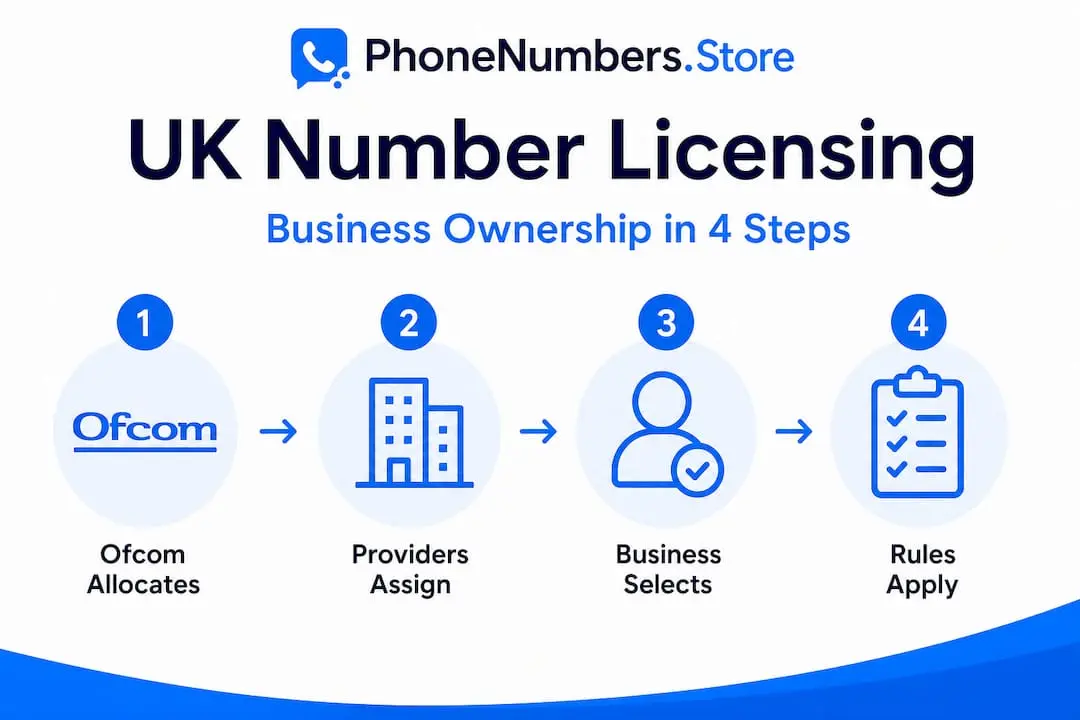
Understanding UK business number rules is essential before you commit to a number for your brand. Providers are held to strict conditions by Ofcom, and those conditions flow down to you as the end user. If a provider acts outside Ofcom’s rules, the numbers they supply can be revoked entirely. Your business continuity depends on choosing carefully.
Key points about how the system is structured:
- Ofcom manages the UK’s national telephone numbering plan
- Businesses cannot apply to Ofcom directly for number allocations
- Providers must meet strict criteria before receiving number ranges
- You as a business user inherit certain obligations from your provider’s licence conditions
- Number ranges can include 01, 02, and 03 landline prefixes, as well as 07 mobile numbers
Pro Tip: When securing business numbers, always verify that your chosen provider is authorised under Ofcom’s general conditions. A quick check of Ofcom’s published registers can save you from a provider that might lose its number allocation without warning.
A common misconception is that having a recognised geographic or local number automatically gives you commercial credibility and legal standing to use it for any purpose. The number itself is just a routing address. What matters just as much is how you obtained it, through whom, and how you then choose to use it.
Key rules and restrictions for using business phone numbers
Knowing how numbers are licensed is only half the challenge. Real risk comes from how you use your number, especially in marketing.

Once your number is in place, the layer of rules governing how you actually use it for customer contact is substantial. The Information Commissioner’s Office (ICO) makes it clear that marketing via live calls requires full PECR compliance, including checking call targets against the TPS and the Corporate Telephone Preference Service (CTPS) registers.
PECR, the Privacy and Electronic Communications Regulations, governs all electronic marketing in the UK. It applies on top of your number’s allocation status. Simply holding a legitimate business number does not grant you any marketing permissions whatsoever.
Here is a comparison to clarify the different regulatory layers:
| Regulation | What it governs | Who enforces it | Key requirement |
|---|---|---|---|
| Ofcom numbering plan | Allocation and use of number ranges | Ofcom | Use number only as permitted by your provider |
| PECR | Marketing calls and messages | ICO | Check TPS/CTPS; do not call registered individuals without consent |
| TPS/CTPS | Individual and corporate do-not-call preferences | ICO (via CTPS operator) | Screen all outbound marketing calls against registers |
| UK GDPR / Data Protection Act 2018 | Processing personal data | ICO | Establish a lawful basis; respect objections |
Typical restrictions businesses face include:
- You cannot call individuals who are registered with TPS unless they have specifically consented to calls from your company
- Corporate numbers registered with CTPS cannot be called for marketing purposes
- You must be able to identify your organisation when making marketing calls
- You cannot withhold your number on outbound marketing calls
- Calling outside permitted hours is strongly discouraged and can trigger complaints
“If you use phone numbers for marketing by live calls in the UK, you must comply with PECR rules, including TPS/CTPS checking and overrides, not just any ‘number licensing’ concept.” — ICO guidance on direct marketing using live calls
Understanding the business numbers basics is your starting point, but PECR compliance is where the serious work begins. The ICO has the power to issue fines of up to £500,000 for serious breaches of PECR, and it regularly does so against businesses that assume their legitimate number gives them marketing freedom.
Before launching any outbound campaign, you should also consider finding available numbers that fit your brand identity, as the choice of prefix can affect how your calls are perceived and answered.
Data protection: What every business must consider
This brings us to another legal dimension: what about data protection and privacy when your number is used for direct outreach?
Making live marketing calls almost always involves processing personal data. The name behind a phone number, the call history, the outcomes of those calls — all of it constitutes personal data under the UK General Data Protection Regulation (UK GDPR). The ICO is explicit that data-protection compliance is mandatory for any business using personal data in live marketing calls, covering lawful basis, fairness, and objection handling.
Practical steps for achieving compliance:
- Identify your lawful basis. Before making any marketing call, confirm that you have either consent or a legitimate interest that has been properly assessed and documented. Legitimate interest is not a blanket excuse — you must balance it against the individual’s rights.
- Screen against TPS and CTPS. Obtain a current licence to access TPS/CTPS data and screen your call lists before every campaign. Lists go stale quickly; screening must be regular.
- Record your compliance decisions. Keep a written record of why you believe you have the right to contact each category of individual. Regulators expect documentation.
- Train your calling teams. Every person making calls on behalf of your business must understand the rules. An uninformed employee can generate a complaint that triggers an ICO investigation.
- Maintain a suppression list. Record every person who objects, and ensure no one on that list is ever contacted again for marketing. Review this list before every campaign.
- Review your data sources. If you purchased a list from a third party, you cannot assume it is compliant. You inherit responsibility for the data the moment you use it.
Pro Tip: A hard objection, where someone tells you clearly they do not want to be called, is not simply a note to add to your CRM. It is a legal obligation to stop. Verifying number ownership correctly at the outset reduces the risk of calling numbers tied to individuals who have previously objected under a different business name.
Objection handling is not just good practice; it is a right individuals hold absolutely under UK GDPR. The moment someone objects to marketing, you must stop using their data for that purpose, and there is no legitimate interest override available.
Common scenarios and edge cases for phone number licensing
With the main rules explained, let’s look at what happens in the real world, where most confusion and problems surface for UK businesses.
Business owners often discover the gaps in their knowledge at the worst possible moment: after a complaint has been filed or a campaign has gone wrong. Here are some of the most common real-world scenarios:
- Number reassignment after a previous tenant: If you acquire a number that was previously used by another business, that number may have been registered with TPS complainants or associated with unwanted calls. Recipients may flag your calls as spam before you have even introduced yourself.
- Rebranding and number retention: When a business rebrands, the consent and permissions it held under its old name do not automatically transfer to the new identity. You may need to obtain fresh consent from your existing customer base before resuming marketing calls.
- Outsourcing outbound calls: If you hire a third-party call centre to make marketing calls on your behalf, you remain the data controller. The call centre becomes a data processor, and you are still legally responsible for their compliance.
- Using numbers for automated calls: Automated marketing calls (using recorded messages) have their own distinct rules under PECR and require prior consent in almost every circumstance.
- Porting numbers between providers: When you move a number from one provider to another, check that the receiving provider is fully Ofcom-authorised. A number ported improperly can lose its allocation status.
The ICO’s guidance on live marketing calls makes it unambiguously clear: even if you have a legitimate right to use a business number, you cannot assume that call or text marketing is permitted. PECR and data protection rules operate as separate, parallel frameworks that can and do override the mere technical fact of number ownership.
The ICO issued over £1.4 million in fines for nuisance calls and texts in a single year during recent enforcement cycles, targeting businesses of all sizes. This is not a risk confined to large call centres; small businesses have been caught out repeatedly.
Before launching any phone-based campaign, work through this checklist:
- Confirm your lawful basis and document it
- Screen your call list against current TPS/CTPS data
- Ensure your number is properly obtained from an authorised provider
- Review your business continuity and numbers strategy so a provider change never leaves you exposed
- Have a plan for protecting your number from misuse or fraudulent porting
Why “licensing” is only half the story: A perspective
After addressing those edge cases, here is a crucial perspective most owners miss when thinking about phone number licensing.
In our experience working with UK business owners across every sector, the technical act of acquiring a phone number is almost never the problem. Providers are generally reliable, Ofcom’s framework is well-established, and the process of obtaining a number — whether a memorable 01 landline or a national 03 number — is straightforward when you work with a reputable supplier.
The real danger lies in what happens next. Businesses invest time and money in building a recognisable number into their brand, their signage, their website, and their advertising. And then they launch a marketing campaign without properly understanding the PECR and data protection obligations that govern every outbound call. That is where businesses find themselves facing ICO investigations, fines, and reputational damage.
There is also a deeper issue. Many business owners treat a phone number as a one-off purchase: you buy it, you use it, you move on. But a business phone number is actually a managed asset. It requires ongoing attention: regular TPS/CTPS screening, suppression list management, staff training, and periodic reviews of your data sources and lawful basis. The businesses that handle this well are the ones that build long-term trust with their customers through consistent, respectful contact.
We would also challenge the idea that a “proper” business line is a shortcut to credibility. Trust is earned through behaviour, not through prefix. A memorable number helps — and there is genuine evidence that recognised numbers improve call answer rates — but it is the consistency and compliance of your outreach that builds lasting relationships.
Following a step-by-step local number acquisition process is a sound starting point, but your compliance programme is what keeps that number working for you long-term. Treat licensing as the foundation, not the finish line.
Find your business number with full peace of mind
Ready to put these insights into action? Here’s where you can secure fully compliant business numbers without the hassle.
At PhoneNumbers.store, we specialise in memorable UK phone numbers, specifically 01 and 02 landline numbers and 07 mobile numbers. Our database lets you search by number sequence, area code, or town and city, so you can find a number that genuinely reflects your brand. And because numbers are no longer tied to local areas, you can use a Leeds, London, or Liverpool number from anywhere in the country.
We pair our number selection service with clear guidance on what responsible ownership looks like, so you start on the right footing. Whether you are looking to buy a phone number for a new venture or you want something truly distinctive like 01132 666333, our team is here to help you choose wisely and use your number with confidence.
Frequently asked questions
Do I need a licence to use a business phone number in the UK?
You do not need a direct licence; numbering “licensing” for businesses is indirect, meaning providers receive allocations from Ofcom and supply numbers to businesses as part of their service.
Can I use my business number for marketing calls without extra checks?
No. Even with a legitimately obtained number, you must comply with PECR rules and screen your call list against the TPS and CTPS registers before making any marketing calls.
What happens if someone objects to my marketing calls?
You must stop using their personal data for marketing purposes immediately; the right to object is absolute under UK GDPR, and there is no legitimate interest override available.
How do I ensure the phone number I use is properly obtained?
Always acquire your number from an authorised UK communications provider that operates under Ofcom’s general conditions; Ofcom allocates number ranges to regulated providers specifically to maintain the integrity of the national numbering plan.
Is using a memorable number enough to build trust with customers?
A memorable number genuinely helps with recognition and call answer rates, but lasting trust is built through consistent, compliant, and respectful communication — the number is the door, and your conduct is what keeps customers walking through it.