
TL;DR:
- A reserved number is a phone number kept from public use to protect branding, ensure operational continuity, and prevent reassignment.
- Businesses can reserve memorable sequences to boost recognition and maintain marketing consistency, but reservation is temporary and regulated by Ofcom.
A reserved number is a phone number intentionally held back from public allocation to secure it for a specific purpose, such as branding, future activation, or system operations. For UK businesses and individuals, understanding the reserved number meaning is the difference between owning a number that defines your brand and losing it to someone else. Phonenumbers specialises in memorable UK landline and mobile numbers, making the concept of reservation directly relevant to anyone serious about their phone presence. This guide explains how reservation works, why it matters, and how to use it to your advantage.
What is a reserved number in UK telecommunications?
A reserved number is a phone number set aside from the general public pool, removed from open availability so it cannot be assigned to anyone else during the reservation period. Think of it like reserving a table at a restaurant. The seat exists, but no one else can take it while your name is on the booking.

In telecommunications, this process happens at the database level. Once a number is flagged as reserved, it is removed from general availability and held exclusively for the person or organisation that requested it. This prevents the number from being reassigned, recycled, or accidentally allocated to another customer during porting, activation, or a marketing campaign.
The analogy to domain name reservation is useful here. Just as registering a web domain prevents others from using that address, reserving a phone number locks it to you. The difference is that phone number reservation is often temporary rather than permanent, governed by service provider policies and regulatory frameworks.
Reservation also plays a role during number porting, the process of transferring a number from one network to another. During porting, a number is typically held in a reserved state to prevent duplication or conflict while the transfer completes. Phonenumbers handles this process for UK customers across 01, 02, and 07 number ranges.
Pro Tip: If you are porting a number, confirm with your provider that the number enters a reserved state during the transfer. This protects you from losing it mid-process. Read more about number porting in the UK before you begin.
What are the practical benefits for businesses and brands?
Reserved numbers give businesses a direct commercial advantage. A number that is held exclusively for your brand cannot be taken by a competitor, reassigned after a contract lapse, or lost during a network migration. That exclusivity has real value, particularly for businesses that use their phone number in advertising, on vehicles, or across printed materials.
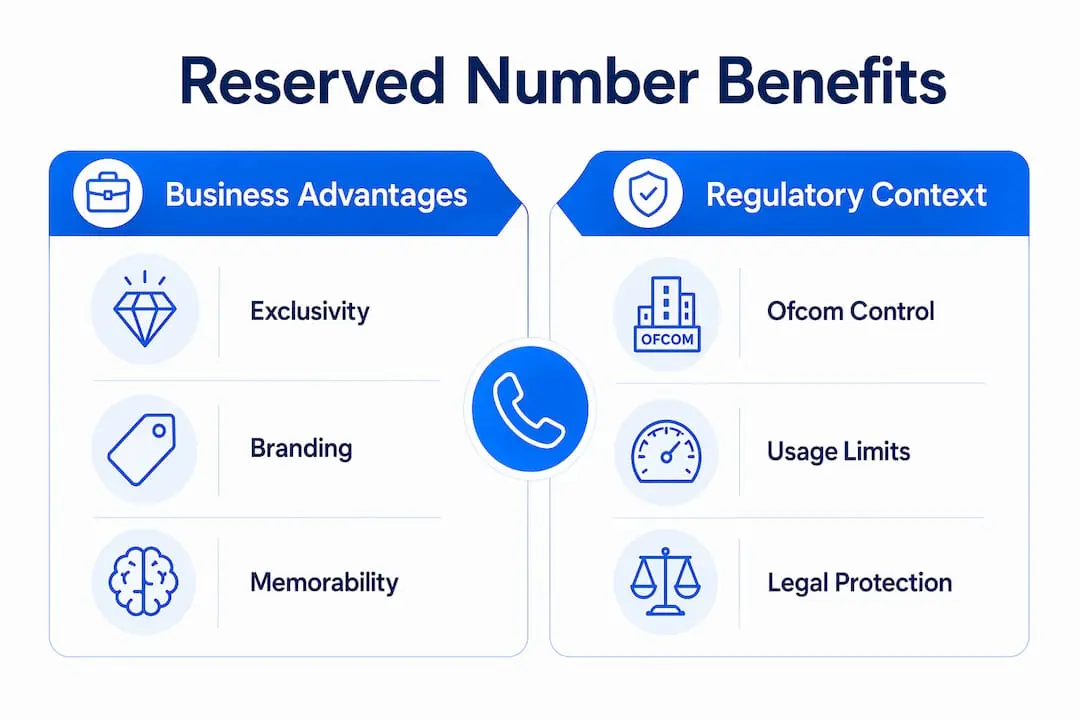
The branding case is strong. Memorable reserved numbers are easier for customers to recall, which reduces friction in the sales process. A number like 0113 255 0000 is far more memorable than a randomly assigned sequence, and once reserved, it belongs to your brand identity rather than to chance.
Here is how reservation supports business operations in practice:
- Brand protection. Reserving a number prevents third parties from acquiring a sequence closely associated with your business. Reserved identifiers protect trademarks and strategic interests by restricting public registration of key codes.
- Marketing consistency. A reserved number stays the same across campaigns, so your TV ad, website, and van livery all carry the same contact point without risk of change.
- Operational continuity. During system migrations or network changes, a reserved number remains yours. It does not re-enter the public pool while the transition is underway.
- Customer trust. A consistent, recognisable number signals stability. Customers are more likely to call a number they have seen repeatedly than one that changes with each campaign.
- Leasing flexibility. Businesses that are not ready to purchase outright can lease a reserved number, locking in the sequence while managing costs.
Pro Tip: Choose a number that reflects your area code or a repeating digit pattern. These are the sequences customers remember after a single exposure. Phonenumbers lets you search by area code or digit sequence to find the right fit.
What legal and regulatory rules apply to reserved numbers in the UK?
Ofcom, the UK’s communications regulator, controls which number ranges are available to businesses and individuals, and which are withheld entirely. Certain number ranges are reserved by regulators for emergencies, media use, or system testing, and these cannot be assigned to consumers or businesses under any circumstances.
This regulatory layer exists to protect public safety. Numbers used by emergency services, broadcasting bodies, or network testing systems must remain stable and free from commercial interference. Assigning them to a business would create serious risks for public communications infrastructure.
The table below summarises the main categories of reserved number status in the UK context:
| Category | Who controls it | Can businesses use it? |
|---|---|---|
| Emergency services numbers | Ofcom | No |
| Media and broadcasting ranges | Ofcom / BBC | No |
| Network testing ranges | Network operators | No |
| Commercially reserved numbers | Service providers | Yes, via reservation |
| Ported numbers in transit | Gaining network | Temporarily restricted |
Beyond regulatory restrictions, businesses must also consider reservation duration. Reservation status is often temporary, expiring if activation requirements or payments are not completed within defined deadlines, which may be as short as 30 or 60 days. Missing that window means the number returns to the public pool and becomes available to anyone.
Trademark law adds another layer. If a number sequence is closely tied to your brand identity, legal protections may apply alongside the technical reservation. Reserving identifiers maintains business control and prevents third-party confusion or infringement. A solicitor familiar with intellectual property can advise on whether your reserved number warrants formal trademark registration.
How can you reserve and use a number effectively?
Reserving a number in the UK follows a clear process, but the details matter. Missing a step or misunderstanding a deadline can cost you the sequence you wanted.
- Search for available numbers. Use a specialist provider like Phonenumbers to search by area code, digit pattern, or town. The database shows which memorable sequences are currently available.
- Select your number. Choose a sequence that is easy to recall and relevant to your brand. Repeating digits, ascending sequences, and area codes tied to your location all perform well in customer recall.
- Confirm the reservation terms. Ask your provider how long the reservation holds and what triggers expiry. Reservation expiry policies vary, and you must act within defined periods to avoid losing the number.
- Complete activation or purchase. Move from reserved to active status before the deadline. If you are leasing, confirm the lease terms cover the full period you need.
- Use the number consistently. Place it on your website, marketing materials, and customer communications from day one. Consistency builds the recall that makes a memorable number worth having.
- Monitor renewal dates. If your reservation or lease has an expiry, set a reminder well in advance. Numbers that lapse return to the open market immediately.
One common pitfall is treating reservation as ownership. A reserved number is not yours until it is activated or purchased. Reservation in operational contexts is often temporary and tied to the lifecycle of the record, not permanent ownership. The same principle applies to phone numbers.
Numbers in the UK are no longer tied to geographic areas. A Leeds 0113 number can be used by a business based in Manchester, London, or anywhere else. This flexibility means you can choose a number for its branding value rather than its location, which significantly expands your options when searching for the right sequence.
Key takeaways
A reserved number gives businesses exclusive control over a phone number sequence, preventing reassignment and protecting brand identity during porting, marketing, and operational changes.
| Point | Details |
|---|---|
| Definition of reserved number | A phone number removed from the public pool and held exclusively for a specific user or purpose. |
| Temporary vs permanent | Reservations often expire; activate or purchase within the provider’s deadline to secure the number. |
| Regulatory restrictions | Ofcom withholds certain ranges for emergencies and testing. These are never available to businesses. |
| Branding advantage | Memorable reserved numbers improve customer recall and protect marketing consistency across campaigns. |
| UK flexibility | UK numbers are not tied to local areas, so you can choose any sequence for its branding value. |
Why reserved numbers matter more than most businesses realise
I have spent years watching businesses treat their phone number as an afterthought, something assigned at setup and never reconsidered. That approach costs them more than they realise, not in fees, but in missed recognition and lost calls.
The businesses that get this right treat their number the way they treat their logo. They choose it deliberately, protect it actively, and use it consistently. A memorable reserved number on a van, a billboard, or a radio ad does something a generic sequence cannot. It sticks. Customers remember it without writing it down.
What surprises most people is how accessible this is. You do not need to be a large corporation to reserve a meaningful number. The process is straightforward, the costs are manageable, and the branding impact for UK trades and service businesses is disproportionately large relative to the investment.
The future of reserved numbers is also shifting. As more communication moves to digital channels, a consistent phone number becomes a trust signal rather than just a contact method. Customers who see the same number across your website, social profiles, and physical presence read that consistency as reliability. Businesses that reserve and protect their number now will have a clear advantage as that expectation grows.
My advice is simple. Do not wait until you need to change networks or reprint your marketing materials to think about your number. Reserve the right one now, activate it, and treat it as a permanent part of your brand.
— Rob
Phonenumbers: find and reserve your UK number
Phonenumbers is the leading provider of memorable UK phone numbers, covering 01 and 02 landline ranges and 07 mobile numbers. Whether you want to buy outright or lease a number while you grow, the process is straightforward and the database is searchable by area code, digit sequence, or town.
Numbers like 0113 255 0000 and 0115 928 8888 are the kind of sequences that customers remember after one exposure. Phonenumbers lists available numbers with clear buying and leasing options, so you can secure the right sequence without delay. Search the full database at Phonenumbers and find a number that works as hard as the rest of your brand.
FAQ
What is a reserved number in simple terms?
A reserved number is a phone number removed from the public pool and held exclusively for a specific person or business. It cannot be assigned to anyone else while the reservation is active.
How long does a phone number reservation last?
Reservation duration depends on the service provider’s policy. Many providers set deadlines of 30 or 60 days, after which the number returns to the public pool if not activated or purchased.
Can any UK business reserve a phone number?
Yes. UK businesses can reserve 01, 02, and 07 numbers through specialist providers like Phonenumbers. Certain ranges controlled by Ofcom for emergency or testing purposes are not available to businesses.
Is a reserved number the same as owning it?
No. Reservation holds the number temporarily. Ownership or a confirmed lease is required to make the arrangement permanent and prevent the number from expiring back into the public pool.
Do reserved numbers have to match my business location?
No. UK phone numbers are no longer tied to geographic areas. You can use a Leeds 0113 number from anywhere in the country, which means you can choose a sequence purely for its branding value.