
TL;DR:
- A telephone prefix is a set of digits at the start of a phone number that guides call routing within networks. Correct use of prefixes like “0,” “00,” and “+44” ensures successful connections and consistent branding, especially for international calls. Proper prefix formatting influences customer trust and brand credibility by signaling geographic location and professionalism.
A telephone prefix is a numeric code placed at the start of a phone number to route a call through national or international networks. Every time you dial a number in the UK, you use at least one prefix without thinking about it. The “0” before a UK area code, the “00” you dial before an international number, and the “+44” on a business card are all forms of telephone prefix. Understanding how these codes work helps you avoid failed calls, format numbers correctly, and choose the right number for your business.

What is a telephone prefix and how does it work?
A telephone prefix is any digit or sequence of digits that precedes the main subscriber number and tells the network how to route the call. The formal industry term is “numbering plan prefix,” governed by ITU-T E.164 standards, which limit the total length of an international phone number to 15 digits including all prefix segments. That 15-digit cap covers the country code, area code, and subscriber number combined.
Prefixes work as routing signals. The network reads them in sequence, like a postal address read from country down to street. Without the correct prefix, the call either fails to connect or reaches the wrong destination entirely.
The UK uses a well-defined set of prefixes at each level of the numbering plan. Knowing which prefix belongs at which level is the foundation of correct dialling, whether you are calling a neighbour or a client in Tokyo.
What are the main types of telephone prefix in the UK?
The UK telephone system uses four distinct prefix types. Each one serves a different routing function.
Trunk prefix
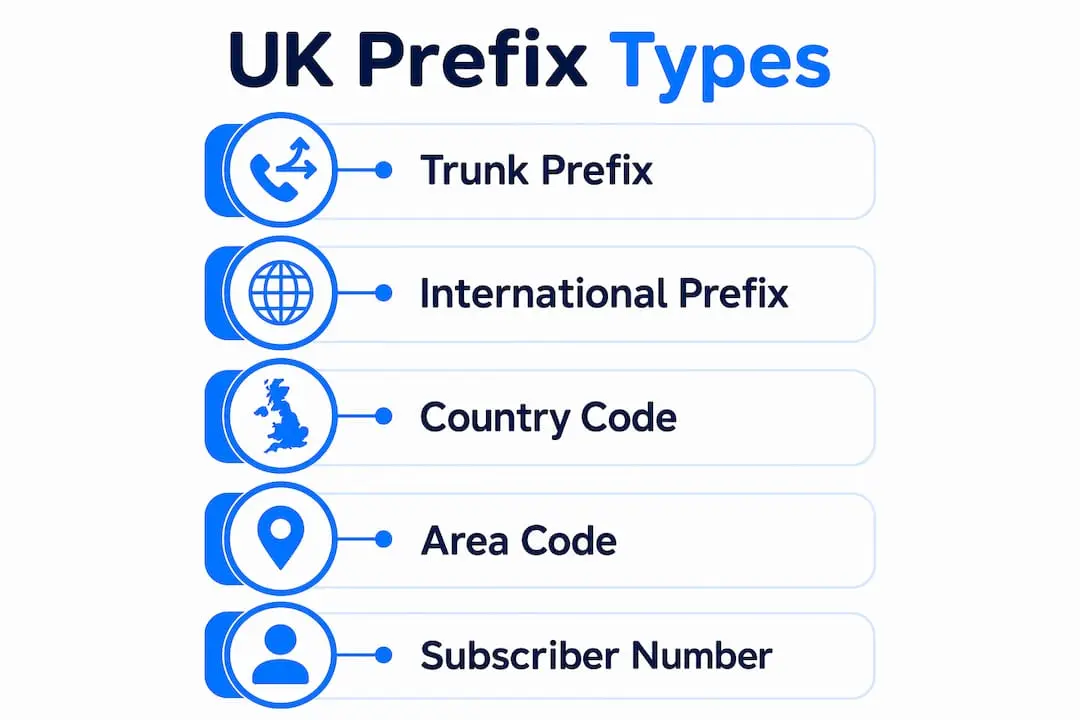
The trunk prefix in the UK is the digit “0.” You dial it before any area code when making a domestic call. It signals to the network that the call is national rather than local or international. The “0” is a routing instruction, not part of the subscriber’s actual address.
International prefix
The international prefix is the code you dial to exit the national network and connect to the international one. The UK uses “00,” which is also the globally recommended standard under ITU-T E.164. North America uses “011” instead, which shows that the code varies by country even though the function is identical.
Country code
A country code identifies the destination nation. The UK country code is +44. When you write a number in international format, you replace the trunk prefix “0” with “+44.” So the London number 020 7946 0000 becomes +44 20 7946 0000 in international format.
Area code and subscriber number
The area code identifies a geographic region or service type. The subscriber number is the final segment that identifies the individual line. Together, they form the national significant number.
A full UK number breaks down like this:
- 0 = trunk prefix (domestic dialling only)
- 20 = area code for London
- 7946 0000 = subscriber number
- +44 20 7946 0000 = full international format, trunk prefix removed
Pro Tip: When saving a number for international use, always store it in the +44 format. This works from any country without adjustment.
How does correct prefix use affect call routing?
Prefix errors cause real call failures. The most common mistake is including the trunk prefix “0” when dialling internationally. If you dial +44 020 7946 0000 instead of +44 20 7946 0000, the network receives an unexpected digit after the country code and the call fails or misdirects.
The “+” symbol prevents a different type of confusion. The ITU clarifies that “+” is a functional character, not a stylistic one. It represents whatever international exit code the caller’s local network requires, whether that is “00” in the UK or “011” in the US. A number written as +44 20 7946 0000 works from any country without the caller needing to know the local exit code.
For businesses, number formatting affects more than just call success. A number displayed incorrectly on a website or business card creates friction for international clients. The consequences of prefix misuse include:
- Failed inbound calls from overseas customers
- Incorrect number storage in CRM systems
- Confusion for clients dialling from mobile devices abroad
- Reduced trust in the professionalism of your contact details
Pro Tip: Display all business numbers in both domestic format (020 7946 0000) and international format (+44 20 7946 0000) on your website. This removes any ambiguity for UK and overseas callers alike.
The E.164 standard also sets a hard limit of 15 digits for the complete international number. Any number exceeding this limit is non-compliant and may fail to route correctly on international networks.
What role do telephone prefixes play in UK business branding?
Telephone prefixes have become a branding tool as much as a technical one. Area codes now function primarily as service identifiers rather than physical routing codes. A business with a 020 London number signals a London presence to customers, regardless of where the business actually operates.
Modern VoIP and cloud telephony have fully decoupled numbers from geography. A business based in Leeds can hold a 020 London number and receive calls on it anywhere. This gives businesses precise control over the geographic identity their phone number projects.
The strategic value of prefix choice breaks down into several clear benefits:
- Local trust: A number with a recognisable regional area code builds immediate credibility with local customers.
- National reach: An 01 or 02 landline prefix signals an established, professional business rather than a personal mobile.
- Brand recall: A memorable number sequence within a chosen prefix is easier for customers to remember and redial.
- Flexibility: With cloud telephony, the number travels with the business, not the physical location.
Phonenumbers specialises in UK memorable phone numbers across 01, 02, and 07 prefixes. You can search by area code, number sequence, or town, and the number works wherever your business operates.
Ofcom also reserves specific number ranges for non-commercial use. The range 07700 900000 to 07700 900999 is reserved for use in drama productions and media, preventing the public from accidentally calling real individuals when a fictional number appears on-screen. This shows that prefix allocation is actively managed at a regulatory level, not left to chance.
What common confusions surround telephone prefixes?
Several persistent misunderstandings trip up both individuals and businesses when dealing with prefixes.
-
Trunk prefix versus area code. The trunk prefix “0” and the area code are separate elements. The “0” is a routing signal that disappears in international format. The area code, such as “20” for London or “161” for Manchester, stays in place in both domestic and international formats.
-
Vertical service codes are not routing prefixes. Codes beginning with * or # are vertical service codes that control telephony features such as call forwarding or voicemail. They interact with the network’s signalling layer, not the routing layer. Dialling *67 does not route a call to a destination; it modifies how the call behaves.
-
The “+” sign is not optional. Some businesses display numbers as 0044 20 7946 0000 rather than +44 20 7946 0000. Both are technically correct, but the “+” format is universally recognised by mobile devices and VoIP systems and is the preferred format under ITU guidelines.
-
Area codes are not fixed to physical infrastructure. The UK numbering plan has evolved so that geographic prefixes no longer require physical presence in that area. A business can hold any regional number regardless of location.
-
Reserved ranges exist for good reason. Using a number from a reserved Ofcom range for commercial purposes is not permitted. Always verify that a number falls within a commercially available range before using it for business.
Pro Tip: When formatting numbers for international audiences, use the E.164 standard: +[country code][area code][subscriber number], with no spaces, brackets, or hyphens. This format is machine-readable and works across all telephony systems.
Key takeaways
A telephone prefix is the routing code at the start of any phone number, and correct prefix use is the difference between a call that connects and one that fails.
| Point | Details |
|---|---|
| Trunk prefix “0” | Dial before area codes for domestic UK calls; drop it when using international format. |
| International prefix “00” | The UK exit code for international calls; replaced by “+” in stored number formats. |
| E.164 standard | Limits total international number length to 15 digits, covering country code, area code, and subscriber number. |
| Area codes as branding | Businesses can hold any UK area code regardless of physical location, thanks to VoIP and cloud telephony. |
| Reserved Ofcom ranges | Ranges such as 07700 900000–07700 900999 are set aside for media use and cannot be used commercially. |
Why prefix choice matters more than most businesses realise
I have seen businesses spend thousands on marketing materials only to print a phone number in the wrong format. An international client dials +44 020 7946 0000, the call fails, and the sale is lost. The fix takes ten seconds. The damage to the relationship takes much longer to repair.
The deeper point is that a telephone prefix is not just a technical formality. It is the first thing a customer reads when they see your contact details. A 020 or 0161 number tells them you are an established business with a fixed presence. A well-chosen memorable number within that prefix tells them you take your brand seriously. A number stored in the wrong format tells them neither.
The shift to VoIP has made this more interesting, not less. Businesses now have genuine freedom to choose any UK prefix that fits their brand positioning. A national business can hold a London 020 number, a Manchester 0161 number, or both, and route calls to the same team. That flexibility did not exist a decade ago.
My advice to any UK business reviewing its contact strategy: start with the prefix, then choose the number. The prefix sets the geographic and professional signal. The number sequence within it determines how memorable it is. Get both right, and your phone number becomes a genuine brand asset rather than an afterthought.
— Rob
The right UK number starts with the right prefix
Choosing a telephone number for your business is a branding decision, not just a practical one. The prefix you select signals your geographic reach, your professionalism, and your ambition.
Phonenumbers offers a searchable database of memorable UK landline numbers across 01 and 02 area codes, as well as 07 mobile numbers. Numbers like 01132 777999 combine a recognisable Leeds area code with a sequence that sticks in the memory. You can search by area code, town, or number pattern, and because numbers are no longer tied to physical locations, you can use any number anywhere in the UK. Visit Phonenumbers to find a number that works as hard as the rest of your brand.
FAQ
What is a telephone prefix?
A telephone prefix is a digit or sequence of digits placed before the main subscriber number in a phone number. It routes the call through national or international networks according to the ITU-T E.164 numbering standard.
What is the difference between a trunk prefix and an area code?
The trunk prefix “0” is a routing signal used in domestic dialling and is dropped in international format. The area code, such as 020 for London, identifies the geographic or service region and remains in both domestic and international formats.
Why do I remove the “0” when dialling a UK number internationally?
Including the trunk prefix “0” after the country code +44 causes call failures because the network expects only the national subscriber number after the country code. The correct format is +44 20 7946 0000, not +44 020 7946 0000.
What does the “+” symbol mean in a phone number?
The “+” symbol represents the international exit code required by the caller’s local network, such as “00” in the UK or “011” in the US. It allows the same number to work from any country without the caller needing to know the local exit code.
Can a UK business use any area code prefix regardless of location?
Yes. Modern VoIP and cloud telephony have decoupled numbers from physical geography. A business can hold a 020 London number or a 0161 Manchester number and operate from anywhere in the UK, as Ofcom’s current numbering plan permits this flexibility.