
TL;DR:
- An identity phone number serves as a digital anchor, verifying and linking your online and real-world identities. Managing these numbers through role discipline—using separate lines for personal, business, and recovery purposes—maximizes security and brand trust. Protecting against threats like SIM swapping and account exploits is essential for both individuals and UK businesses to safeguard their digital assets.
An identity phone number is a phone number used to verify and link your digital and real-world identity across platforms, services, and accounts. It goes far beyond a contact detail. Your phone number now functions as a digital master key connecting your banking, social media, email recovery, and business communications in a single string of digits. For UK individuals and business owners, understanding this shift is no longer optional. The consequences of mismanaging an identity phone number range from account lockouts to full identity theft.
What is an identity phone number and how does it work?
The industry term for this concept is a digital identity anchor. An identity phone number is the specific number you register with services to prove you are who you claim to be. When you sign up for a bank account, a Google Workspace, or a government portal, that number becomes your verification credential, your recovery route, and often your primary login method simultaneously.
Phone numbers were not originally designed as secure identifiers. They were built for voice calls. Yet phone numbers are now the primary login and recovery method for hundreds of services, from WhatsApp to HMRC’s online tax portal. This evolution happened without most users noticing, and it created a significant security gap.
The purpose of an identity phone number is threefold. It confirms you own a device at the point of registration. It acts as a second factor when you log in. And it serves as the recovery route if you lose access to your account. That triple function is what makes it so powerful and so worth protecting.
How identity verification phone numbers work in practice
Modern identity verification phone numbers rely on several technical mechanisms working together. Understanding these helps you choose the right verification method for your own accounts or your business’s onboarding process.
The most common methods include:
- One-time passcodes (OTPs): A code sent via SMS or voice call that expires within minutes. Modern security standards favour 6-digit OTP codes, which offer up to 1,000,000 combinations compared to just 10,000 for 4-digit codes. That difference makes brute-force attacks significantly harder.
- Number verification APIs: Services such as Telefonica’s Open Gateway use real-time mobile operator data to confirm a number is active and matches the registered SIM, without sending any code at all. This method reduces fraud more effectively than SMS OTP alone.
- Silent network authentication: The verification happens entirely in the background by querying the mobile network, removing the risk of OTP interception.
- Missed call verification: A call is placed to the number and immediately disconnected. The user’s device logs the call, confirming possession without requiring any user input.
Each method sits on a spectrum from convenient to secure. SMS OTP is the most widely used but the most vulnerable. Network-based verification APIs are the strongest but require technical integration, making them more common in banking and fintech than in small business tools.
Pro Tip: If you run a UK business that collects customer phone numbers at registration, require real-time OTP verification rather than just asking users to type a number. This single step filters out fake registrations and protects your customer database from the start.
What are the risks of using a phone number as your identity?
Phone numbers carry risks that most people underestimate. The core problem is that a number alone rarely enables a hack, but it acts as a gateway to broader data aggregation that enables sophisticated attacks. Once an attacker has your number, they can begin building a profile.
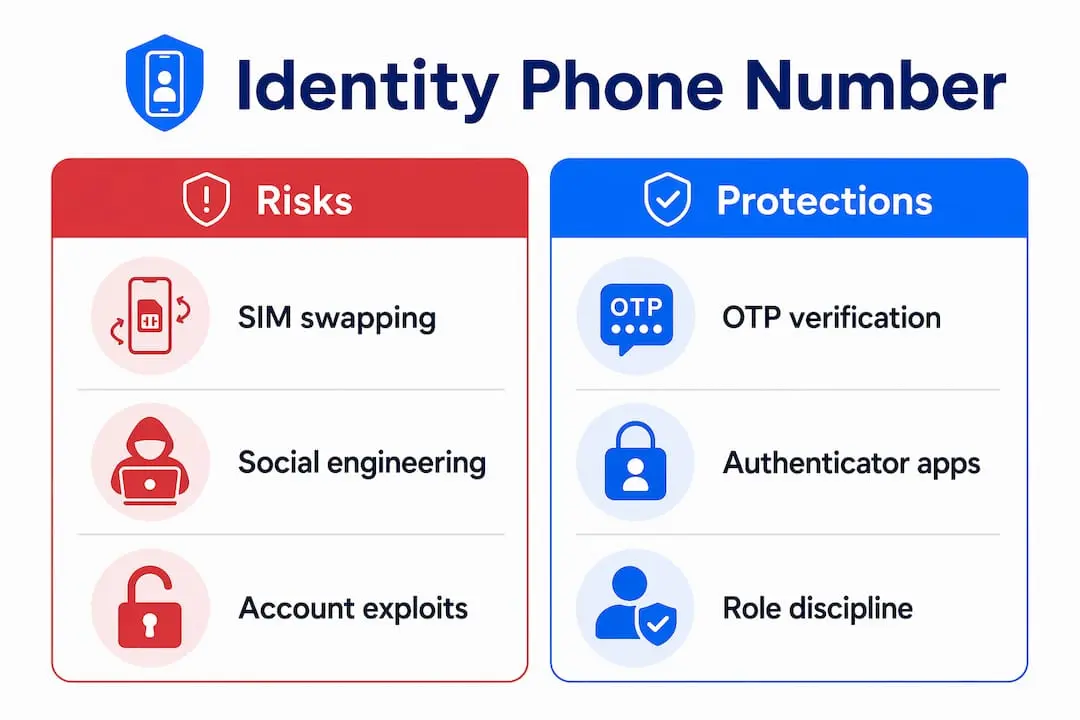
The three most significant threats are SIM swapping, social engineering, and account recovery exploits.
SIM swapping involves a fraudster contacting your mobile carrier, impersonating you, and convincing them to transfer your number to a new SIM card. Once successful, every OTP and recovery code sent to your number goes directly to the attacker. They can then reset passwords for your email, banking apps, and social media accounts within minutes.
Social engineering targets the human layer rather than the technical one. Attackers pose as bank staff, HMRC representatives, or tech support agents to extract your number or the codes sent to it. This tactic requires no technical skill and succeeds regularly because it exploits trust rather than systems.
Account recovery exploits take advantage of the fact that most platforms treat your phone number as proof of identity. If an attacker can receive your recovery SMS, they own your account regardless of how strong your password is.
“Your phone number is now the skeleton key to your digital life. Lose control of it and you lose control of everything attached to it.” This is not an exaggeration. Data brokers actively trade phone numbers alongside names, addresses, and employment history, making your number a prime target for cybercriminals and commercial data aggregators alike.
For UK businesses, the stakes are higher still. A compromised business number can redirect customer calls, intercept verification codes for company accounts, and damage the trust you have built with clients.
How to manage and protect your identity phone number
Protecting your identity phone number requires a deliberate approach to how you assign and use different numbers. The principle is called role discipline, and it is the single most effective strategy available to both individuals and businesses.
Role discipline means using separate numbers for separate purposes so that no single number links all your accounts and activities together. Here is how to implement it practically:
- Primary personal number: Use this for calls and messages with people you know. Do not register it with apps, loyalty schemes, or online retailers.
- Account recovery number: This is the number linked to your most critical accounts such as email and banking. Keep it on a separate SIM, ideally not your primary device. Apple’s support guidance specifically recommends maintaining a trusted recovery number unlinked to your main phone to retain account access if your primary device is lost or stolen.
- Business-facing number: The number your customers, suppliers, and partners call. This should be a dedicated line, ideally a memorable UK number that reinforces your brand. Read more about protecting business numbers from fraud in the UK context.
- Disposable or registration number: Use a secondary number for app sign-ups, online forms, and services you do not fully trust. This prevents your primary number from appearing in data broker databases.
- Internal communication number: For businesses with teams, keep internal coordination on a separate line from your public-facing number.
Pro Tip: Never use your business’s public-facing number as the recovery contact for your company’s Google Workspace, Microsoft 365, or banking portal. If that number is ever ported or compromised, attackers gain access to your entire business infrastructure.
Beyond role discipline, use authenticator apps such as Google Authenticator or Microsoft Authenticator as your second factor wherever possible. These are not tied to your phone number and cannot be intercepted via SIM swap.
The role of identity phone numbers in UK business branding
For UK businesses, an identity phone number serves two distinct functions: security and brand identity. These are not separate concerns. They reinforce each other when managed correctly.
Custom and memorable phone numbers build brand recognition and customer trust in business communications. A number like 0113 255 0000 is easier to recall from a van livery or radio advert than a randomly assigned mobile number. That recall translates directly into inbound calls and customer confidence.
The table below compares the key differences between a generic assigned number and a custom identity phone number for business use:
| Feature | Generic assigned number | Custom identity phone number |
|---|---|---|
| Brand recall | Low. Customers rarely remember it. | High. Designed to be memorable and shareable. |
| Fraud risk | Higher if publicly listed without protection. | Manageable with dedicated verification and monitoring. |
| Customer trust | Neutral. No signal of professionalism. | Positive. Signals an established, credible business. |
| Portability | Tied to a carrier by default. | Can be used anywhere in the UK regardless of location. |
| Verification use | Shared with personal accounts in many cases. | Kept separate from recovery and internal lines. |
UK businesses also have a legal and reputational incentive to verify customer phone numbers at the point of onboarding. Mandatory OTP verification at registration reduces identity fraud and maintains the integrity of your customer database. A database full of fake or mistyped numbers is a liability, not an asset.
The rise of mobile numbers in business has also changed customer expectations. Clients now expect to reach businesses via a consistent, recognisable number whether they are calling, receiving a verification code, or checking a missed call. Separating your public-facing number from your internal and recovery lines is not just good security practice. It is good business practice. For a deeper look at why multiple numbers benefit UK businesses, the case for using multiple numbers in 2026 is well established.
Key takeaways
An identity phone number functions as a digital identity anchor, and managing it with role discipline is the most effective way to protect both personal and business accounts.
| Point | Details |
|---|---|
| Definition of identity phone number | A number used to verify and link your digital identity across platforms, accounts, and services. |
| Verification methods vary in strength | Network-based APIs offer stronger fraud protection than SMS OTP alone. |
| SIM swapping is the primary threat | Attackers can take over all accounts linked to a number by porting it to a new SIM. |
| Role discipline reduces exposure | Use separate numbers for recovery, business, personal, and disposable purposes. |
| Custom numbers build business trust | Memorable UK numbers improve brand recall and signal professionalism to customers. |
Why most people are still getting this wrong
I have spent years watching both individuals and business owners treat their phone number as an afterthought. They pick one number, register it everywhere, and assume the problem belongs to someone else. It does not.
The uncomfortable truth is that phone numbers were never built to carry this much identity weight. The telecom infrastructure underpinning UK mobile networks was designed for voice calls in the 1980s, not for authenticating access to cloud banking in 2026. We have layered enormous trust on top of a system that was not engineered for it.
What I find most overlooked is the recovery number problem. Most people set up a recovery number once and never revisit it. That number might belong to an old SIM, a number you no longer own, or a device that has been lost. When you actually need it, it fails. Apple’s guidance on trusted recovery numbers exists for a reason, and almost nobody follows it.
The other thing I would push back on is the idea that only large businesses need to worry about this. A sole trader in Leeds with a single mobile number registered to their banking, their accounting software, their email, and their client WhatsApp group is carrying enormous risk on a single point of failure. Role discipline is not a corporate security policy. It is basic hygiene for anyone operating in the UK digital economy.
The good news is that the solutions are not expensive or technically complex. A second SIM, a memorable business number, and an authenticator app cover most of the risk. The barrier is awareness, not cost.
— Rob
Find the right number for your business identity
Phonenumbers is the UK’s leading provider of memorable 01, 02, and 07 numbers. Whether you need a public-facing business number that customers will actually remember, or a dedicated line to separate your brand identity from your personal accounts, the Phonenumbers database lets you search by number sequence, area code, or town. Numbers are no longer tied to local areas, so a memorable Leeds number like 0113 255 0000 works just as well for a Manchester business as a Yorkshire one. Browse options including 0113 273 2222 and 0115 928 8888 to find a number that builds your brand and keeps your identity lines clean.
FAQ
What is the purpose of an identity phone number?
An identity phone number verifies that you own a specific device or account and acts as a recovery route if you lose access. It links your real-world identity to your digital accounts across banking, social media, and business platforms.
How does identity verification by phone number work?
Verification works by sending a one-time passcode to your number or by querying mobile operator network data in real time to confirm the number is active and matches the registered SIM. Network-based verification is more secure than SMS OTP alone.
What are the identity phone number benefits for UK businesses?
A dedicated business identity number builds brand recognition, filters fake registrations through OTP verification, and separates your public-facing line from sensitive internal and recovery accounts, reducing fraud risk significantly.
Can someone hack my accounts just by knowing my phone number?
Your number alone rarely enables a direct hack, but it acts as a gateway to data aggregation and SIM swapping attacks that can give attackers access to every account linked to that number.
What is role discipline for phone numbers?
Role discipline means using separate numbers for different purposes: one for business, one for account recovery, one for personal use, and one for disposable registrations. This prevents any single compromise from exposing all your accounts at once.