
TL;DR:
- A number portability workflow involves five key steps: CSR retrieval, LOA completion, LSR submission, FOC receipt, and executing the cutover. Automation via APIs significantly reduces errors, ensuring a smooth transition and minimizing port rejections caused by data mismatches. Accurate documentation, adequate lead time, and pre-staged services are essential for a successful and disruption-free porting process.
A number portability workflow is the defined sequence of administrative and technical steps that allows businesses to retain their telephone numbers when switching providers. The process spans five core stages: gathering the Customer Service Record (CSR), completing a Letter of Authorisation (LOA), submitting a Local Service Request (LSR), receiving a Firm Order Commitment (FOC), and executing the cutover. Ofcom regulations govern the process in the UK, and modern porting process automation via APIs has significantly reduced manual errors. Getting each stage right is what separates a smooth transition from a costly service outage.
What are the key steps in the number portability workflow?
The industry-standard workflow follows five sequential stages, and skipping or rushing any one of them is the most reliable way to trigger a rejection. Here is how each stage works in practice.
-
Request the Customer Service Record (CSR). Contact the losing carrier and request the official CSR for every number you intend to port. The CSR contains the authoritative billing name, service address, and Billing Telephone Number (BTN). These details must appear verbatim on your LOA. Never rely on what a client tells you from memory.
-
Complete the Letter of Authorisation (LOA). The LOA is the customer’s signed permission for the gaining carrier to initiate the port. Copy data directly from the CSR. A single character difference in the billing name or postcode will cause a rejection.
-
Submit the Local Service Request (LSR). The gaining carrier submits the LSR to the losing carrier, along with all validated documentation. Both carriers must agree on the details before the process advances.
-
Receive the Firm Order Commitment (FOC). The losing carrier issues an FOC confirming the agreed cutover date and time. Ports are typically scheduled 4–10 business days after the FOC is received. This is your confirmed window for planning the transition.
-
Execute the cutover and test. On the agreed date, the number transfers to the gaining carrier. Immediately test inbound and outbound calls, and verify that all post-port features such as voicemail and call forwarding are functioning correctly.
Pro Tip: Always request the CSR before you touch the LOA. Copying data verbatim from the official record prevents the document mismatches that cause the majority of port rejections.
How do automation and apis improve the porting process?
Modern carrier workflows have shifted to automated processes using REST and SOAP APIs, replacing the spreadsheet-heavy manual systems that dominated the industry a decade ago. The shift matters because automation removes the human error that sits at the root of most port failures.
Key benefits of porting process automation include:
- LSR submission via API. Carriers interface directly with clearinghouses such as NPAC and iconectiv to submit and track LSRs in real time, eliminating manual data entry at each handoff.
- State-machine workflow management. Each port is managed as a defined state machine, moving automatically through stages such as submitted, validated, FOC received, and cutover complete. No stage can be skipped.
- Automated routing updates. Post-port, systems like Oracle Number Portability and PortaOne automatically update ENUM and NAPTR routing databases. This removes the delay between port completion and live call routing.
- Error detection before submission. Automated validation checks flag mismatches between the LOA and CSR data before the LSR is submitted, catching problems that would otherwise result in a rejection.
- Scalability for enterprise migrations. API-driven carrier workflows enable high-volume customer migrations without service interruptions, which is critical for enterprise clients porting dozens of numbers simultaneously.
Pro Tip: Set up automated status monitoring for every active port request. Systems that push alerts when a port stalls at validation or FOC stage allow you to intervene before the delay becomes a disruption.
What causes port rejections and how do you avoid them?

Mismatched billing names, service addresses, or BTNs versus the losing carrier’s records are the leading cause of port rejections. This single issue accounts for the majority of failed first submissions across UK business ports. The fix is straightforward but demands discipline.
The table below maps the most common rejection causes to their practical solutions.
| Rejection Cause | Solution |
|---|---|
| Billing name mismatch | Copy the name exactly from the CSR, including punctuation and abbreviations |
| Incorrect service address | Verify against the CSR, not the customer’s verbal account |
| Wrong Billing Telephone Number | Confirm the BTN from the official CSR, not the number being ported |
| Premature service cancellation | Keep the old service active until port completion is confirmed |
| Insufficient lead time | Set the port-in date at least three weeks ahead to allow for corrections |
Premature service cancellation is a particularly damaging error. Terminating the account early releases the number back into the losing carrier’s pool, making it impossible to port. Once that happens, the number is gone. There is no recovery process.
Setting a port-in date at least three weeks in advance gives you the buffer needed to handle a rejection, resubmit corrected documentation, and still meet your client’s deadline without disruption. Tight timelines are the second most common reason ports fail after document mismatches.
Pro Tip: Build a pre-submission checklist that cross-references every LOA field against the CSR line by line. Run this check before every submission, regardless of how straightforward the port appears.
What best practices ensure a smooth cutover?
Pre-staging is the single most effective way to eliminate downtime during cutover. Managing cutover with pre-staged services including extensions, voicemail, and call routing configured in advance means the transition is invisible to end users.
Follow these steps to protect service continuity:
- Configure all new service settings, call flows, IVR menus, and voicemail greetings on the gaining carrier’s platform before the cutover date.
- Confirm the FOC date and time with both the client and the gaining carrier at least 48 hours in advance.
- Schedule the cutover during a low-traffic period, typically early morning or at the weekend, to minimise the impact of any brief interruption.
- Test inbound and outbound calls immediately after cutover. Verify every number in the ported group, not just the primary line.
- Update routing records immediately after port completion. Failure to update routing tables causes intermittent inbound call failures that are difficult to diagnose after the fact.
- Keep the old service active until all tests pass and the client confirms full functionality. Only then should you initiate cancellation of the previous account.
- Notify clients of the exact cutover window and what to expect. A brief period of call unavailability is normal. Clients who are not warned will raise unnecessary support tickets.
How does the workflow differ for business vs mobile numbers?
The mobile number transfer workflow and the business landline process share the same core stages but differ significantly in timeline and complexity. Understanding these differences helps you set accurate expectations with clients.
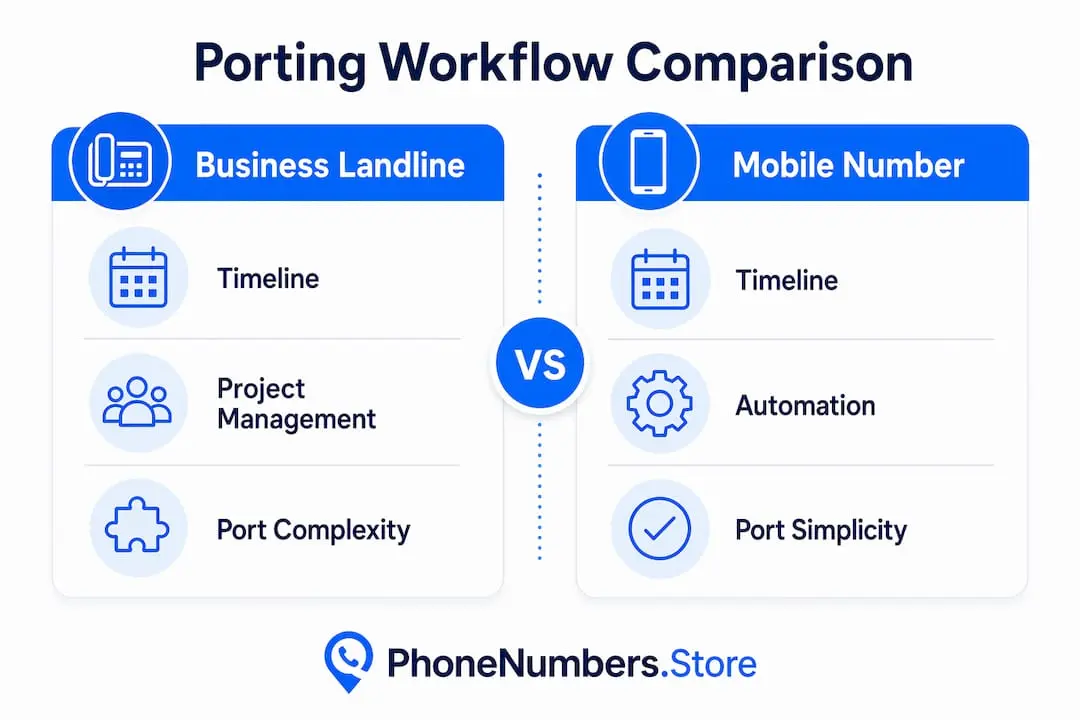
| Aspect | Business Landline Port | Mobile Number Port |
|---|---|---|
| Typical timeline | 7–14 business days in practice | Often 1–3 working days for standard consumer ports |
| Key document required | CSR, LOA, recent bill | PAC or STAC code from current provider |
| Primary rejection risk | Document mismatch on LOA | Incorrect PAC code or expired authorisation |
| Enterprise complexity | High: multi-site, DDI ranges, project management required | Lower for individual numbers; higher for corporate SIM estates |
| Routing update method | ENUM/NAPTR database update via carrier | Handled automatically by mobile network operators |
| Regulatory oversight | Ofcom General Conditions | Ofcom General Conditions, with specific mobile porting rules |
Business landline ports, particularly those involving multiple DDI ranges across several sites, require project management discipline. Each number group may have its own CSR and LOA, and the cutover must be coordinated across locations simultaneously. For enterprise clients, assigning a dedicated port coordinator is standard practice, not optional. The UK number portability rules for business numbers also carry specific compliance obligations that do not apply to standard consumer mobile ports.
Key takeaways
A well-executed number portability workflow depends on accurate documentation, realistic timelines, and automated routing updates at every stage.
| Point | Details |
|---|---|
| CSR accuracy is non-negotiable | Always copy LOA data verbatim from the official CSR to prevent rejections. |
| Build in three weeks of lead time | Setting the port-in date three weeks ahead allows corrections without client disruption. |
| Automate routing updates post-port | Failing to update ENUM and NAPTR records immediately causes inbound call failures. |
| Never cancel old service early | Premature cancellation releases the number permanently and cannot be reversed. |
| Business ports take longer than mobile | Landline ports typically take 7–14 days; mobile ports often complete in 1–3 working days. |
What i have learned running number ports for UK businesses
The documentation discipline required for a clean port is something most teams underestimate until their first rejection. In my experience, the CSR retrieval step is where the majority of problems originate. Clients routinely provide billing names that differ from what the losing carrier holds on record, sometimes by a single character or a trading name variation. Retrieving the CSR first and treating it as the single source of truth removes that risk entirely.
Automation has changed the game for volume porting. Teams that still manage ports via spreadsheets and manual email chains are carrying unnecessary risk. The state-machine approach used by platforms such as PortaOne and Oracle Number Portability does not just save time. It enforces process compliance at every stage, which is exactly what you need when managing enterprise migrations.
The advice I give every telecom manager I work with is this: set your port date three weeks out, pre-stage everything before the FOC arrives, and do not touch the old service until your client has confirmed calls are working. The LNP dip and routing table update are technical steps that happen in the background, but they are the difference between a clean cutover and a morning of missed calls. Treat them as critical, not administrative.
— Rob
Find the right number before you port
If your client is moving to a new provider and wants a memorable number to go with it, Phonenumbers has the UK’s leading selection of 01, 02, and 07 numbers available to buy or rent. Numbers are no longer tied to local areas, so a Leeds 0113 number works just as well from Manchester or London.
Browse the Phonenumbers database by area code, town, or number sequence to find the right fit before the porting process begins. A memorable number paired with a clean port is the strongest possible start for any business telecoms transition. Explore options like this memorable Leeds number or this Nottingham business number to see what is available right now.
FAQ
What is a number portability workflow?
A number portability workflow is the end-to-end sequence of steps required to transfer a telephone number from one provider to another. The core stages are CSR retrieval, LOA completion, LSR submission, FOC receipt, and cutover.
How long does a business number port take in the UK?
Business number ports typically take 7–14 business days in practice, even though simple ports can theoretically complete within one business day under regulatory standards.
What is the most common reason a port gets rejected?
Document mismatches are the leading cause of port rejections. Billing names, service addresses, or BTNs that differ from the losing carrier’s records will trigger an automatic rejection.
Can i cancel my old service once i submit the port request?
No. Cancelling your old service before the port completes releases the number back into the provider’s pool permanently. Keep the old account active until full testing confirms the port is successful.
How does mobile number porting differ from business landline porting?
Mobile ports use a PAC or STAC code rather than a CSR and LOA, and they typically complete within 1–3 working days. Business landline ports involve more documentation and coordination, particularly for multi-site enterprise accounts.