Most slow ports come down to a missing or mismatched PAC, wrong account details, or a hold-up at the provider you are leaving. Ofcom says a mobile port should normally finish within one working day of the new provider receiving your PAC. Landlines and multi-line orders take longer. Confirm your PAC is valid and ring the gaining provider today.
TL;DR:
- A PAC remains valid for 30 days; providers must issue it immediately by phone or within two working days after an online or text request.
- Match the account holder’s name, address, and postcode to the losing provider’s bill, then ask the gaining provider for the exact rejection code.
- Requests for 2 to 24 numbers must be submitted online or by phone, and one failed line can delay the whole batch.
- If a switch leaves you without service for more than one working day, request compensation in writing; payment is normally due within 30 calendar days.
- Keep the old service active until the port is confirmed, because early cancellation can trigger a no active service rejection and may cost you the number.
Table of Contents
- What is a normal porting timeline for mobile and landline numbers?
- Why do ports get stuck, and what do the rejection codes mean?
- How does the porting process work from PAC to activation?
- What can you check right now to move a stuck port forward?
- When should you escalate, and what compensation can you claim?
- Why do landline, multi-line and legacy ports take longer?
- What happens on port day?
- How do number portability rules affect memorable and non-geographic numbers?
- How do you verify a number is eligible to port?
- What part do the losing and gaining providers play in delays?
- How does porting affect your contract or service commitments?
- Our view: how we reduce porting friction
- Need help now? Search, buy or rent a memorable UK number
- FAQ
- Sources
What is a normal porting timeline for mobile and landline numbers?
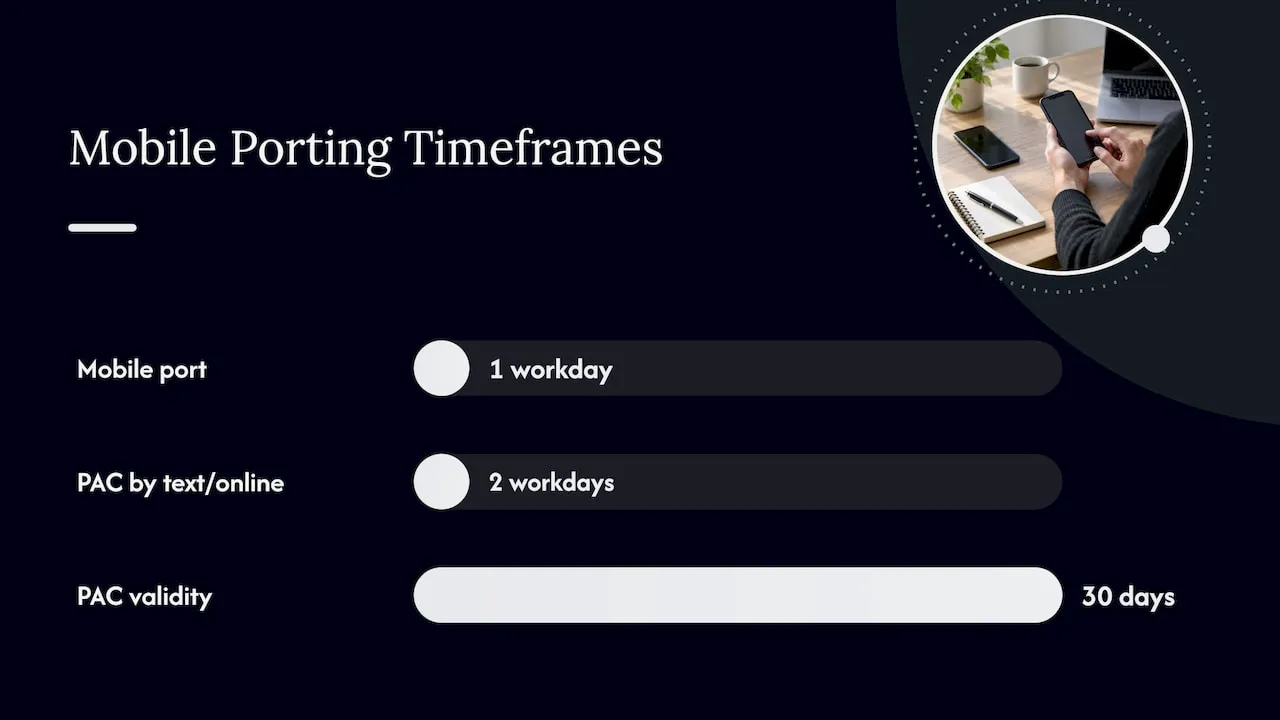
For a standard mobile number, the clock starts when your new provider has your Porting Authorisation Code (PAC). Ofcom’s guidance says the port is typically completed within one working day after that point, and a PAC stays valid for 30 days. You can request one by texting PAC to 65075. If your port started and nothing has moved for several days, something other than normal processing is probably holding it up.
Getting the PAC itself should be quick. Ofcom says a provider must hand it over immediately on a phone call, or within two working days if you ask online or by text. Slow delivery of the code is one of the most common reasons the whole timeline slips before the order even exists.
Business and landline numbers can run on a different rhythm. Timing varies by supplier, so ask yours for a firm date in writing.
Several factors stretch a timeline further:
- Multi-line orders, where every number has to validate cleanly before the batch moves
- Engineer visits or hardware changes tied to a landline move
- Legacy PSTN migrations, where older systems process orders more slowly
- International ports, which involve carriers outside the UK process
If yours falls into one of those groups, a longer wait is normal. If it is a single mobile number with a PAC in hand, a long wait is not.
Why do ports get stuck, and what do the rejection codes mean?
Most stuck ports are administrative, not technical. The order reaches the central validation stage, something on it fails to match the losing provider’s records, and it bounces back. You then wait for someone to read the rejection, correct it and resubmit.
PAC problems. Providers vary in how they issue codes, and Ofcom’s own consultation notes variability in PAC issuance methods and timelines between them. Some providers also attempt to retain you when you ask for a code, which adds days.
Data mismatches. The name, address or postcode on your order must match what the losing provider holds. A tenant’s name instead of the account holder’s, or an old postcode, is enough to trigger a rejection. The BT and OTA rejection guidance recommends checking the losing provider’s bill and using pre-order validation to cut resubmissions.
Order-level errors. Industry code tables include rejections for a missing requested porting date or time, a number that has already been exported, and orders that timed out by the end of day two. Incomplete DDI ranges on multi-number business lines are another frequent cause.
Installation and security constraints. Some lines need an engineer to complete the move, which can affect the order.
The codes you are most likely to see, from the BT and OTA guidance:
- C41: the postcode on the order is incorrect
- C44: the DDI range is incomplete
- C31: the losing provider shows no active service on that number
Ask your new provider for the exact code, not a summary. The code tells you which detail to fix, and it saves another round of guessing.
How does the porting process work from PAC to activation?
Knowing the sequence helps you spot where yours has stalled.
- Request the PAC. Ask your current provider by text, online or by phone. For mobile, you can request a PAC by texting PAC to 65075, and the code arrives with an expiry date.
- Give the PAC to the new provider. They need it along with your number and the account details exactly as the losing provider holds them.
- The gaining provider places the order. It goes through the industry validation systems, where the number, account details and requested date are checked against the losing provider’s records.
- A port date is scheduled. If validation passes, the order is confirmed for a date. If it fails, you get a rejection and the cycle restarts after the fix.
- The number moves. On the day, the number is switched across and your new service goes live.
Ofcom’s reforms introduced Auto-Switch and set special rules for accounts with several numbers. Under those rules, requests for 2 to 24 numbers must be made online or by phone instead of by text, which is why batch ports follow a different submission route from single ones. Industry proposals suggest automation and hub-based switching can bring minimum lead times down to the next working day, but older processes still run alongside the new ones, so some orders keep taking the slower path.
Delays usually surface at step 3, where mismatched data gets caught, or at step 1, where the PAC never arrives.
What can you check right now to move a stuck port forward?
Work through these in order. Each one removes a common cause.
- Confirm the PAC exists and has not expired. It lasts 30 days. If you never received one, request it again and note the method and timescale your provider promises.
- Check the gaining provider actually has it. A code sitting in your inbox does nothing until it is on the order.
- Compare your details with the losing provider’s bill. Match the account holder’s name, address and postcode exactly. If anything differs, correct it on the order.
- Ask for the rejection code or notification email. Write the code down and ask what specifically needs changing.
- Request an immediate resubmission once the fix is made. Do not wait for the next batch cycle if the provider can resubmit sooner.
- Ask for a complaint reference if rejections repeat. Say something like: “This is the third rejection on my port. Please log a formal complaint, give me a reference number and tell me when I will hear back.”
Pro Tip: If you or your provider has access to OTA pre-order validation, run the order through it before submitting. It catches mismatches before they become rejections.
Our own guide on what you need to transfer your number covers the documents and bill details worth having to hand before you start.
When should you escalate, and what compensation can you claim?
Escalate when a provider keeps rejecting without a clear fix, or when you have lost service. Ofcom’s rules require compensation if a switch leaves you without service for more than one working day. Payment should normally arrive within 30 calendar days of the delayed switch or missed appointment. Ask in writing, quote the dates, and keep copies.
Ofcom also protects your right to leave. Its ‘Right to Port’ protection means providers must not block or delay a port to stop you leaving. If you think you are being obstructed, ask for a complaint reference number.
That reference matters. Ofcom’s complaint process says a provider that stonewalls can face an independent investigation, and in persistent cases the industry panel can order the port to proceed if the losing provider is unfairly blocking it. Give formal resolution realistic time, since it runs on industry panel schedules, not a same-day clock. The sensible sequence is front-line support first, then a written complaint with a reference, then the panel route if the block continues.
Why do landline, multi-line and legacy ports take longer?
Landline moves bring physical work into a process that mobile ports handle entirely in software. Ofcom notes that landline switching may involve engineer visits or equipment changes, and your new provider should explain each step. Broadband routing changes can add to this when the voice service rides on the same line.
Legacy systems matter too. Numbers tied to the BT PSTN network pass through older ordering processes that sit alongside the newer automated ones, so timing depends on which route your order lands on. Nobody can promise the faster path for every line.
Batch orders and enterprise moves add validation steps. With 2 to 24 numbers, each one has to match records, and a single failed line can hold the group. Large DDI ranges need every number accounted for, which is exactly where the C44 incomplete-range rejection appears. If you run a business line, assume the longer end of any estimate and build in cover for calls during the move.
What happens on port day?
Port timing and any service interruption vary. Ask your provider what to expect during the scheduled move.
Your old SIM or line may keep working briefly before it stops. Once the port completes, test properly: call your number from another phone, send and receive a text, and check that calls reach the right handset.
If no confirmation arrives by the end of the scheduled window, contact your new provider at once and ask for the order status. Check that your PAC has not expired and ask whether the order was rejected overnight. If you rely on the number for work, our guide to staying reachable with virtual phone calls explains how to keep calls arriving during a migration.
How do number portability rules affect memorable and non-geographic numbers?
Portability rules cover more than ordinary mobile numbers, but the practical experience differs by number type. Memorable numbers port under the same framework as other numbers of their type. The pattern itself does not determine the porting route.
Non-geographic numbers may follow a different process from geographic numbers. Ask your provider which steps apply to your number and whether any additional checks are needed.
Because memorable numbers carry real value to a business, delays cost more than they would on a throwaway line. Hold the PAC or porting authority in writing, confirm the number is genuinely yours to port, and keep the current service live until the new one is confirmed. Our guide to choosing your own number and the porting steps walks through that in more detail.
How do you verify a number is eligible to port?
Start by identifying the number type, because the route depends on it. Mobile, geographic landline and non-geographic numbers may follow different processes. Ask your new provider whether it can accept your number type.
Next, confirm the number is active with the current provider. The C31 rejection means the losing provider shows no active service, so a number that has been ceased, suspended or already exported cannot port until that is resolved. Check the account is live and in your name or your company’s name.
Then check the account details. The name, address and postcode you give must match the losing provider’s records exactly. Your latest bill is the safest reference, and pre-order validation, where available, tests the match before you submit.
Finally, ask whether anything blocks the line: a security service, a special line type, or an unpaid balance a provider might use as a reason to resist. Some constraints are legitimate, such as a number that has already moved, and some are not. If a provider cites a reason that does not stand up, the complaint route above is there for exactly that.
What part do the losing and gaining providers play in delays?
Each provider owns a different part of the delay. The losing provider controls the PAC, the account records and any retention conversation. When it is slow to issue a code, or its records differ from what you supplied, the order stalls through no fault of the new provider. This is why Ofcom’s Right to Port protection exists: providers must not use these steps to hold on to you.
The gaining provider controls the order itself. It enters your details, picks the submission route, reads the rejection and resubmits. Careless data entry, a missed rejection email or a slow resubmission cycle all land on the gaining side.
In practice, the useful move is to work out which side is stuck. If you cannot get a PAC, the problem sits with the losing provider. If you have a PAC but the order keeps failing, the problem is probably in the match between the order and the losing provider’s records, and the gaining provider needs to fix and resubmit. Ask the gaining provider which side the delay is on, and ask for the rejection code in writing.
The OTA publishes a best practice guide, including a Number Porting Quick Start Guide, that helps providers and engineers follow consistent steps. A provider that follows it generally produces fewer rejections.
How does porting affect your contract or service commitments?
Porting a number and ending a contract are two separate things, and mixing them up causes avoidable surprises. Moving your number does not cancel your agreement with the old provider. If you are still within a minimum term, early termination charges may apply, so read your terms before you start.
Ofcom’s landline guidance says the old provider must not charge beyond the switchover date. That protects you from paying for service you have left, but it does not erase a commitment you signed for a fixed term. Check the end date and any notice period first.
Keep the old service running until the port is confirmed. If you cancel too early, the losing provider may close the account, and a closed account can trigger the C31 no-active-service rejection and cost you the number. For a business, overlapping the two services for a short period is cheaper than missing calls.
If a port drags on while you are paying for service you cannot properly use, keep records of the dates and any outage. Those records support a compensation claim under Ofcom’s one working day rule.
Our view: how we reduce porting friction
Delays can be administrative, and reading the rejection code can help identify a fix. We check customer details against the losing provider’s records before an order goes in, watch the order through validation and advise on the PAC method that avoids the common rejections. A supported route saves you the cycle of rejection, correction and resubmission. If you want guided help, start with our transfer checklist.
— Rob
Need help now? Search, buy or rent a memorable UK number
We sell and rent memorable UK numbers, and our hosting and SIM options keep them portable. Search available numbers or contact us.
FAQ
How long does it take to port a number to EE?
Mobile ports to any network, EE included, should normally complete within one working day of the new provider receiving your PAC. Ofcom’s guidance sets that one-working-day expectation. If the PAC is missing or your details do not match, it takes longer.
How do I change my number?
You can ask your provider for a new number, or take a different one from a seller of numbers. If you want to keep your existing number on a new provider instead, you port it with a PAC. Memorable and business numbers can be searched and bought from specialist suppliers.
What are the disadvantages of porting a number?
Porting can bring a short outage on the day, and a landline move may need an engineer visit. Moving does not cancel a fixed-term contract, so early termination charges can still apply. If you cancel the old service too soon, the port can also fail.
What is a port in date?
It is the date the gaining provider schedules for your number to move to the new service. It is set once your order passes validation. If the order is rejected, the date is lost and a new one is booked after the fix.