
TL;DR:
- Outbound numbers are the phone numbers a business displays when initiating calls, and they impact trust and answer rates. Proper management requires screening against TPS and CTPS, verifying caller ID, and maintaining accurate records to stay compliant with UK regulations. Regular testing and documentation ensure effective outbound calling and protect your business from legal and technical issues.
Outbound numbers are the phone numbers a business uses to initiate calls to customers, prospects, or partners. They are distinct from inbound numbers, which receive calls, and they carry significant legal, technical, and reputational weight. For UK business owners, explaining outbound numbers properly means understanding three things: what the law requires, how caller identification works, and which metrics tell you whether your calls are actually landing. Get any one of these wrong, and your outbound calling strategy will cost you more than it earns.
What are outbound numbers and why do they matter?
An outbound number is the phone number that appears on a recipient’s screen when your business makes a call. In telecom terminology, this is governed by Calling Line Identification, or CLI. CLI is the technical standard that transmits your number to the receiving network before the call connects. The number displayed is not always the physical line you are calling from. Businesses often present a central switchboard number, a regional number, or a dedicated campaign number instead.

The distinction between outbound and inbound numbers matters more than most business owners realise. An inbound number is published for customers to call you. An outbound number is what you present when you call them. These can be the same number, but they do not have to be. Many UK businesses use separate outbound numbers for different teams or campaigns, which creates both flexibility and compliance obligations.
The importance of outbound numbers extends beyond simple identification. The number you display affects whether recipients answer, whether they trust you, and whether your calls are flagged as spam. A number that looks unfamiliar, non-geographic, or inconsistent with your brand will reduce answer rates and increase complaints.
What legal rules govern outbound calling in the UK?
UK outbound calling is regulated primarily by the Privacy and Electronic Communications Regulations 2003, known as PECR, alongside the UK GDPR. PECR sets the rules for live marketing calls and automated calls. Breaking these rules risks fines from the Information Commissioner’s Office, or ICO, of up to £500,000.
The key distinction in UK law is between who you are calling:
- Calls to individuals and sole traders are governed by the Telephone Preference Service, or TPS. Calling a TPS-registered number without prior consent is prohibited.
- Calls to limited companies, LLPs, and public bodies fall under the Corporate Telephone Preference Service, or CTPS. Cold calling incorporated businesses not on the CTPS register is legal, but calling CTPS-registered organisations without consent is not.
- Automated calls require explicit prior consent from the recipient, regardless of whether they are on TPS or CTPS.
The TPS register currently holds over 17 million UK numbers. That scale means any outbound campaign without proper screening is almost certain to breach the rules. You must screen your calling lists against both TPS and CTPS before any campaign begins, and then re-screen every 28 days because new numbers are added continuously.
UK GDPR adds another layer. If you are processing personal data to make outbound calls, you need a lawful basis for doing so. Legitimate interest is commonly used for B2B calls, but it requires a documented balancing test. Consent is required for most B2C marketing calls.
Pro Tip: Keep a written record of every TPS and CTPS screening exercise, including the date and the data provider used. The ICO expects this documentation during any enforcement investigation.
How does caller ID affect your outbound number presentation?
Caller ID is the single most misunderstood element of outbound calling for UK business owners. Most assume that whatever number they configure will appear cleanly on every recipient’s phone. The reality is more complicated.
Receiving carriers control caller ID display, querying their own databases or third-party CNAM (Caller Name) databases to match a number to a business name. These databases are often stale. Different networks may show entirely different caller names for the same number, depending on which database they query and when it was last updated. A number you registered under your trading name six months ago may still show an old name, a previous owner’s name, or nothing at all on certain networks.
Ofcom has moved to address the fraud risk this creates. Since 2023, UK networks have been required to identify and block invalid CLI. From 2025, calls presenting a UK mobile CLI but originating outside the UK are blocked. A full UK-wide CLI authentication scheme is being implemented in 2026. This means the days of presenting any number you choose are ending. Ofcom’s goal is to ensure the displayed number matches the actual calling party.
Presenting a consistent, real business switchboard number is legal. Caller ID spoofing is legal only when it presents a legitimate business number used consistently. Using a spoofed number to facilitate fraud or harassment is a criminal offence.
What affects how your outbound number appears?
Several factors determine what a recipient actually sees:
- CLI configuration at your telephony provider or PBX system
- CNAM database records, which vary by carrier and update at different speeds
- Spam filter algorithms used by mobile networks and handset manufacturers
- Geographic or non-geographic number type, which affects trust signals on the recipient’s device
Pro Tip: After updating your CNAM records, test your outbound number across at least three different UK networks before launching a campaign. Propagation delays mean caller name updates can take days to sync fully across carriers.
Protecting your business phone numbers from fraud starts with verifying that your CLI is correctly registered and consistently presented. Many businesses mistake carrier database inconsistencies for system errors. The fix is persistence with your provider and thorough cross-carrier testing.
What metrics should you track for outbound call campaigns?
Outbound call metrics tell you whether your numbers and your strategy are working. The most important metrics to monitor are:
- Call connection rate: the percentage of dialled numbers that result in a live answer. This is your baseline health indicator.
- Contact rate: the percentage of calls that reach the intended decision-maker. Contact rates on warm lists run at 28–38%, while cold lists typically achieve 12–18%.
- Complaint rate: the number of calls that generate a TPS complaint or spam report. A rising complaint rate signals a CLI or compliance problem.
- Conversion rate: the percentage of contacts that result in the desired outcome, whether that is a sale, a booked appointment, or a qualified lead.
- Call abandonment rate: relevant for automated or predictive dialling campaigns, where calls connect before an agent is available.
Data quality drives all of these metrics. Poor data leads to low connection rates. Accurate CLI presentation reduces complaints and increases engagement. A business calling from a number that looks legitimate and consistent will always outperform one calling from a generic or unrecognised number.
Tracking caller identity also supports ROI calculations. If you run multiple outbound campaigns from different numbers, you can attribute inbound callbacks and conversions to specific numbers. This tells you which campaigns and which number types are generating returns.
How can UK businesses get better results from outbound numbers?
Improving your outbound calling results comes down to five practical areas.
-
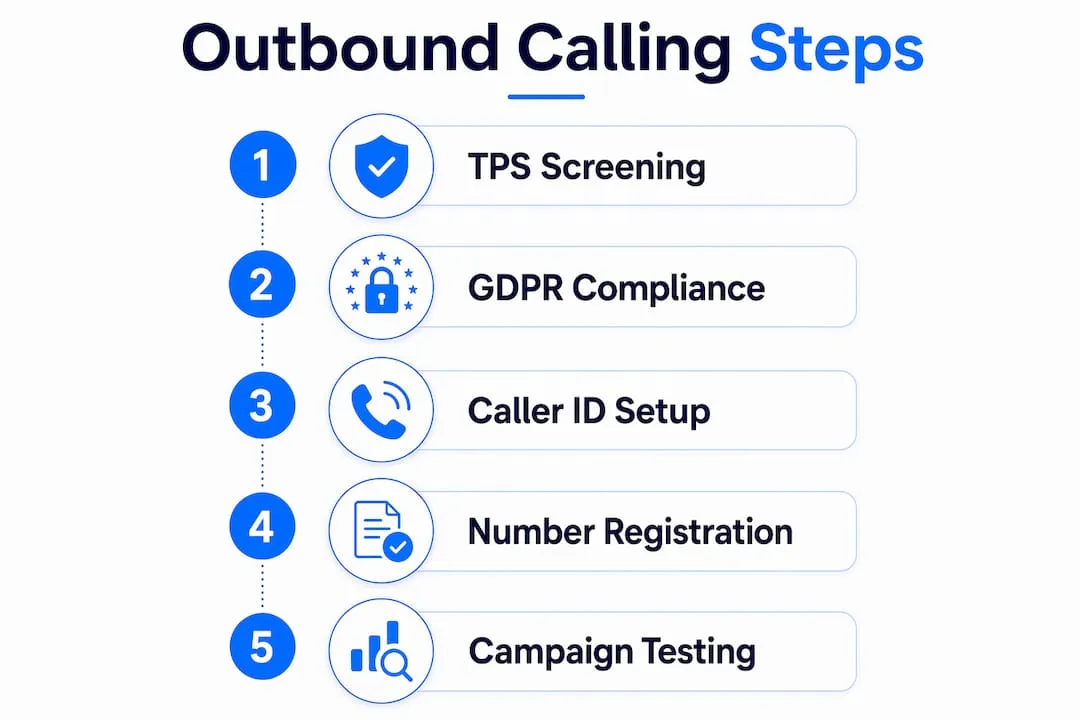
Verify and register your outbound numbers correctly. Before any campaign, confirm that your CLI is correctly configured with your telephony provider. Using geographic, verified numbers linked to a legitimate business presence reduces the chance of calls being blocked by fraud prevention systems. Non-geographic or generic numbers trigger spam filters far more often.
-
Screen against TPS and CTPS every 28 days. Set a calendar reminder. Do not rely on a one-off screen at the start of a campaign. New numbers join the registers continuously, and a single missed screen can result in an ICO investigation.
-
Disclose AI automation immediately. If you use AI-generated voice agents for outbound calls, disclose the automated nature within the first 5 seconds and provide a clear opt-out mechanism. This is a legal requirement, not a courtesy.
-
Maintain and update your CNAM records. Contact your telephony provider and request a CNAM update whenever your business name changes. Accept that propagation across networks takes time, and plan campaigns accordingly.
-
Document everything. Keep records of your TPS and CTPS screening dates, your CLI configuration, your consent records, and your call logs. The ICO expects documentation. Your telecom provider may also need it if a complaint is raised.
Pro Tip: If you work with a third-party agency for outbound calling, get written confirmation that they will use only your registered CLI and screen against TPS and CTPS on your behalf. You remain legally responsible for calls made in your name.
For a broader view of how your phone presence fits into your overall business visibility, the owner-operated business SEO checklist covers how consistent contact details across platforms support both compliance and discoverability.
Key takeaways
Outbound numbers are a legal, technical, and commercial asset that require active management to deliver results and avoid ICO enforcement.
| Point | Details |
|---|---|
| Define your outbound CLI clearly | Register a consistent, verified number with your provider before any campaign begins. |
| Screen TPS and CTPS every 28 days | The TPS holds over 17 million numbers; continuous re-screening is mandatory under PECR. |
| Manage CNAM records proactively | Carrier databases update at different speeds, so test across networks after any name change. |
| Track contact and complaint rates | Contact rates vary from 12–38% depending on list quality; complaints signal a CLI or compliance issue. |
| Document all compliance activity | Written records of screening, consent, and CLI configuration are the ICO’s first request in any investigation. |
Why most businesses underestimate their outbound number setup
Most business owners I speak to treat their outbound number as an afterthought. They pick a number, configure it once, and assume it works. That assumption is expensive.
The compliance side alone should command more attention. The TPS and CTPS registers are not static. Numbers join them every week. A campaign that was fully compliant in january can be in breach by march if you have not re-screened. The ICO does not accept “we screened at the start” as a defence.
The technical side is equally underestimated. I have seen businesses spend months diagnosing low answer rates, convinced the problem was their script or their timing. The real issue was a CNAM record showing a previous business owner’s name, or a non-geographic number being flagged as spam before the call even rang. These are fixable problems, but only if you know to look for them.
The businesses that get outbound calling right treat their outbound number as a registered asset, the same way they treat their domain name or their VAT number. They verify it, maintain it, test it, and document it. The ones that do not eventually face either an ICO fine or a campaign that simply stops working and nobody can explain why.
Telecom regulations in the UK are tightening, not loosening. Ofcom’s CLI authentication rollout in 2026 will make it harder to present numbers that are not genuinely yours. That is good for consumers and good for legitimate businesses. Get your outbound number setup right now, and the new rules will work in your favour.
— Rob
Your outbound number is your business identity on every call
The number you call from is the first thing a recipient sees. It shapes whether they answer, whether they trust you, and whether they call back. A memorable, verified, geographic number from a reputable provider gives your outbound calls the best possible start.
Phonenumbers is the UK’s leading provider of memorable 01, 02, and 07 numbers. Whether you need a memorable landline number for a specific region or a recognisable number that works anywhere in the UK, Phonenumbers lets you search by number sequence, area code, or town. Numbers are no longer tied to local areas, so you can use any number from any location. Browse the full range at Phonenumbers and find a number that represents your business properly.
FAQ
What is an outbound number in business telephony?
An outbound number is the phone number a business presents to recipients when it initiates a call. It is controlled by CLI settings at the telephony provider level and may differ from the number customers use to call you.
Do I need to screen against TPS before every outbound campaign?
Yes. UK law requires screening against TPS and CTPS before any marketing campaign, and re-screening every 28 days. The TPS register holds over 17 million numbers, and failure to screen risks ICO fines of up to £500,000.
Why does my business name not appear correctly on outbound calls?
Receiving carriers query CNAM databases that are often outdated or inconsistent across networks. Caller name updates can take several days to propagate fully, and different networks may show different results for the same number.
Is it legal to display a different number than the one I am calling from?
Presenting a consistent, legitimate business switchboard number is legal in the UK. Using a spoofed number to mislead recipients or facilitate fraud is illegal under Ofcom rules and criminal law.
How do I improve my outbound call answer rates?
Use a verified geographic number linked to your business, keep your CNAM records current, and screen your calling lists against TPS and CTPS. Non-geographic or unregistered numbers are far more likely to be filtered as spam before they ring.