
TL;DR:
- Freephone numbers (0800/0808) are free for callers and place the cost on the business, while local numbers (01/02) signal geographic location and are usually free for callers.
- Modern VoIP technology enables businesses to display local numbers from any UK region without physical presence, enhancing trust and reducing costs.
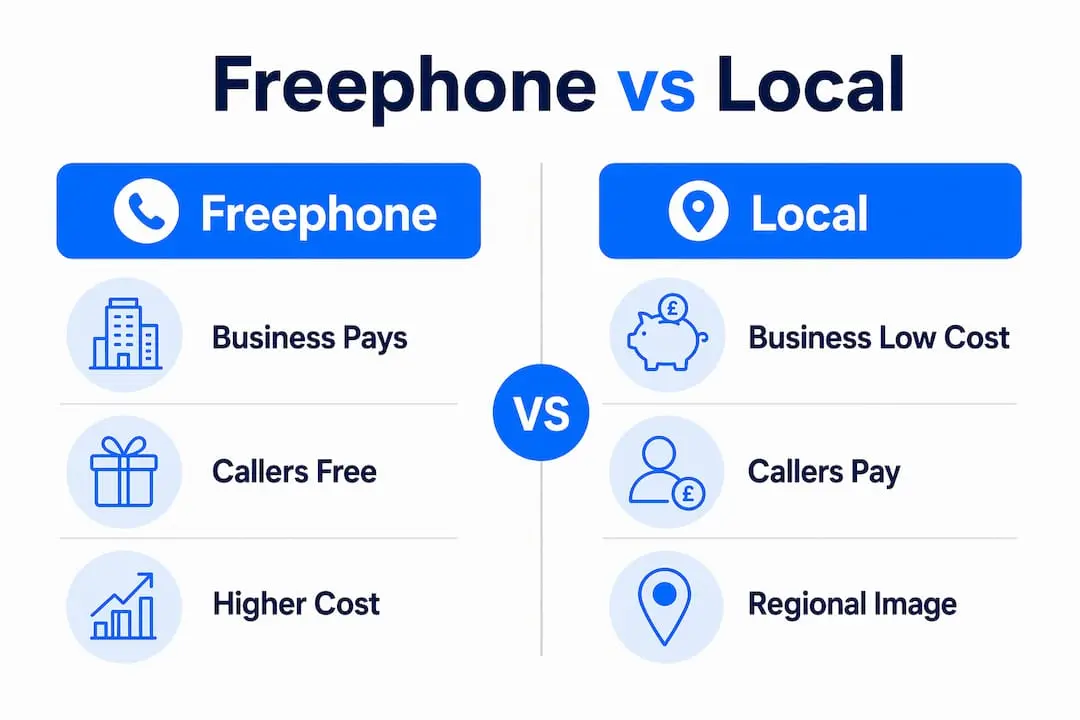
The difference between freephone and local numbers is defined by two things: who pays for the call, and what geographic signal the number sends to your customers. Freephone numbers, starting with 0800 or 0808, are free for the caller. Local numbers, starting with 01 or 02, carry standard geographic call charges and signal a specific UK location. Understanding this distinction shapes every practical decision about how your business presents itself by phone.
Ofcom regulates both number types, and the rules governing them have real consequences for your customers and your costs. Whether you are a sole trader in Sheffield, a growing clinic in Cardiff, or a national service provider, the number you display affects how customers perceive you before you even answer. This article breaks down the freephone pricing structure, local number benefits, and the calling costs comparison that should inform your choice.
What is the difference between freephone and local numbers?
Freephone numbers (0800 and 0808) place the entire cost of the call on the business receiving it. Businesses pay wholesale fees averaging 4p to 10p per minute, plus monthly rental charges. The caller pays nothing, from any UK landline or mobile. That changed in 2015 when Ofcom ruled 0800 calls free from mobiles nationwide. Before that ruling, mobile users could face significant charges for calling 0800 numbers, which undermined the whole premise of a freephone service.

Local numbers (01 and 02) work the opposite way. The business pays little or nothing to receive calls, and the caller pays standard geographic rates. In practice, calls to local numbers are included in most UK mobile and landline inclusive bundles, so the majority of callers pay nothing extra either. The key difference is not always about literal cost at the point of call. It is about the signal each number sends and the financial model sitting behind it.
How do freephone numbers work and what are their benefits?
A freephone number routes incoming calls through a wholesale carrier network to wherever the business chooses to receive them. That destination can be a landline, a mobile, a VoIP system, or a call centre. The caller dials 0800 or 0808 and pays nothing. The business pays the carrier for every minute of incoming call time, plus a standing monthly rental fee for the number itself.
The advantages for businesses are clear:
- National accessibility. Any customer in the UK can call without worrying about cost, removing a genuine barrier to contact.
- Professional appearance. An 0800 number signals scale and customer commitment. It tells callers you have invested in making contact easy.
- Marketing flexibility. Freephone numbers are memorable and work well in advertising because the “free to call” message is a direct incentive.
- No geographic restriction. The number carries no regional identity, which suits businesses serving customers across the whole country.
The limitations are worth knowing too. Freephone numbers carry a risk of scam abuse because they appear official and trustworthy. Fraudsters exploit this perception, which means some consumers have become wary of unfamiliar 0800 calls. There is also no local identity attached, which can work against businesses whose customers specifically want a local provider.
Pro Tip: If you use an 0800 number in outbound marketing, make sure your number appears on a verified business directory so customers can confirm its legitimacy before calling back.
What defines local phone numbers and why do businesses choose them?
Local numbers carry a two or three digit area code that identifies a specific UK city or region. The 0161 prefix signals Manchester. The 0131 prefix signals Edinburgh. The 020 prefix signals London. These codes are deeply embedded in how UK consumers read trust and proximity into a phone number.
Here is why businesses actively choose local numbers over freephone:
- Local trust signals. Local numbers signal proximity and familiarity to customers, which is particularly valuable for trades, clinics, and neighbourhood services where community connection matters.
- Lower business costs. Receiving calls on a local number is cheaper than receiving them on an 0800 number, because the business does not absorb per-minute wholesale fees.
- Bundle inclusion for callers. Calls to 01 and 02 numbers are included in virtually every UK mobile and broadband bundle, so callers face no extra charge.
- Credibility in specific markets. A London-based law firm or a Bristol estate agent benefits from displaying a recognisable local code. It tells clients the business is rooted in their area.
The old limitation of local numbers was that you needed a physical presence in the area to justify the code. Modern VoIP has eliminated that restriction. Businesses can now hold local numbers for multiple UK cities without a single office in any of them, routing calls to wherever their team actually works. Phonenumbers specialises in exactly this: memorable 01 and 02 numbers that you can use from anywhere in the UK.
Pro Tip: If you want to project a local presence in a city where you have no office, a VoIP-routed local number lets you answer calls on your existing phone system while displaying a credible local code to customers. Read more about the advantages of local numbers for UK businesses.
What are the key cost differences between freephone and local numbers?
The calling costs comparison between freephone and local numbers splits into two perspectives: what the caller pays, and what the business pays.
What the caller pays
| Number type | From a UK landline | From a UK mobile |
|---|---|---|
| 0800 / 0808 (freephone) | Free | Free |
| 01 / 02 (local geographic) | Standard rate (usually in bundle) | Standard rate (usually in bundle) |
| 0333 (non-geographic) | Standard rate (usually in bundle) | Standard rate (usually in bundle) |
From the caller’s perspective, the practical difference between freephone and local numbers is minimal in 2026. Most UK mobile contracts include unlimited calls to 01, 02, and 0333 numbers. Calls to 0333 and 0345 numbers are classified as standard rate and included in inclusive minute bundles on British mobile networks, exactly like 01 and 02 calls.
What the business pays
This is where the real financial difference lies. A business running an 0800 number pays wholesale termination fees on every inbound call, typically between 4p and 10p per minute. A business using a local 01 or 02 number pays no per-minute fee to receive calls. The monthly rental cost for a local number is also generally lower than for an 0800 number.
0333 numbers sit in a useful middle position. Ofcom classifies 0333 as standard rate with no revenue share or service charge, making them cheaper to receive than 0800 while still projecting a national, non-geographic identity. For many businesses, this makes 0333 the most cost-efficient option for UK-wide presence.
How do freephone and local numbers affect business branding and trust?
The number you display is a branding decision as much as a practical one. Customers read meaning into number prefixes before they even dial.
Local numbers carry a specific set of associations:
- Community connection. A 0113 Leeds number tells a local customer you are part of their area, not a distant call centre.
- Accessibility for older customers. Many older UK consumers are more comfortable calling a recognisable local code than an unfamiliar national prefix.
- Trades and professional services. Plumbers, solicitors, and GPs benefit from local identity because their customers are choosing on proximity as much as price.
Freephone numbers carry different associations. They suggest scale, national reach, and a business that has invested in customer access. A charity helpline, a national retailer, or a financial services firm all benefit from the 0800 signal. It says: we are here for you, and calling us costs you nothing.
The trust picture is complicated by fraud. Scammers exploit the trusted appearance of 0800 numbers, impersonating banks and government agencies. Consumers are increasingly advised to verify unfamiliar 0800 numbers independently before returning calls. Businesses using freephone numbers should make their number easy to find on official channels so customers can confirm its legitimacy. Guidance on protecting your business number from fraud is worth reviewing if you operate a high-volume inbound line.
0333 numbers occupy a middle ground. They present a national image without the per-minute cost burden of 0800, and most SMEs now choose 0333 for a national identity that keeps caller costs in line with local number rates.
Which phone number type should your business choose?
The right choice depends on your customer base, your geographic reach, and your cost priorities. Here is a practical framework:
- Local businesses with a defined catchment area (trades, clinics, estate agents, restaurants) benefit most from a local 01 or 02 number. The geographic signal builds trust and the costs are lower on both sides.
- National service providers (insurers, retailers, charities, helplines) benefit from 0800 or 0808. The free-to-call message removes barriers and the national identity fits the brand.
- Growing SMEs serving multiple regions are often best served by 0333, which offers national presence at standard rate costs. VoIP-enabled local numbers for individual branches can complement a central 0333 line.
- Businesses expanding into new cities can use local numbers via VoIP without opening offices, projecting credibility in each target market.
The most common mistake is choosing a number type based on tradition rather than strategy. A regional solicitor who has always used a local number may assume that is the only option. A startup may default to 0800 because it sounds professional. Neither assumption holds up under scrutiny. Match your number to how your customers actually think about you, and to what you can afford to pay per inbound call.
Key takeaways
The core difference between freephone and local numbers is cost responsibility: freephone numbers charge the business per minute, while local numbers pass standard geographic rates to callers who are usually covered by their bundle.
| Point | Details |
|---|---|
| Freephone cost model | Businesses pay 4p to 10p per minute wholesale plus monthly rental; callers pay nothing. |
| Local number cost model | Callers pay standard geographic rates, almost always included in UK mobile bundles. |
| Geographic signalling | Local 01/02 numbers signal community presence; 0800 signals national reach. |
| 0333 as an alternative | Non-geographic, standard rate, and cheaper to receive than 0800 for businesses. |
| VoIP flexibility | Businesses can hold local numbers for any UK area without a physical office there. |
Why the 0333 shift tells you something important
I have spent years watching businesses agonise over freephone versus local, treating it as a binary choice. The reality in 2026 is that 0333 has quietly become the default for a large proportion of UK SMEs, and for good reason. It gives you a national identity, keeps caller costs in line with local number rates, and costs less to receive than 0800. If you are a growing business without a strong reason to signal local roots or absorb per-minute inbound costs, 0333 is often the most rational choice.
What I find more interesting is how VoIP has changed the local number conversation entirely. The old logic was: you need a Manchester office to justify a 0161 number. That logic is gone. A business in Bristol can display a Leeds number, a Glasgow number, and a London number simultaneously, routing all calls to the same team. This is not a loophole. It is how modern telephony works, and Phonenumbers is built around exactly this flexibility.
The one thing I would caution businesses about is the scam association with 0800. It is not a reason to avoid freephone numbers, but it is a reason to make your number visible and verifiable. If a customer cannot find your 0800 number on your website, your Google Business profile, and your invoices, you are making their trust decision harder than it needs to be.
— Rob
Find your ideal UK business number with Phonenumbers
Phonenumbers is the UK’s leading provider of memorable 01 and 02 landline numbers, with a searchable database covering every area code, town, city, and county in the country. Whether you want a memorable local number for a specific city or a nationally recognised number that customers will remember, Phonenumbers makes it straightforward to find, rent, or buy a number that fits your business. Numbers are no longer tied to physical locations, so you can use any 01 or 02 number from anywhere in the UK. Browse the database, search by area code or town, and find a number that works as hard as your business does.
FAQ
Are 0800 numbers free from UK mobiles?
Yes. Since the 2015 Ofcom ruling, all 0800 and 0808 freephone numbers are free to call from any UK mobile or landline.
Do local 01 and 02 numbers cost extra to call?
Calls to 01 and 02 numbers are charged at standard geographic rates, which are included in virtually all UK mobile and broadband inclusive bundles, so most callers pay nothing extra.
Can I use a local number without an office in that area?
Yes. VoIP technology allows businesses to hold and use local numbers for any UK area code without a physical office, routing calls to wherever the team works.
What is the cheapest option for businesses receiving high call volumes?
Local 01 or 02 numbers are the cheapest to receive, as businesses pay no per-minute wholesale fee. For a national image at similar cost, 0333 numbers are regulated at standard rate with no revenue share charges.
Is it safe to call back an unfamiliar 0800 number?
Not always without checking first. Scammers use 0800 numbers because they appear official. Always verify an unfamiliar 0800 number via the company’s official website before returning a call.