TL;DR:
- Temporary phone numbers help UK small businesses protect privacy and maintain professional branding.
- They ensure compliance with Ofcom regulations and are useful for short-term campaigns and verification needs.
- Choosing the right solution depends on usage, compliance, and the specific needs of the business.
Running a small business in the UK means your phone number is everywhere: on flyers, in email footers, across online listings, and shared with every new client. Most entrepreneurs default to their personal mobile without thinking twice, not realising they are handing their private number to cold callers, data brokers, and marketing lists. Temporary phone numbers offer a smarter, more professional alternative. This guide explains exactly what these numbers are, how they work under UK regulations, how solutions compare, and how you can start using one to protect your privacy and sharpen your business communication.
Table of Contents
- What is a temporary phone number?
- Why UK businesses use temporary numbers
- How temporary phone numbers work: UK technology and regulations
- Comparing temporary phone number solutions
- How to set up and manage a business temporary phone number
- The reality of temporary business numbers: what most British entrepreneurs miss
- Ready to protect your business privacy?
- Frequently asked questions
Key Takeaways
| Point | Details |
|---|---|
| Enhanced business privacy | Temporary phone numbers help UK entrepreneurs protect their personal details while appearing professional. |
| Flexible communication | You can set up, forward, and retire numbers as your business needs change. |
| Regulatory compliance | Using a reputable UK provider ensures you meet Ofcom’s requirements and avoid fines or issues. |
| Choose the right solution | VoIP is cheaper and app-based, while real SIMs are better for confirmations; know which fits your case. |
What is a temporary phone number?
A temporary phone number is a telephone line used for a defined period, campaign, or specific purpose, rather than as your permanent contact. Think of it as a professional layer sitting between your real mobile number and the outside world. Once a campaign ends or a project wraps up, you simply discontinue the number, and your personal details remain untouched.
In the UK, you will generally encounter two main types:
- App-based virtual numbers (VoIP): These are delivered entirely over the internet using Voice over Internet Protocol technology. Apps like Hushed and Burner let you activate a UK number within minutes. Best temp phone apps 2025 data shows these services are praised for strict privacy policies, including no-log policies for UK users, with business VoIP plans typically costing between £5 and £20 per user per month with unlimited UK calls. However, some strict services such as banks can block VoIP numbers during verification.
- SIM-based temporary numbers: These use a physical SIM card, giving you a genuine mobile number. They are more reliable for SMS verification, closer in behaviour to a traditional mobile, but they cost more and offer fewer instant switching options.
Understanding the benefits of virtual phone numbers is the first step. The core advantage for any small business owner is simple: you keep your personal number off public-facing materials entirely. You can use a temporary number for online classified ads, one-off client onboarding, seasonal promotions, or any campaign where you expect high inbound volume. Once the campaign is done, you retire the number without a trace.
For a solid grounding in how these fit alongside other business communication tools, the business phone number basics guide is worth your time. The landscape has changed significantly in recent years, and knowing your options gives you a genuine competitive edge.
Why UK businesses use temporary numbers
With the basics clear, it is worth understanding why so many UK entrepreneurs and small-to-medium enterprises are making the switch, and where temporary phone numbers deliver the most tangible value.
1. Privacy and personal security. When you advertise your personal mobile, it enters countless databases. Within weeks, you are fielding spam calls, unsolicited WhatsApp messages, and cold pitches. A temporary number absorbs that noise. You can publish it freely, knowing your real number stays private.
2. Professionalism and brand identity. A dedicated business number, even a temporary one, signals that you are organised and serious. Clients respond differently when they see a local 01 or 02 number versus an obviously personal mobile.
3. Legal compliance under Ofcom rules. This is where many business owners fall short. Ofcom’s premium rate service framework is clear: virtual numbers must comply with the UK National Numbering Plan. Providers must register their number allocations, calling line identification (CLI) must not mislead recipients, and premium rate misuse in customer service contexts is prohibited. If you use a virtual telephone number for your business, you need to be confident your provider is properly registered.
4. Flexibility for campaigns. Temporary numbers let you set up, route, and retire lines at will. This is invaluable for seasonal promotions or testing a new marketing channel. You can run two separate ad campaigns with different numbers, then measure which one generated more calls. That kind of attribution is impossible with a single personal mobile.
A freelance contractor in Leeds shared that switching to a temporary 0113 number for a six-week tender process meant they could share it freely in proposals without worrying about unwanted calls months later. When the tender closed, the number was simply retired.
Pro Tip: Before committing to any temporary number provider, verify that they appear on the Ofcom registered providers list. Unregistered providers may not comply with CLI rules, which could create compliance exposure for your business if clients or regulators investigate.
For a detailed overview of what the rules actually mean in practice, the business number compliance guide covers UK-specific obligations clearly.
How temporary phone numbers work: UK technology and regulations
Understanding why these numbers are valuable leads naturally to a practical question: how do temporary lines actually function in the UK, and what rules govern them?
VoIP numbers work by converting your voice or SMS into data packets sent over the internet. Your provider assigns you a UK number from their registered allocation, and calls made to that number are routed to whatever device or app you choose. The cost savings are substantial. The flexibility is genuine. The trade-off is that some services, particularly UK banks and certain government portals, detect VoIP numbers and block them during account verification, as verification success rates from leading services show roughly 99% success for standard services but notably lower figures for strict financial institutions.

SIM-based temporary numbers are more expensive but behave identically to any standard UK mobile. They pass verification checks that VoIP numbers fail. If your business regularly needs to register with financial services, HMRC portals, or payment processors, a SIM-based option is the safer choice.
The regulatory picture is evolving. The Ofcom-compliant virtual numbers space in the UK must navigate a significant change: from April 2026, the Global Title leasing ban affects certain SMS signalling capabilities. This means some providers relying on leased Global Title routing for SMS delivery will face restrictions, directly impacting how reliably they can send or receive texts on behalf of business customers.
| Feature | VoIP virtual number | SIM-based number |
|---|---|---|
| Cost (per month) | £5 to £20 | £15 to £40+ |
| Setup speed | Instant (app-based) | 1 to 3 days |
| UK calls included | Unlimited (most plans) | Variable |
| Bank verification | Often blocked | Generally accepted |
| SMS reliability post-2026 | May be affected | Not affected |
| Privacy | No-log options available | Standard carrier logs |
| Ofcom compliance | Provider-dependent | Standard mobile rules |
Pro Tip: If you are evaluating best UK number providers for your business, ask directly whether they register allocations with Ofcom and whether their SMS routing will be affected by the April 2026 Global Title leasing changes. A provider that cannot answer this clearly is a red flag.
Comparing temporary phone number solutions
Now that you understand the technology and regulatory basics, it is time to compare your real-world options side by side.
| Solution type | Best for | Privacy level | Compliance | Approx. monthly cost |
|---|---|---|---|---|
| App VoIP (e.g. Hushed) | Campaign privacy | High (no-log) | Good, provider-dependent | £5 to £15 |
| Business VoIP platform | Scaling, teams | Moderate | Strong if UK-registered | £10 to £20/user |
| SIM rental | Verifications, banking | Standard | Excellent | £20 to £40 |
| Memorable UK landline | Brand credibility | Standard | Excellent | Varies |
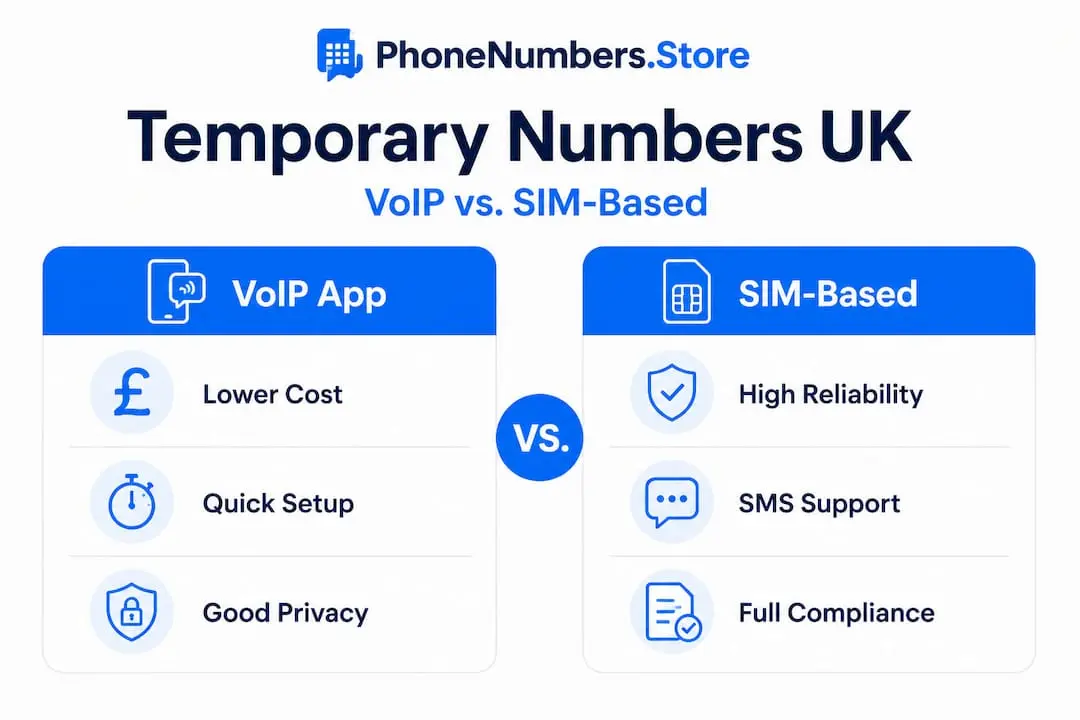
As the best temp phone apps 2025 benchmarks confirm, Hushed and Burner consistently receive top marks for privacy, particularly their no-log policies and availability of genuine UK numbers. For a business owner who simply needs a clean, private number for a specific project, these are effective and affordable.
Business VoIP platforms are the sweet spot for growing teams. They support multiple users, call routing, and voicemail, all under a single business identity. The downside is the setup investment and the need to ensure your provider’s CLI settings are correctly configured to avoid misleading recipients, which is an Ofcom requirement.
SIM rental is the most expensive option but the most reliable for SMS verification and financial compliance. It is the right choice for businesses that need to authenticate accounts with banks or government portals regularly.
For a thorough side-by-side breakdown, the virtual landline service comparison page covers leading UK providers in detail.
Quick checklist before you choose:
- How long do you need the number? (Days, weeks, or ongoing?)
- Do you need SMS, calls, or both?
- Will the number be used for bank or payment verification?
- Does your provider register their allocations with Ofcom?
- Will the April 2026 GT leasing ban affect your provider’s SMS capabilities?
- Do you want a local area code to strengthen brand credibility?
How to set up and manage a business temporary phone number
Once you have compared solutions, implementation is straightforward if you follow a clear process. Here is a practical step-by-step approach for UK business owners.
-
Choose your provider. Prioritise UK-based or UK-registered providers who can confirm Ofcom compliance. Check whether they offer the number type you need: 01 or 02 local landline, 03 non-geographic, or 07 mobile. Use the business line setup guide to shortlist options suited to your specific industry.
-
Select your number. If you want a number associated with a particular area code (for instance, a Birmingham 0121 number or a Manchester 0161 number), check availability in the provider’s database. Remember: in the UK, numbers are no longer tied to physical locations. You can operate from anywhere and still use a recognisable local number.
-
Configure call and SMS routing. Decide whether incoming calls should ring your mobile, a team member, or go to voicemail. Most VoIP platforms let you set routing rules, office hours, and even hold music. SMS routing can be pointed to an email inbox or a separate app.
-
Test before launch. Call the number from an external phone. Send a test SMS. Confirm that CLI displays correctly and that voicemail is set up. A number that fails silently during a live campaign can cost you real business.
-
Log and monitor usage. Even for a temporary number, maintain basic records: what campaigns used the number, the approximate call volume, and the date you retired it. This is good housekeeping and useful if any compliance questions arise later.
-
Retire the number cleanly. When the campaign ends, formally discontinue the number with your provider. Do not simply abandon it. Numbers that are not formally released may be reallocated to another business, which can cause confusion.
Common mistakes to avoid:
- Using a VoIP app number for banking or government portals. It will likely be rejected.
- Choosing a provider based purely on price without checking Ofcom registration.
- Forgetting to update marketing materials when a temporary number is retired.
As leading services show, business VoIP at £5 to £20 per user per month with unlimited UK calls represents strong value, but only when matched correctly to the right use case.
Pro Tip: Choose a number with a recognisable local area code for your target market. A Leeds-based consultancy using a 0113 number, or a London startup displaying a 020 number, instantly signals local credibility, even when the team is working remotely from elsewhere in the UK.
The reality of temporary business numbers: what most British entrepreneurs miss
Here is the perspective that most guides on temporary phone numbers quietly skip over. These numbers are tactical tools. Brilliant ones, when used correctly. But they are not a universal solution, and treating them as one is where many UK small business owners quietly come unstuck.
The temptation is understandable. Cheap VoIP numbers look identical to local landlines from a caller’s perspective. They cost a fraction of a traditional business line. Setting one up takes minutes. So why not use one for everything? The answer lies in what happens when things matter most: bank account setup, HMRC verification, merchant account registration, payment processor onboarding. These are precisely the moments when many VoIP numbers are flagged and rejected, leaving business owners scrambling.
There is also a regulatory dimension that gets glossed over. The Ofcom National Numbering Plan is not optional or aspirational. CLI misrepresentation, premium rate misuse, and unregistered number allocations carry real consequences. The April 2026 Global Title leasing ban will further tighten the landscape, and some providers who have been operating in grey areas will find their SMS services disrupted. If your business depends on SMS communication with clients, you need to audit your provider now, not after the restrictions hit.
The entrepreneurs who get the most from temporary numbers treat them as one layer in a broader communication strategy. They use a memorable, permanent UK number for brand-facing communications, and deploy temporary lines tactically for campaigns, testing, and short-term projects. This approach protects privacy, maintains compliance, and preserves professional credibility. Understanding virtual number pitfalls before you commit to a provider saves you from the most common and costly errors.
The uncomfortable truth is that the cheapest option almost never serves every need. Matching your specific use case to the right solution is what separates a business that communicates well from one that quietly loses clients through missed calls, failed verifications, and compliance gaps.
Ready to protect your business privacy?
Temporary phone numbers are a genuinely powerful tool for UK small businesses, and the right number can be live and working for your next campaign within the hour. Whether you need a recognisable local number to project credibility, a clean line to shield your personal mobile from public listings, or a dedicated number for a seasonal promotion, finding the right option matters.
At phonenumbers.store, we specialise in memorable UK landline and mobile numbers, including 01 and 02 local numbers and 07 mobile numbers, available across any area code you choose. Browse our database by number sequence, area code, town, or county and find a number that works anywhere in the UK. For instant brand recognition, explore standout options like the memorable 01132 666333 number or the memorable 01132 777999 number. These are the kinds of numbers clients remember and trust.
Frequently asked questions
Are temporary phone numbers legal for business use in the UK?
Yes, they are completely legal as long as they comply with Ofcom’s regulations, including the National Numbering Plan, correct CLI display, and no premium rate misuse in customer service contexts.
Can I use a temporary phone number for banking verification?
Most UK banks prefer genuine SIM-based numbers; app-based VoIP numbers are frequently blocked during account verification because banks flag them as non-standard mobile lines.
What happens to my call and message data with UK temporary number apps?
Leading providers such as Hushed and Burner operate strict no-log privacy policies for UK users, meaning your call and message data is not stored or shared beyond what is necessary for the service to function.
Will temporary numbers still support business SMS after April 2026?
Some providers may face restrictions on certain SMS signalling because the Global Title leasing ban coming into force after April 2026 directly affects how specific SMS routing is handled in the UK.
How much does a business temporary phone number cost in the UK?
App-based virtual numbers typically start from around £5 per user per month for unlimited UK calls, while SIM-based options and more fully featured business VoIP platforms generally run from £15 to £40 per month depending on features.