To find and secure the memorable UK number you want, search a specialist marketplace such as Phonenumbers and place a reservation or buy it outright before someone else takes it. From there, the process is straightforward: filter by number type, check the metadata on each result, then reserve, buy or rent while you sort out porting and compliance.
TL;DR:
- Search exact digits, wildcard patterns, or locations, then check each listing’s availability, call forwarding, SMS support, and setup details before choosing.
- Choose 01 or 02 for local recognition, 03 for national reach at geographic rates, 07 for mobile familiarity, or 0800 for free calls.
- Screen live marketing lists against TPS and CTPS, record each check, and remember that new TPS registrations can take 28 days to take effect.
- Buy if the number anchors your brand; rent for flexibility, and reserve it for 30 days for £10 while arranging porting and call forwarding.
- Ask whether your provider supports Do Not Originate marking for numbers that should only receive calls, and verify call routing and caller ID after setup.
Table of Contents
- How to search for a memorable UK number by digit, area or pattern
- Which number type suits your marketing: geographic, non-geo, mobile or freephone
- Quick compliance checklist for marketing from your new number
- Protecting your number from spoofing and keeping calls trusted
- Reserving, buying or renting a number: the steps and porting checklist
- How reverse phone lookup services and apps actually work
- Spotting a suspicious call before you answer or call back
- Why caller ID does not always show a number
- Reporting nuisance or fraudulent calls
- Author perspective: why a memorable number is worth the investment
- Search, reserve and set up your number with Phonenumbers
- FAQ
- Sources
How to search for a memorable UK number by digit, area or pattern
Finding the right number starts with knowing what you are searching for. A specialist directory lets you hunt for an exact sequence, a repeating pattern, or a number tied to a particular town or county, rather than scrolling through random listings.
- Enter the exact digits you want, or use a partial sequence with wildcards to surface numbers that contain a specific pattern.
- Search by area code, town, county or keyword if local recognition matters more than a specific digit combination.
- Filter results by number type: 01, 02, 03 or 07, depending on whether you want a geographic, non-geographic or mobile identity.
- Check each listing’s metadata before deciding, since this tells you whether the number is available to buy outright, available to rent, or held under a time-limited reservation.
Metadata usually covers more than availability. Good listings show whether a number supports call hosting and forwarding, whether it can carry SMS traffic, and what the setup process looks like once you commit. A number that only forwards calls will suit a sole trader differently than one that needs full hosted voice for a small team.
Pro Tip: Search for two or three digit patterns at once (your postcode prefix, your trade, a repeating sequence) so you have backup options if your first choice is already reserved.
Which number type suits your marketing: geographic, non-geo, mobile or freephone
The prefix you choose affects how callers perceive you and, in some cases, what they pay. Ofcom sets out the main categories UK businesses choose between.
- 01 and 02 numbers are geographic and carry local trust and recognition, even though the number can be used from anywhere once it is hosted.
- 03 numbers are non-geographic but charged at standard geographic rates, which makes them a useful national number that does not add cost for the caller.
- 07 numbers are mobile, giving a familiar format for customers who expect to text or call a direct line.
- 0800 and 0808 numbers are free to the caller, which suits businesses that want to remove any cost barrier to getting in touch.
- 084, 087 and 09 ranges carry premium or service charges and are generally a poor fit for everyday customer-contact marketing.
Ofcom’s own guidance confirms that 03 numbers cost the same as geographic calls, which is worth remembering if a customer ever questions why your “non-geographic” number did not cost them extra.
Quick compliance checklist for marketing from your new number
Buying a memorable number does not exempt you from the rules that govern outbound marketing. Before you dial a single customer from a freshly acquired line, run through the basics that the ICO’s PECR guidance sets out for live calls.
- Screen every marketing list against the TPS and CTPS registers, and keep a log of when each check was run.
- Remember that consent requirements differ between individual consumers and corporate numbers, and that automated or recorded calls carry their own separate rules.
- Always display a valid, working contact number when you make a live marketing call, and be ready to give a contact address or Freephone number if the person asks for one.
TPS entries take 28 days to take effect after registration, so a list checked too soon after a customer opts out may still include them. Treating this checklist as routine, rather than a one-off task before a campaign launch, keeps a new number’s reputation clean from day one.
Protecting your number from spoofing and keeping calls trusted
A memorable number is only useful if customers trust what shows up on their screen. NCSC guidance on business communications sets out several practical steps to reduce the risk of your number being spoofed or blocked by fraud filters.
- Apply Do Not Originate (DNO) marking to any number that should only ever receive calls and never make them.
- Ask your provider how calls are routed, and avoid offshore routing for UK-to-UK traffic, since this is a common trigger for spoofing and fraud detection.
- Confirm your provider follows correct signalling practices rather than assuming it is handled automatically.
- Restrict access to any public SMS or messaging API, validate number formats on web forms, and watch for unusual call or text patterns that might signal misuse.
Pro Tip: Ask your telephony provider directly whether they support DNO marking before you commit to a hosting plan, since not every provider offers it as standard.
Reserving, buying or renting a number: the steps and porting checklist
Once you have found a number worth keeping, the next decision is whether to buy, rent or hold it with a short reservation while you finalise your plans.
- Place a time-limited reservation if you need a few weeks to confirm budget or internal sign-off before committing to a purchase.
- Choose to buy outright if the number is central to long-term branding and you want full ownership from day one.
- Choose to rent if you want the flexibility of a memorable number without a permanent purchase commitment.
- Gather the details your porting process will need: your current number, your existing provider’s account reference, and the date you want the switch to complete.
- Plan a short overlap period with call forwarding active so customers calling your old number are not left in silence during the port.
- Check how hosting, forwarding and SIM options integrate with the number once it is live, since this determines whether it rings a landline, a mobile, or both.
Our guidance on choosing and porting a UK number walks through the Ofcom porting basics in more detail if you want the full sequence before you start.
How reverse phone lookup services and apps actually work
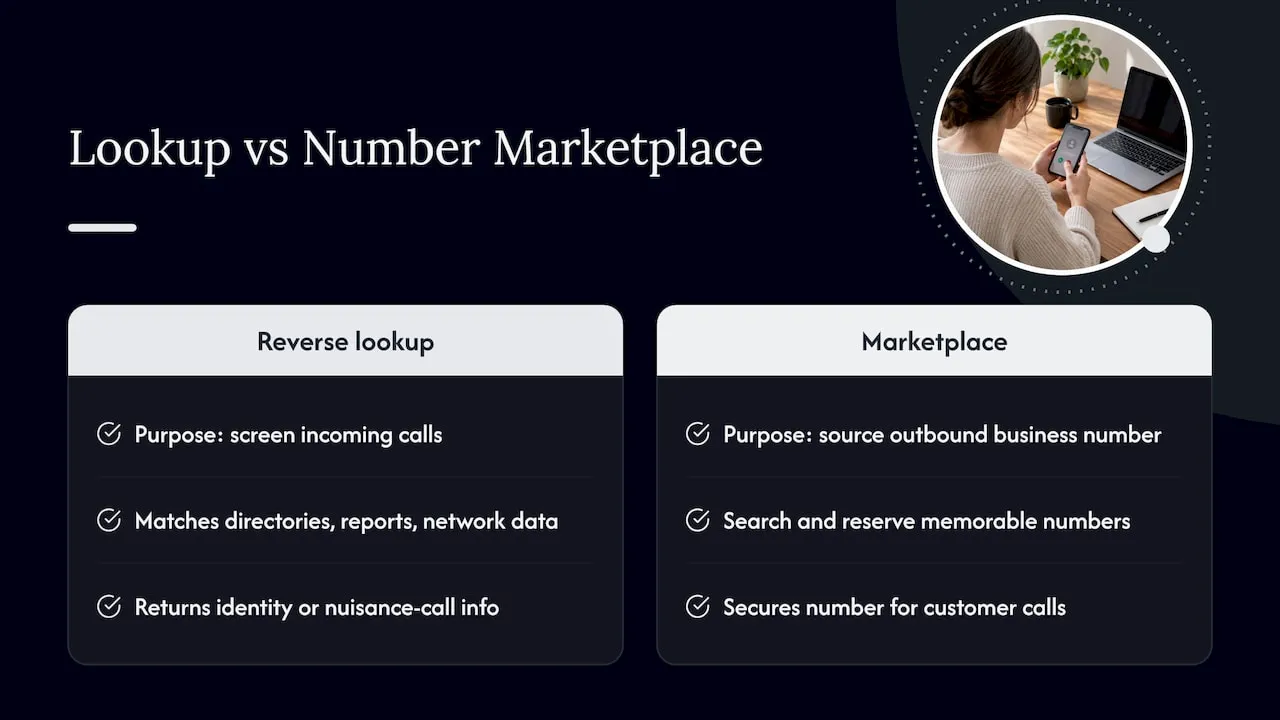
Reverse lookup tools and apps work by matching an incoming number against databases built from public directories, user reports and network data, then returning whatever identity information they hold. Some apps cross-reference caller reports in real time, flagging a number as a likely nuisance call based on how often it has been reported by other users of the same app.
These tools are genuinely useful for screening incoming calls, but they are a different task from sourcing and securing a number for your own business. If you are trying to work out who is calling your mobile, a lookup app or your network’s built-in caller identification feature is the right tool. If you are trying to find and acquire a memorable number for your business to call customers from, that is a search-and-reserve task through a numbers marketplace, not a lookup task.
Coverage varies between apps, and none of them guarantee a match, since plenty of legitimate business numbers are too new or too lightly used to appear in any database yet. Treat a lookup result as a useful signal rather than a definitive answer, particularly for numbers that have only recently been allocated or ported.
Spotting a suspicious call before you answer or call back
A few patterns tend to recur in spam and scam calls, and knowing them helps you decide quickly whether to pick up. A call that begins with a recorded message before connecting you to a person, a caller who pressures you to act immediately, or a number that looks local but the caller claims to be from a national organisation are all common warning signs.
Scam calls frequently spoof a legitimate-looking number, including ones that resemble your own area code, to increase the chance you will answer. Which? reporting on number spoofing notes that many consumers are not aware this is possible, and recommends treating any unexpected caller ID with some caution rather than assuming it is accurate.
If a caller asks for banking details, remote access to your computer, or payment through an unusual method such as vouchers or cryptocurrency, that is a strong signal to end the call and verify independently through a number you already trust, rather than one the caller gives you.
Why caller ID does not always show a number
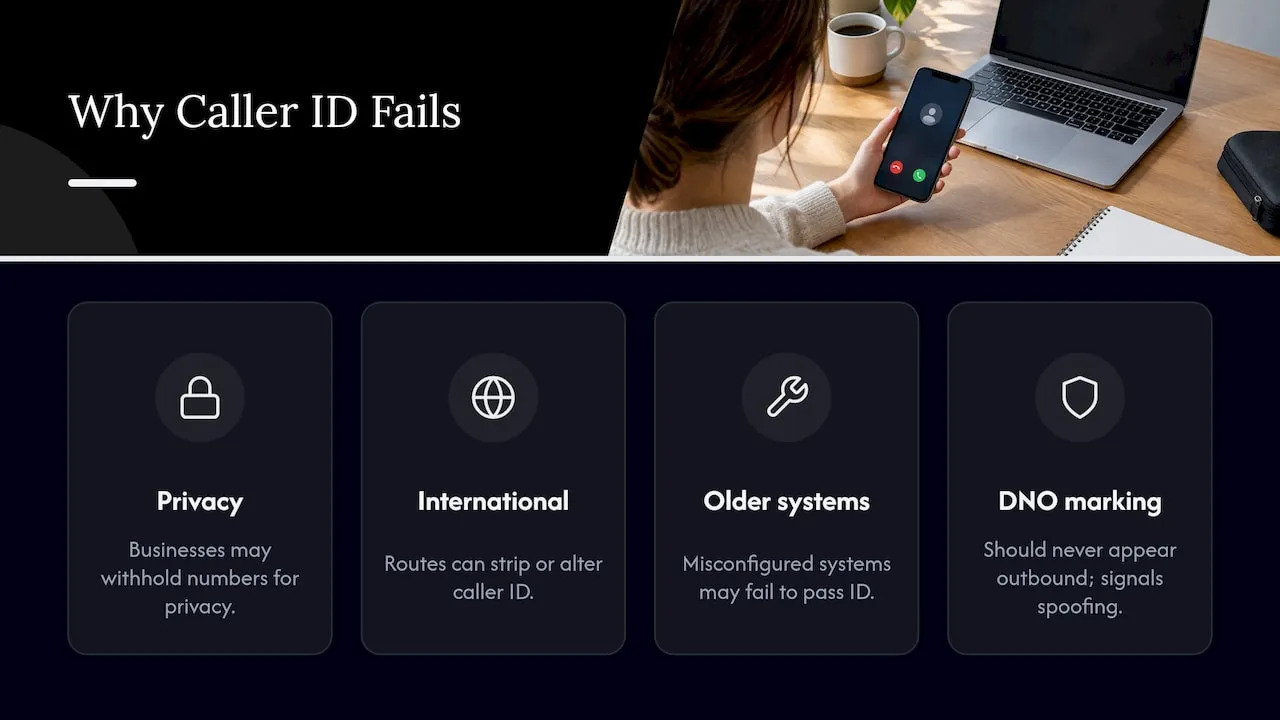
Caller ID relies on the calling party’s network correctly passing identification data through to the receiving network, and that chain can break down in several ways. Some businesses deliberately withhold their number for privacy reasons, some international routes strip or alter caller ID data in transit, and some older or misconfigured systems simply fail to pass it through correctly.
This is also why DNO marking matters for businesses: a number marked Do Not Originate should never appear as the caller ID on an outbound call, so if it does, that is itself a sign of spoofing rather than a genuine call from that organisation, according to NCSC guidance.
For businesses setting up a new memorable number, this means testing your own outbound caller ID after setup is worth doing once, simply to confirm your provider is passing your chosen number through correctly rather than a default or withheld one. Our verification checklist covers the practical steps for checking this.
Reporting nuisance or fraudulent calls
Reporting a suspicious or unwanted call helps regulators build a picture of active scam campaigns and, over time, supports network-level blocking. Ofcom and the ICO both accept reports from consumers and businesses about nuisance calls, and your own network provider usually has a short reporting code or app for flagging a specific call.
A government-industry initiative described in the Gov commits mobile networks to upgrades designed to make it harder for foreign call centres to spoof UK numbers, with 96% of mobile users reported to decide whether to answer a call based on the number displayed on screen, which is part of why this matters so much to network operators.
If you run a business and suspect your own number is being spoofed by scammers targeting other people, reporting it to your provider and to Ofcom helps get the pattern recognised faster, and protects your brand’s reputation in the process.
Author perspective: why a memorable number is worth the investment
A number people remember without checking their phone pays for itself in call volume alone. Customers ring a number they recall rather than hunting for a saved contact, and that small friction removed often means the difference between a lead calling you and calling a competitor instead.
The temptation is to chase vanity digits over practical features. A number that looks striking but lacks decent hosting or forwarding options will frustrate you operationally long after the novelty wears off, so weigh memorability against what the number can actually do for your call handling.
— Rob
Search, reserve and set up your number with Phonenumbers
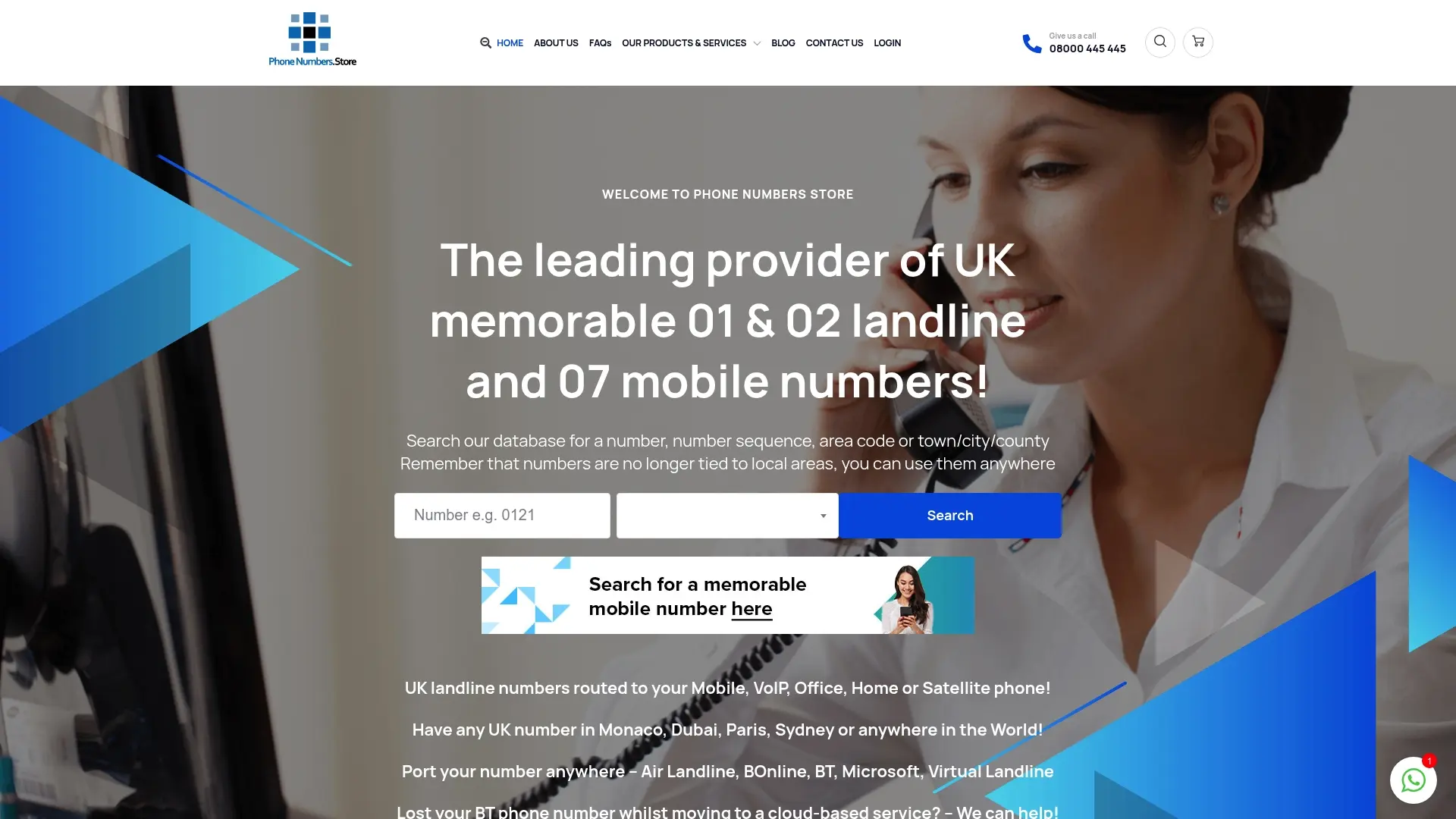
Searching a suitable database takes a few seconds: enter a sequence, a town or county, or a number type, and you can see what is available to buy or rent straight away. Holding a 30-day reservation while you confirm budget or sign-off costs far less than losing the number to another buyer in the meantime.
Once you have chosen a number, there are several ways to put it to work:
- Host it with our XL Premier Service for managed call handling.
- Run it through XL Hosted Voice Service with a VoIP phone (XLHV) if you want a desk phone setup.
- Keep your existing BT line and route it through XL-IP via your broadband router.
- Pair it with an XL Mobile SIM for a fully mobile setup.
If you are planning to route calls through an automated answering service once your new number is live, Wattle’s guidance on contractor phone answering is worth a read for handling the increase in enquiries a memorable number tends to bring.
Search our full catalogue of UK numbers now and reserve the one you want before someone else does.
FAQ
How do I find out what number is best for my business?
Search a UK numbers marketplace by digit sequence, area code or town, then filter by type (01, 02, 03 or 07) to match your budget and branding needs. Checking the metadata on each listing tells you whether it is available to buy, rent, or only reservable for a limited period.
What is the difference between 01/02, 03 and 07 numbers?
01 and 02 numbers are geographic and carry local recognition, 03 numbers are non-geographic but charged at standard geographic rates, and 07 numbers are mobile. Each suits a different kind of customer-contact strategy depending on whether local trust, national reach or mobile familiarity matters most.
Do I need to check TPS or CTPS before calling customers?
Yes, businesses making live marketing calls must screen their lists against the TPS and CTPS registers under ICO guidance on PECR. You should also display a valid contact number on every marketing call and log when each check was carried out.
How much does it cost to reserve a memorable number?
A 30-day reservation costs £10 one-off through our search and reservation page, which holds the number while you finalise your decision. Buying or renting afterwards depends on the specific number and hosting plan you choose.
Why does my business number sometimes not show on caller ID?
Caller ID depends on the calling network correctly passing identification data through to the receiving network, and this can fail due to withheld settings, international routing, or misconfigured systems. NCSC guidance recommends confirming your provider follows correct signalling practice to avoid this happening on your own calls.
Sources
- Phones and broadband: phone numbers and call costs | Ofcom
- Electronic and telephone marketing | ICO
- Business communications — SMS and telephone best practice | NCSC
- Gov