
TL;DR:
- Effective taxi phone line management integrates AI voice automation with dispatch software to handle unlimited calls, reduce errors, and operate 24/7 without increasing staff. Implementing phased automation, API integration, and confirmation loops enhances efficiency, scalability, and customer trust while minimizing common friction points. The key to success lies in treating AI as an evolving tool, not a full replacement, and ensuring consistent, reliable booking processes.
Effective taxi phone line management is the practice of combining AI-powered voice automation with integrated dispatch software to handle unlimited concurrent calls, eliminate booking errors, and deliver 24/7 customer service without increasing headcount. For taxi operators and dispatch managers, knowing how to manage taxi phone lines is no longer optional. Manual phone booking creates hard ceilings on capacity, and every missed call is a lost fare. The operators pulling ahead in 2026 are those who treat the phone line as a fully automated booking channel, not a staffing problem.
What tools and technologies are essential for managing taxi phone lines?
The most effective toolkit for taxi phone line management combines AI voice agents, booking software with real-time validation, and API-based dispatch integration. Each layer solves a distinct problem, and together they convert your phone line from a bottleneck into a scalable revenue channel.

AI-powered voice agents handle unlimited concurrent inbound calls, which means no busy signals during Friday night surges or airport rush hours. A human receptionist can manage one call at a time. An AI agent handles fifty simultaneously, capturing every booking detail without fatigue or error.
The second layer is taxi booking software with real-time data capture. Systems like those used in modern dispatch operations reduce booking errors by validating pickup and drop-off details the moment a caller provides them, prompting immediately for missing information rather than relying on staff follow-up. This matters because incomplete bookings are the single most common cause of driver no-shows and customer complaints.
The third layer is dispatch and driver app integration via API. This connects phone intake directly to job assignment, removing the manual step where a dispatcher re-enters booking data into a separate system.
| Technology layer | Core function | Operational benefit |
|---|---|---|
| AI voice agent | Answers and processes calls | No busy signals, 24/7 coverage |
| Booking software | Captures and validates trip data | Fewer errors, faster confirmations |
| API dispatch integration | Routes bookings to drivers | No manual re-entry, faster assignment |
| Human fallback routing | Transfers complex calls to staff | Customer trust maintained |
Pro Tip: Configure your AI voice agent with natural language understanding rather than rigid menu prompts. Callers who say “I need a cab from the station to the hospital” should be understood immediately, not forced through a five-step IVR tree.
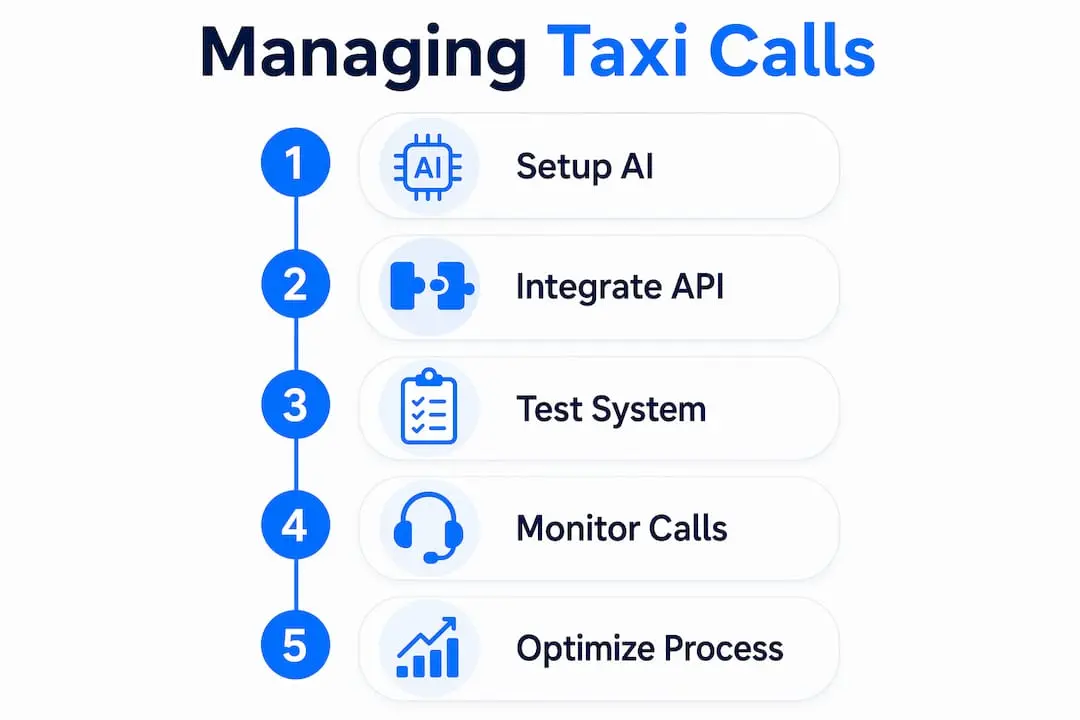
How to implement a step-by-step process for modernising phone line management
Modernising your phone line management works best as a phased transition rather than an overnight replacement. Phased adoption starting with after-hours AI call handling reduces risk and builds staff confidence before you extend automation to peak hours.
-
Start with after-hours and overflow routing. Direct calls that arrive outside staffed hours, or when all operators are busy, to your AI system first. This captures revenue you are currently losing without disrupting your existing daytime workflow.
-
Configure booking detail capture and validation. Set your AI to collect name, pickup address, destination, date, and time on every call. Programme confirmation loops so the system reads back the booking before finalising it. This single step eliminates the majority of transcription errors.
-
Integrate via API with your dispatch software. Taxi dispatch software deployments can be completed in 10 to 20 minutes, with full data migration finished within 24 to 48 hours and no downtime. Connect your phone intake system to your dispatch platform so confirmed bookings flow directly into the job queue without a dispatcher touching them.
-
Set up human fallback procedures. Callers who request a live operator by saying “operator” or pressing zero should reach a human immediately. Define which call types always escalate: account disputes, accessibility requirements, and multi-stop corporate bookings are good starting categories.
-
Train your dispatch team on exception management. Staff should monitor the system for flagged calls rather than processing routine bookings. This frees them to handle the situations that genuinely need human judgement.
-
Monitor, measure, and expand scope. Review call handling data weekly for the first month. Track answered calls, booking completion rates, and escalation frequency. Once after-hours performance is stable, extend AI coverage to peak daytime hours.
Pro Tip: Run a two-week parallel period where your AI handles after-hours calls and your team reviews every booking the next morning. This builds trust in the system’s accuracy before you reduce manual oversight.
The key discipline here is resisting the urge to automate everything at once. Operators who phase adoption report smoother staff transitions and fewer customer complaints during the changeover period.
What common challenges arise when managing taxi phone lines?
Even well-configured systems encounter friction. Knowing where problems typically appear lets you address them before they affect customers or drivers.
Incomplete booking information is the most frequent issue. Callers sometimes provide vague addresses, use local nicknames for landmarks, or forget to specify the return leg of a journey. AI systems with natural language understanding parse complex, casual speech and check for clarification before finalising a booking, but you still need to audit edge cases regularly and update your system’s address database with local landmarks.
AI to human handover friction frustrates callers when the transfer is slow or requires them to repeat information. The solution is to pass the full call transcript and captured booking data to the human operator before they speak to the caller. The caller should never have to repeat their name or address.
Lost calls during peak demand remain a risk if your AI system has capacity limits or your telephony provider throttles concurrent connections. Verify your provider’s concurrent call ceiling before peak periods like New Year’s Eve or major local events.
Technical integration failures between your phone system and dispatch software are usually caused by API authentication errors or data format mismatches. Test the integration with live bookings in a staging environment before going live, and set up automated alerts for failed data transfers.
“The operators who struggle with AI phone systems are almost always the ones who tried to replace their entire workflow in a single weekend. The ones who succeed treat it as a gradual handover, not a switch.”
Maintaining customer trust requires consistency. Customers who receive a professional greeting, accurate booking confirmation, and an on-time driver will not care whether a human or an AI took their call. Customers who are confused by the system or receive wrong booking details will complain regardless of the technology involved.
What are the best practices for improving taxi phone responsiveness?
The best practices for efficient taxi customer service via phone centre on three principles: eliminate queues, confirm every detail, and make your number easy to remember.
Eliminating call queues is the most direct way to improve taxi phone responsiveness. Automated systems absorb fluctuating demand without hiring more staff, which means your phone line scales with demand rather than against it. A single operator handling a queue of six callers loses at least two of them to hang-ups. An AI system answers all six simultaneously.
Confirmation loops are underused and highly effective. After capturing booking details, your system should read them back to the caller and ask for explicit confirmation before ending the call. AI voice systems enhance booking accuracy by confirming details immediately, which reduces downstream corrections and improves driver efficiency. One confirmation loop at the point of booking prevents three correction calls later.
24/7 availability without increased payroll is achievable only through automation. AI provides consistent professional greetings and quick bookings at 3am just as reliably as at 3pm, without overtime costs or fatigue-related errors.
Memorable phone numbers are a practical branding tool that directly affects booking volume. A number like 0800 200 200 is recalled and redialled far more readily than a randomly assigned local number. Research into how memorable numbers transform taxi performance shows that number recall directly influences repeat booking rates, particularly for customers who book by phone rather than app.
Pro Tip: Use your call analytics to identify the hours with the highest abandonment rates. These are your priority windows for extending AI coverage first.
| Approach | Manual phone handling | AI-automated handling |
|---|---|---|
| Concurrent calls | One per operator | Unlimited |
| Hours of operation | Staffed hours only | 24/7 |
| Booking error rate | Higher, reliant on staff accuracy | Lower, real-time validation |
| Scalability during peaks | Requires additional staff | No additional cost |
How does integrating phone line management with dispatch software improve efficiency?
Direct integration between your phone intake and dispatch software is the step that converts phone line management from a customer service improvement into a full operational upgrade. API integration converts the phone line from a simple answering service into complete dispatch automation, with captured data flowing directly to driver assignment without any manual intervention.
The immediate benefit is the removal of manual data re-entry. Every time a dispatcher copies a booking from a notepad or a call log into the dispatch system, there is a risk of transcription error, delay, or omission. Automated intake eliminates that step entirely.
Real-time updates reduce driver wait times because job assignments are generated the moment a booking is confirmed, not when a dispatcher gets around to processing it. In a busy operation, that delay can be several minutes per booking. Across a full shift, it compounds into significant inefficiency.
Automated systems record call activity alongside booking outcomes, giving you visibility into missed calls, completed bookings, and escalations. This data supports operational decisions about staffing, automation scope, and peak-hour coverage. Without it, you are managing by instinct rather than evidence.
The dispatch team’s role shifts from processing routine calls to managing exceptions. Configuring systems to alert staff only for exceptions such as driver no-shows or complex itinerary changes reduces workload and improves focus. A dispatcher who handles twenty routine bookings per hour has no capacity to notice that a driver is running fifteen minutes late. A dispatcher managing exceptions catches that problem immediately.
Pro Tip: When evaluating dispatch software for integration, ask specifically about webhook support and real-time API documentation. Systems that require batch data transfers rather than real-time pushes will introduce delays that undermine the speed benefits of automation.
Key takeaways
Effective taxi phone line management requires AI voice automation, API-integrated dispatch software, and phased implementation to eliminate call queues, reduce booking errors, and scale capacity without additional staffing.
| Point | Details |
|---|---|
| AI handles concurrent calls | Voice agents answer unlimited simultaneous calls, removing busy signals during peak demand. |
| Phased adoption reduces risk | Start with after-hours automation before extending to peak hours to build staff confidence. |
| API integration removes manual steps | Direct connection between phone intake and dispatch eliminates re-entry errors and speeds job assignment. |
| Confirmation loops cut errors | Reading booking details back to callers before finalising reduces downstream corrections significantly. |
| Memorable numbers improve recall | Easy-to-remember phone numbers increase repeat bookings from customers who book by phone. |
Why I think most taxi operators are solving the wrong phone problem
I have watched operators spend months debating which dispatch software to buy while their phone lines remain the actual constraint. The dispatch software is not the problem. The phone line is. Every booking that does not get through is revenue that never enters the system, regardless of how good your dispatch platform is.
The operators I have seen succeed with AI phone management share one habit: they treated the first automation phase as a learning exercise, not a cost-cutting exercise. They ran after-hours AI alongside their existing setup, reviewed the bookings each morning, and corrected the system’s edge cases before expanding coverage. That discipline produced systems that their staff trusted and their customers never noticed.
The uncomfortable truth about taxi phone management in 2026 is that the technology is no longer the barrier. The barrier is the assumption that customers prefer speaking to a human. Most customers prefer getting through immediately. If your AI answers in two seconds and confirms a booking accurately, the customer is satisfied. If your human operator puts them on hold for three minutes, they hang up and call a competitor.
The future of taxi communication is not about replacing people. It is about deploying people where they add genuine value: handling the complex, the sensitive, and the exceptional. Routine bookings should never require a human. The operators who accept that earliest will have the most capacity to serve the customers who genuinely need personal attention.
For operators considering porting existing numbers to a new system, the process is far simpler than most assume and preserves the brand equity you have already built with your customer base.
— Rob
Get the right phone number for your taxi operation
A well-managed phone line starts with a number worth remembering. Phonenumbers is the UK’s leading provider of memorable 01, 02, and 07 numbers, and the right number is the foundation every automated booking system needs. A number your customers recall without looking it up means more direct calls, fewer lost bookings, and stronger brand recognition across every advert, vehicle livery, and word-of-mouth recommendation. Browse the Phonenumbers store to find a number that fits your area, your brand, and your growth plans. Numbers are no longer tied to local areas, so you can use any 01 or 02 number anywhere in the UK. Find yours today.
FAQ
What is the most effective way to handle high call volume for a taxi firm?
AI voice agents handle unlimited concurrent calls, eliminating busy signals during peak periods. Pairing them with API-integrated dispatch software converts every answered call directly into a confirmed booking without manual intervention.
How long does it take to set up an automated taxi phone booking system?
Taxi dispatch software deployments typically complete in 10 to 20 minutes, with full data migration finished within 24 to 48 hours. Most operators run a parallel testing phase for one to two weeks before extending automation to live traffic.
Should taxi operators keep human operators alongside AI phone systems?
Yes. Configuring human fallback options so callers can request a live operator maintains customer trust for complex or unusual requests. The recommended model is AI for routine bookings and human staff for exceptions only.
How does a memorable phone number improve taxi bookings?
A memorable number increases the likelihood that customers recall and redial your firm without searching for it. This directly supports repeat booking rates, particularly among older customers and those who prefer phone over app-based booking. Phonenumbers offers dedicated taxi phone numbers across all UK area codes.
What data should taxi operators track to monitor phone line performance?
Track answered calls, booking completion rates, escalation frequency, and missed call volume. Automated systems record call activity alongside booking outcomes, giving operators the visibility needed to adjust staffing and automation scope based on real demand patterns.