
TL;DR:
- The phrase “portable plumbing number” is not an official UK telecom term; it likely refers to number portability or memorable business numbers. Using portable numbers ensures business continuity across providers, relocation, and expansion, improving customer retention and brand consistency. Understanding and leveraging these concepts help small businesses build resilient, recognizable communication systems for long-term growth.
If you’ve searched for a “portable plumbing number” and landed here slightly puzzled, you’re not alone. This phrase trips up a surprising number of UK business owners who are actually looking for something very specific: a phone number they can take with them when they move, switch provider, or simply want something more memorable for their brand. The good news is, what you’re really looking for absolutely exists, and getting hold of it is simpler than the jargon-filled telecoms industry would have you believe. This guide cuts through the confusion and gives you everything you need to make the right call.
Table of Contents
- What does ‘portable plumbing number’ really mean?
- Number portability vs. memorable business numbers
- Why choose a portable business number?
- How to secure a memorable, portable number for your UK business
- Our take: why clarity on terminology is crucial for business telecoms
- Get the right number for your business today
- Frequently asked questions
Key Takeaways
| Point | Details |
|---|---|
| Clarify telecoms terms | Understanding the right terminology avoids costly mistakes when managing business numbers. |
| Number portability benefits | Porting lets you keep your contact number even as your business grows or changes suppliers. |
| Memorable numbers enhance branding | A standout, easy-to-recall number boosts brand recognition and customer access. |
| Practical steps available | It’s straightforward to identify, secure, and implement a portable number for your business. |
What does ‘portable plumbing number’ really mean?
Let’s be direct: “portable plumbing number” is not a recognised telecoms term anywhere in the UK. If you’ve come across it, it’s likely a misreading or mishearing of a term related to number portability, which is a very real and very useful concept for business owners. Alternatively, some people use it as a loose shorthand for a mobile number used by a plumber or trades business. Either way, the phrase itself will get you nowhere with a phone provider.
The distinction matters enormously. If what you mean is keeping the same phone number when switching landline, mobile, or VoIP suppliers, the correct term is number porting, not “portable plumbing number.” If you mean choosing a number that’s easy for customers to remember and dial, that’s a memorable number. And if you want one that follows you across providers and locations, that’s where virtual numbers come in.
“If what you mean is ‘keeping the same phone number’ when switching landline, mobile, or VoIP suppliers, the correct term to use is ‘number porting/number portability,’ not ‘portable plumbing number.’”
Here’s a quick glossary of the terms you actually need:
- Number porting: The process of moving your existing phone number from one telecoms provider to another without losing the number.
- Number portability: The ability of a phone number to be moved between networks, locations, or services.
- Memorable number: A phone number chosen specifically because it’s easy for customers to remember, repeat, or dial.
- Virtual number: A number not tied to a physical line or SIM, often hosted in the cloud and portable across providers.
Understanding these terms is the first step to making a genuinely informed decision about your business communications.
Number portability vs. memorable business numbers
These two concepts often get muddled, but they serve quite different purposes, and the smartest businesses use both together.
Number portability refers to moving your phone number between services, while memorable business numbers enhance brand recall. One is about continuity; the other is about impact. Think of portability as your safety net and memorability as your marketing tool.
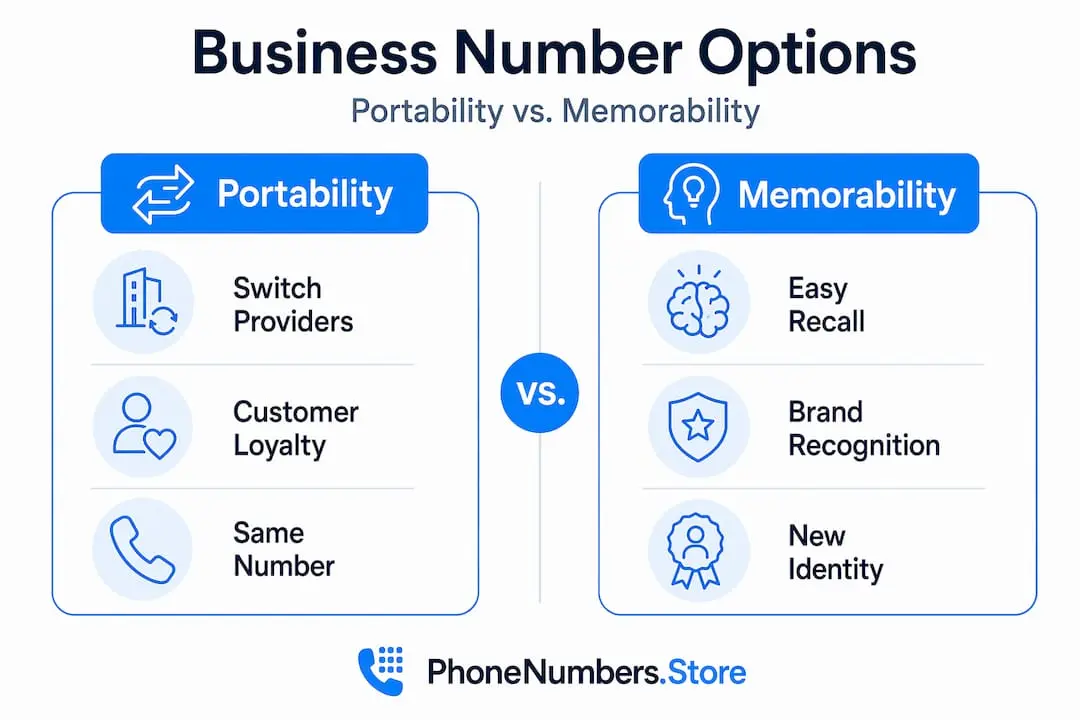
Here’s how they compare side by side:
| Feature | Number portability | Memorable business number |
|---|---|---|
| Primary purpose | Keep your number when changing supplier | Make your number easy to recall |
| Process | Request port via new provider | Select and acquire from specialist provider |
| Key benefit | No disruption to existing customers | Stronger brand awareness and recall |
| Best for | Businesses switching networks | Businesses growing their customer base |
| Cost | Often free or low-cost | Varies by number, can be premium |
| Time to set up | A few working days | Often immediate |
Both approaches protect your brand in different ways. Portability ensures customers who already know your number can always reach you. A memorable number makes it far easier for new customers to find you in the first place, especially if they heard your number on the radio, saw it on a van, or spotted it on a leaflet.
When you use porting your number in the UK alongside a strategically chosen memorable number, you create a communications setup that’s both resilient and commercially powerful.
Pro Tip: Prioritise portability when you already have an established customer base who knows your number. Prioritise memorability when you’re actively marketing to new audiences and want your number to work as hard as your advertising does. Use a standout business number from the start to combine both advantages in one.
Why choose a portable business number?
Understanding the distinction is one thing. Knowing why it matters to your bottom line is another. Here’s the reality for UK small businesses: your phone number is often the first point of contact a customer has with your brand. Changing it, even once, can cost you more than you’d expect in missed calls, confusion, and lost trust.
Number portability offers genuine flexibility and resilience for UK businesses in ways that many owners don’t fully appreciate until they face a problem. Consider these practical advantages:
- Business relocation: Moving premises doesn’t mean changing your number. A portable number stays with you regardless of your physical address, and crucially, UK numbers are no longer tied to local areas. You can use an 0113 Leeds number from a business based in Cornwall.
- Provider switching: Found a better deal with a new telecoms provider? Port your number and switch without any disruption to your customers.
- Disaster recovery: If your primary line fails, a portable virtual number can be rerouted to a mobile instantly, keeping your business reachable.
- Mobile working: For trades businesses, sole traders, and field teams, a portable number means your business identity travels with you.
- Scaling and expansion: As your business grows and adds locations or staff, a portable number infrastructure scales without the administrative headache of updating all your marketing materials.
It’s worth noting that retaining your existing number has a direct impact on customer retention. Customers who’ve saved your number in their phone won’t know to search for a new one. They’ll simply try the old one, find it dead, and call a competitor instead.
The benefits of virtual phone numbers are particularly strong for businesses that want both portability and memorability simultaneously. A virtual number sits in the cloud, routes calls wherever you need them, and can be as memorable as you choose it to be, whether that’s a catchy sequence, a repeated digit pattern, or an 0800 freephone format.

The UK telecommunications sector continues to grow, and businesses that build smart, flexible communications foundations are the ones that scale most smoothly.
Pro Tip: When you acquire a memorable virtual number, you own the commercial identity of that number from day one. That means even if you change your underlying phone service in future, the number and the brand recognition you’ve built around it comes with you.
How to secure a memorable, portable number for your UK business
Right, let’s get practical. Structured steps for small business owners exist to make this process as smooth as possible, and following them in order saves you from costly mistakes.
Here’s what the process typically involves:
| Step | Action | Key consideration |
|---|---|---|
| 1 | Select your ideal number | Choose a format: 01/02 landline or 07 mobile; prioritise recall |
| 2 | Check availability | Search by sequence, area code, or pattern |
| 3 | Confirm portability | Verify your chosen number can be ported if needed in future |
| 4 | Acquire the number | Buy or rent from a specialist UK provider |
| 5 | Set up call routing | Point the number to your existing mobile, landline, or VoIP system |
| 6 | Test thoroughly | Make test calls from multiple networks before going live |
| 7 | Update all records | Website, social media, directories, van signage, print materials |
Follow these steps in order:
- Define your objectives. Are you replacing an existing number, adding a marketing line, or setting up a brand-new business? Your goal shapes your choice.
- Choose your number format. A 01/02 number gives you a local feel and credibility, especially for trades and professional services. A 07 mobile number signals accessibility and flexibility. Neither is tied to a specific location any longer.
- Search for availability. Use a specialist database to search by digit pattern, area code, or word sequence. Numbers like 0113 255 0000 stand out immediately because of the repeating zeroes.
- Acquire and set up. Once you’ve secured your number, configure call routing so it connects seamlessly to your existing devices.
- Inform your network. Update your business phone numbers everywhere they appear, from Google Business Profile to your email signature.
- Monitor and adjust. Track which marketing channels drive calls to your memorable number so you can measure its real commercial value.
The mobile franchising business model demonstrates just how important a consistent, portable number is across distributed teams and locations. The principle applies to any business with ambitions to grow.
Our take: why clarity on terminology is crucial for business telecoms
Here’s something the telecoms industry won’t always admit: the jargon is confusing by design. Terms like “DDI,” “SIP trunking,” “PSTN,” and “number portability” are thrown around without explanation, and business owners are left to piece together what they actually need. The result? Businesses end up on the wrong tariff, with the wrong number type, or stuck in a contract that doesn’t serve their actual goals.
We’ve seen it repeatedly. A sole trader searches for a “portable plumbing number” because they heard the phrase from someone in their trade network, not realising it isn’t a real telecoms category. They contact a generic provider, get confused by the options, and either choose something unsuitable or give up entirely and stick with their personal mobile. Neither outcome is good for their business.
The practical wisdom here is this: always confirm definitions with every provider before you commit. If a provider uses a term you don’t recognise, ask them to explain it in plain language. Any reputable provider will do so willingly. If they can’t or won’t, that tells you something important about how they’ll handle your account when something goes wrong.
There’s also a broader point about proactive research. Business owners who take the time to understand the difference between portability and memorability, between a virtual number and a VoIP line, and between keeping your landline phone number and acquiring a new one, make consistently better commercial decisions. They negotiate better deals, set up more resilient systems, and don’t get caught out when their provider changes terms.
Your phone number is not a detail. For many small businesses, it’s the single most visible piece of contact information you have. It appears on every piece of marketing material, every vehicle, every invoice. Getting it right, and getting it portable, is a decision that pays dividends for years.
Get the right number for your business today
Sorting out your business number shouldn’t feel like wading through technical manuals. Whether you’re after a memorable 01/02 landline number, a flexible 07 mobile number, or both, the process is far more straightforward than most providers make it seem.
At phonenumbers.store, you can search our full database of available UK numbers by sequence, area code, or location. Browse by the town or city you want to be associated with, find a number with a pattern your customers will actually remember, and set it up quickly without any technical headaches. Want to see what a truly standout number looks like? Take a look at something like 0113 255 0000 for a sense of the impact a repeating sequence creates. Numbers like these don’t just get noticed; they get remembered.
Frequently asked questions
Is ‘portable plumbing number’ an official telecoms term in the UK?
No, it is not. The correct term for moving or keeping your business number across providers is “number portability”, and “portable plumbing number” is simply a misunderstanding of number porting.
Can I keep my business number if I change phone providers?
Yes, absolutely. Number porting lets you retain your existing phone number when switching providers, so your customers never need to update their records.
What’s the difference between a memorable number and a portable number?
A memorable number is one chosen because it’s easy for customers to recall and dial, such as a repeating digit pattern. A portable number is one that can be moved between phone suppliers or locations as your business evolves, and the best business numbers are both.
How do I buy or rent a memorable, portable number for my business?
You can search a specialist provider’s database for available UK numbers, select one that fits your brand, and set it up to route calls to your existing devices. Many numbers are available to buy or rent immediately.
Why should small businesses care about number portability?
Number portability reduces friction during growth and provider changes, meaning your customers always reach you on the same number regardless of what’s happening behind the scenes in your telecoms setup.