
A VoIP caller is someone placing a phone call over the internet rather than through the old copper telephone network. That’s the whole definition, but it matters because the technology that makes internet calling cheap and flexible also makes the number on your screen unreliable. Keep reading to find out how to check what’s really going on before you answer.
TL;DR:
- VoIP calls often pass through multiple intermediaries, which can alter or misrepresent caller ID information, making verification difficult.
- Most scam and spoofed calls use VoIP because it allows easy number manipulation and cheap, high-volume automated dialing.
- Trusting the displayed number is unreliable, so calling back on an independently sourced number is essential for verification.
- Choosing a reputable VoIP provider that controls signaling end-to-end reduces the risk of spoofing and call tampering.
- The UK is transitioning to digital VoIP infrastructure, so an increasing number of calls are VoIP-based, amplifying the importance of call authentication practices.
Table of Contents
- 1. Types of VoIP callers you might encounter
- 2. How VoIP call technology works behind the scenes
- 3. Why people and businesses choose VoIP calling
- 4. Why VoIP is linked to scam calls and number spoofing
- 5. How to tell if a call is VoIP or likely spoofed
- 6. What to do when you suspect a VoIP scam call
- 7. Why routing and provider choice matter more than most people think
- Keeping control of how your number is presented and routed
- FAQ
- Sources
1. Types of VoIP callers you might encounter
A VoIP caller can be almost anyone. Internet calling now covers consumer messaging apps, office phone systems and everything between. The common thread is that the voice never touches a traditional copper line until, in some cases, the very last step of the journey.
You’ll run into VoIP calls in several everyday forms:
- Consumer apps: WhatsApp, Microsoft Teams and Skype calls route entirely over broadband or mobile data.
- Softphones: apps or desktop programs that turn a laptop or smartphone into a phone line, often used by freelancers and small businesses.
- Hosted PBX systems: business phone systems run by a provider rather than a box in the office, common in call centres and customer service teams.
- SIP trunking: larger organisations connect their internal phone systems to the public network through a single internet-based trunk line, handling dozens of calls at once.
The difference between a consumer app call and a business-hosted system is largely about scale and control. A WhatsApp call is one person, one device, one session. A hosted PBX or SIP trunk might route hundreds of calls a day through shared infrastructure, often presenting one main number regardless of which employee or extension is actually dialling.
This shift is not a niche trend. The United Kingdom is migrating analogue phone lines to digital VoIP infrastructure by 2027, meaning many households will have a VoIP-based landline even if they never change their number or buy new equipment. Understanding what a VoIP caller is, in other words, is becoming a basic part of understanding how any phone call works, not just a concern for the technically minded.
2. How VoIP call technology works behind the scenes
VoIP calls do not travel as a continuous electrical signal the way a traditional copper line call does. Instead, your voice is chopped into small digital packets, compressed by a codec, and sent across the internet to be reassembled and played back at the other end, typically within milliseconds.
Setting up and managing that call relies on a signalling protocol, usually the Session Initiation Protocol (SIP). SIP handles the handshake between devices and networks: establishing the call, carrying details like the number being dialled, and tearing the call down when it ends. The information that becomes your Caller ID, known formally as Calling Line Identification (CLI), travels as part of this signalling data rather than as a fixed, hard-wired identifier.
That distinction is the root of most VoIP-related problems. Ofcom’s guidance on Calling Line Identification explains that CLI is signalling information exchanged between providers, not a verified form of identity. When a call passes through several intermediary networks, perhaps routed offshore to cut costs, there’s room for that signalling data to be altered, lost or misrepresented before it reaches your phone.
Here is what typically happens to a VoIP call in sequence:
- Your voice is converted into digital packets by a codec.
- Packets are sent over the internet using SIP to manage signalling.
- The call may pass through one or more intermediary carriers, including international routes.
- Your phone displays whatever Caller ID information arrives with the final signalling packet, correct or not.
Many mobile users decide whether to answer a call based mainly on the number shown on screen. That single habit is exactly why fraudsters bother spoofing numbers at all. If nobody trusted Caller ID, spoofing wouldn’t be worth the effort.
3. Why people and businesses choose VoIP calling
VoIP exists because it solves real problems that traditional phone lines never could. Cost is the obvious one: internet calls, especially international ones, tend to be cheaper than routing through the old public switched telephone network.
Portability is just as significant. A VoIP number isn’t tied to a physical line or a specific building, so a business can keep the same number when it moves office, and an employee can take their extension home without needing an engineer to rewire anything.
The feature set tends to go further too:
- Call forwarding that routes calls to multiple devices or locations at once.
- Voicemail-to-email, so messages arrive as audio files or transcripts in your inbox.
- One number, many devices, letting a team answer the same line from desk phones, mobiles and laptops.
- Remote working support, since a VoIP extension works anywhere there’s a decent broadband or mobile connection.
Hosted call centres often present a single outbound number for every agent on the team, regardless of who is actually dialling. That’s a legitimate business practice, not a red flag on its own, though it does explain why a call from an unfamiliar “local” number sometimes turns out to be a large organisation calling from a different city entirely.
Pro Tip: If a call claims to be from a well-known company but the number looks unfamiliar, hang up and dial the organisation’s published contact number instead of calling back.
4. Why VoIP is linked to scam calls and number spoofing
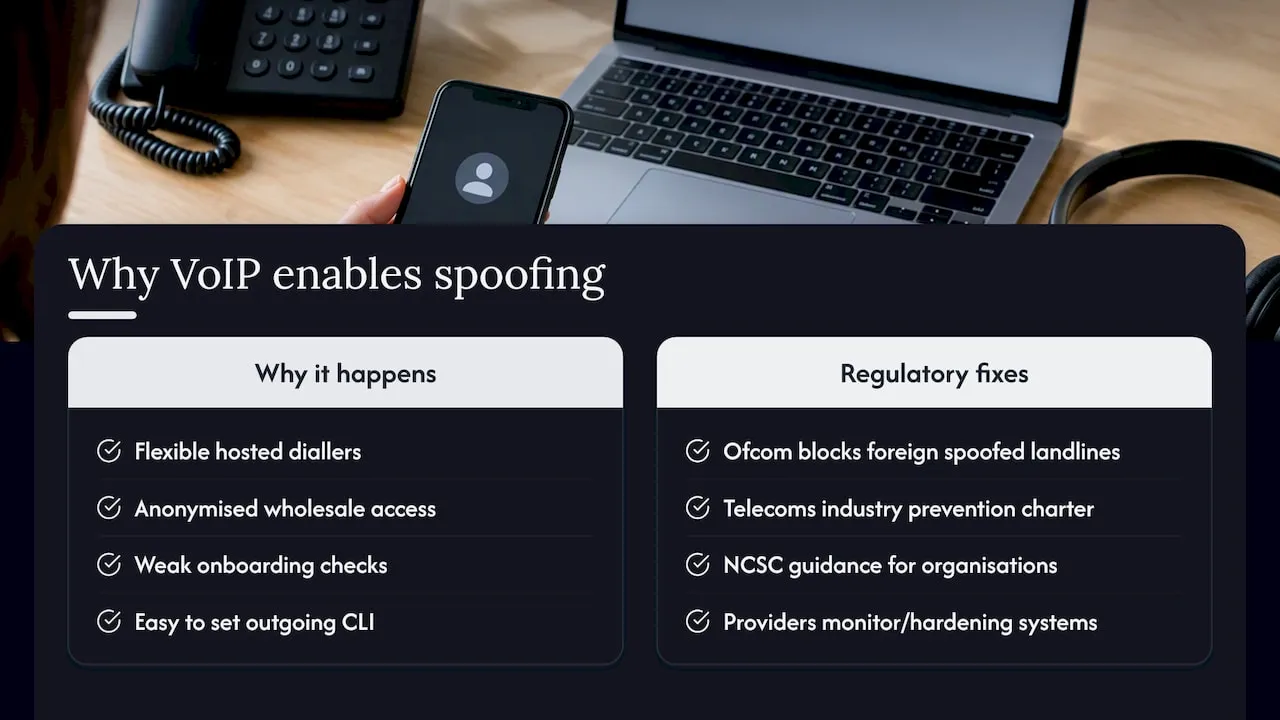
VoIP’s flexibility is precisely what criminals exploit. Hosted dialler platforms, SIP trunks and anonymised access to wholesale voice services make it straightforward to launch large volumes of calls while displaying whatever number suits the scam, often a legitimate local area code to make the call feel trustworthy.
A government call for evidence on anonymous access to phone numbers notes that weak onboarding checks at some number providers and wholesale platforms let fraudsters scale their operations with minimal friction. Criminals don’t need to hack anything sophisticated: they simply need access to a dialling platform that lets them set an outgoing CLI to whatever number they choose.
Many users decide whether to answer a call almost entirely based on the number displayed, which makes a spoofed local number one of the simplest tools available to a scammer.
That reliance on Caller ID as a trust signal, documented by Ofcom’s work on number spoofing, is why spoofing remains so persistent despite years of warnings.
Regulators have responded with practical fixes rather than just advice. Ofcom introduced new blocking requirements for calls from abroad that falsely present UK landline numbers, closing off one of the most common spoofing routes. Telecoms providers have also committed to a broader industry charter on scam call prevention, and the National Cyber Security Centre’s guidance on business communications sets out how organisations should monitor their own systems to avoid being hijacked as a source of spoofed calls in the first place.
5. How to tell if a call is VoIP or likely spoofed
Most spoofed calls share a handful of behavioural tells, regardless of how convincing the number looks. Pay attention to how the call feels, not just where it claims to come from.
Watch for these signs during the call itself:
- Pressure to act immediately, especially around payments, security codes or personal details.
- A number that looks local but the conversation doesn’t match, such as claiming to be a bank you’ve never used.
- Odd timing, like calls outside normal business hours for the organisation named.
- Repeated short calls that hang up after a few rings, often a sign of automated dialling testing live numbers.
Beyond the conversation itself, a few quick technical checks help:
- Run a reverse number lookup to see if the number has been reported before.
- Compare the country code of the number against what the caller claims, since a mismatch is a strong warning sign.
- Call back using an independently sourced number, never one given to you during the suspicious call.
Business owners handling inbound VoIP traffic should ask their provider directly how calls are routed, whether signalling is verified end-to-end and whether any part of the traffic passes through offshore networks that could affect how numbers are presented. Our guidance on verifying a phone number walks through independent checks step by step.
6. What to do when you suspect a VoIP scam call
The first few seconds of a suspicious call matter more than anything that follows. Stay calm, give away nothing, and verify independently before doing anything the caller asks.
- Hang up if you feel pressured, regardless of how official the caller sounds.
- Never share codes, passwords or payment details over a call you didn’t initiate.
- Verify independently by calling the organisation back on a number from its official website or a recent statement, not one the caller provided.
- Report the call using Stop! Think. Fraud’s guidance on spotting phone fraud, which covers the reporting routes available in the United Kingdom.
- Block the number on your device, even though a spoofed number is often never reused.
Pro Tip: Save your bank’s and utility providers’ official numbers directly into your phone contacts, so you’re never tempted to trust a number read out during a call.
Businesses carry extra responsibility here. Restrict international and premium-rate dialling where it isn’t needed, monitor for spikes in short-duration outbound calls that might indicate a compromised PBX, and insist that any provider follows proper signalling practices under Ofcom’s General Conditions. Our breakdown of how call forwarding actually works covers some of the configuration checks worth making on hosted systems.
7. Why routing and provider choice matter more than most people think
VoIP genuinely improved how we communicate: cheaper calls, number portability, and features landlines never managed. But the convenience comes with a catch that most guidance glosses over. The quality of the routing behind a call, not the technology itself, decides whether Caller ID can be trusted.
A number hosted by a provider that controls presentation and signalling end to end behaves predictably. One routed through several anonymous wholesale carriers does not, and that gap is where most spoofing lives. Choosing a reputable number provider is less about brand loyalty and more about reducing the number of hands your signalling data passes through.
— Rob
Keeping control of how your number is presented and routed
We built our service around a problem this article keeps circling back to: once a number passes through too many anonymous hands, you lose control over how it’s presented and whether its signalling stays accurate. Choosing who hosts your number and how it routes is one of the few genuine levers you have against spoofing and misrepresentation.
Our XL Hosted Voice Service with a VoIP phone (XLHV) gives you a managed VoIP line with a physical handset, so presentation and routing sit with a provider you can actually question and audit. For readers migrating an existing landline number away from the old copper network, XL-IP keeps your current BT number working over your broadband router rather than leaving you exposed during the switch.
If you’re starting from scratch, our number search tool lets you find and reserve a memorable UK landline, non-geographic or mobile number with full visibility over who’s providing it and how it’s routed, rather than inheriting whatever a reseller happens to assign you.
- Hosted voice service with a VoIP handset for direct provider accountability.
- Broadband-based line continuity for numbers moving off the old network.
- Searchable, reservable UK numbers across landline, non-geographic and mobile ranges.
Have a look through our available numbers and see which option fits how you want your calls presented and routed.
FAQ
Should I answer a VoIP caller?
Answering isn’t risky on its own, but treat the displayed number as unverified until the conversation gives you reason to trust it. If the caller asks for codes, payments or personal details, hang up and call back using an independently sourced number, as Stop! Think. Fraud recommends.
Why would someone call a VoIP number?
Most VoIP calls are entirely ordinary: businesses running hosted call centres, remote workers using softphones, or friends calling through apps like WhatsApp. VoIP is also simply cheaper and more flexible than the traditional network, which is why so many legitimate organisations use it.
Why am I getting VoIP calls?
You may be receiving more VoIP calls simply because the industry is shifting that way. The UK is migrating landlines to digital VoIP infrastructure by 2027, so a growing share of all calls, including scam attempts, now originate from VoIP systems rather than the old copper network.
Do I need a landline for a VoIP phone?
No, a VoIP phone works over broadband or mobile data rather than a traditional landline connection. Services like XL-IP let you keep an existing landline number while routing it entirely through your broadband router instead.