A caller ID number is the telephone number that appears on the recipient’s screen while your call is still ringing. In the UK the industry calls it Calling Line Identification, or CLI. For a taxi firm or a plumber it is the first thing a customer sees of your business, and it often decides whether they pick up.
This guide explains what the number is, where it comes from, how to hide or show it, why it can be faked, and how to make yours work for you.
TL;DR
- A caller ID number (CLI) is the number your phone network sends ahead of your voice. Whoever you call sees it before answering.
- Ofcom’s CLI guidance says the number must be valid and dialable, and that providers should deliver accurate CLI data where technically feasible.
- It can be spoofed, so treat it as a convenience, not proof of identity.
- For tradespeople, one memorable, consistent number shown on every outbound call builds recognition and trust.
- If your calls show as withheld or unknown, the fault is usually in your phone system settings, not the customer’s phone.
Table of Contents
- What a caller ID number actually is
- Why the number on the screen matters to your business
- Local, mobile or non-geographic: what the number tells people
- How to hide your number, show it, and see who called
- Why you sometimes see “No Caller ID”, “Withheld” or “Unknown”
- Spoofing: why caller ID is not proof of identity
- Make your caller ID work for the business
- Our view: the number is a shop sign
- Getting a memorable caller ID number with us
- FAQ
- Sources
What a caller ID number actually is
When you place a call, your phone network sends two things to the person you are calling: the call itself and a small packet of signalling data. Part of that data is your number. The receiving phone reads it and displays it, or shows a saved contact name if the number matches one in the address book.
Ofcom describes CLI data as made up of the caller’s line identity and a privacy marking, and notes it may also include an optional display name field. Two terms matter here:
- Network Number: the number that identifies the line where the call really entered the network.
- Presentation Number: the number displayed to the person receiving the call.
Often they are the same. They can differ legitimately, for example when a business with many lines wants every outbound call to show its main number. That is how a firm with ten drivers or three plumbers on the road can all appear to customers as one recognisable number.
Caller ID, CLI, caller display: the same thing
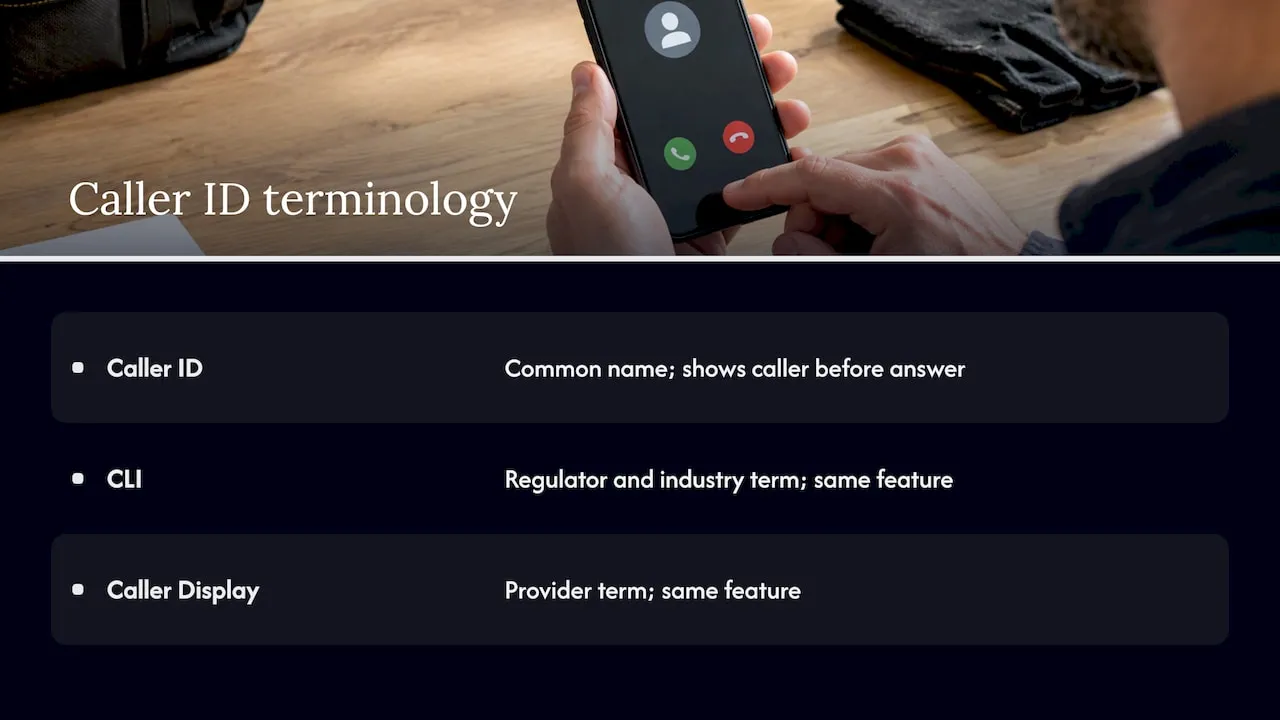
You will see several names. Caller ID is the common one, CLI is the regulator’s and industry’s term, and some providers call it Caller Display. They all describe the same feature: showing who is calling before you answer.
Why the number on the screen matters to your business
People judge a call in the second before they answer. The government has said that 96% of mobile users decide whether to answer a call based on the displayed number, and that three-quarters are unlikely to pick up if it looks like an unknown international number.
That has direct consequences for trades:
- A plumber calling back a quote enquiry from a personal mobile or a hidden number may be ignored. The same call from a number the customer already saw on your van or website gets answered.
- A taxi firm confirming a booking or telling a passenger the car has arrived needs the passenger to recognise the call as the firm, not a stranger.
- A missed call that gets returned only helps you if the number the customer sees is one that reaches you. Return a call to a driver’s personal mobile and the booking may land with the wrong person, or nobody.
In short: the caller ID number is part of your branding. It is worth choosing it on purpose.
Local, mobile or non-geographic: what the number tells people
The prefix of your number says something before anyone reads your name.
| Prefix | Type | What customers tend to read into it |
|---|---|---|
| 01 / 02 | Geographic landline | A local, established business |
| 07 | Mobile | Reachable directly, often a sole trader or driver |
| 03 | Non-geographic | A national or organised business |
| 08 | Non-geographic | Service or helpline numbers |
Geographic numbers are no longer tied to the place you work. You can use a number with a given area code anywhere in the UK, so a firm can pick the code that matches the area it serves and route calls wherever it likes. If you want to compare how landline and mobile numbers differ for callers, our piece on which UK business number can cost callers up to 16p goes through it.
How to hide your number, show it, and see who called
The UK has a few short codes for this. They apply per call or permanently, depending on the code.
- 141 before the number withholds your caller ID for that call. The recipient sees a withheld or private label.
- 1470 before the number shows your number for that call when it would otherwise be withheld.
- 1471 tells you the last number that called you, unless it was withheld.
- *31# is a star code that suppresses your caller ID persistently on some lines, and #31# typically switches that off again. Whether it works depends on your line or provider.
A caution for businesses: do not expect a code to protect a number you want to keep. Dialling a code does not reserve or secure anything. If you want to hold a particular number while you decide, you do that by reservation instead; our guide explains why no dial code can reserve a UK business number.
If a customer rings you from a withheld number and you need to find them, see how to trace a private caller and reserve the number for 30 days, and for a broader walkthrough, how to find out what number is calling you.
Why you sometimes see “No Caller ID”, “Withheld” or “Unknown”
These labels are not all the same and not all sinister.
- Withheld or private: the caller chose to hide the number, or their line is set to do so by default.
- Unknown or unavailable: the network could not pass the number on. This can happen when the call originates abroad, from certain payphones, or over a network type that does not carry the data.
- Switchboard calls: some business switchboards present a general or extension number, or none.
The last point is worth checking if you run dispatch software. If your automated system places calls through a trunk that is not configured to present your number, customers see “unknown” and do not answer. Ask your telephony provider to confirm that your chosen number is set as the Presentation Number on outbound calls, and test it by calling a friend’s mobile from every device your staff use.
Also check the receiving end. Old handsets, a faulty extension lead or interference from other electronics can make caller display appear to fail when the network sent the number perfectly well.
Spoofing: why caller ID is not proof of identity
Because CLI is passed as data between networks, it can be falsified. Ofcom explains that number spoofing is when scammers change their caller ID to disguise their identity, often imitating a trusted person or organisation. The National Cyber Security Centre gives the same message in its telephone best practice guidance for businesses: do not treat the displayed number as a guarantee of who is calling, especially if they ask for sensitive information or urgent payment.
That applies in both directions:
- As a customer of yours, people may receive a call that shows your number but is not you. Tell customers you will never ask for card details by an unsolicited call, and say so on your website.
- As a recipient, if a caller claims to be your supplier or bank, hang up and ring back on a number you already know.
We have written separately about spotting fake local numbers and VoIP caller spoofing in the UK and how to report it.
What the UK is doing about it
From 29 January 2025, Ofcom’s updated rules expect providers to block calls from abroad that spoof a UK number. Government reported in November 2025 that spoofed numbers were being blocked as mobile networks upgraded their infrastructure.
There is a practical consequence for you. Legitimate businesses can be caught up in blocking if their calls are routed through an unusual path. Ofcom’s guidance expects providers to carry the true Network Number alongside any Presentation Number, and routing a UK number in and out of an overseas platform is the kind of pattern that can trigger a block. Use a UK-based, reputable provider and keep the way your number is routed simple.
Make your caller ID work for the business
A few habits make the biggest difference.
- Use one main number. The NCSC advises keeping telephone numbers, email addresses and sender IDs to an absolute minimum and keeping communications consistent. A plumber with one number on the van, the invoice, the Google listing and every outbound call is easier to recognise, and easier for networks to trust. The same logic applies to brand more widely: why brand consistency matters for business growth is a useful read if you are tidying up your presence.
- Show it on every outbound call. Do not let drivers or engineers call back from personal mobiles. Route their calls through the business number or a business mobile.
- Choose a number people can remember. A number with repeated digits or a clean sequence is easier to say, to write on a van door and to dial from memory.
- Do not withhold it for customer calls. Withheld numbers get ignored.
- Test regularly. Ring a mobile on each network from every device you use, and after any change to your phone system.
- Keep calls on UK routes. Do not route your number offshore.
If you forward calls to a mobile, the number the customer sees depends on how forwarding is set up. Our guide on which number shows when call forwarding is on gives three checks, and the UK call divert guide covers the common +44 setup mistake.
Our view: the number is a shop sign
We sell memorable UK numbers for a living, so we have a clear opinion on this. Most tradespeople we speak to think of their number as a way to be reached. We think of it as a shop sign that also happens to ring.
Here is what follows from that.
- Pick it before you print it. A number goes on vans, uniforms, cards and directories. Changing it later costs more than choosing carefully now. That is why we offer a 30 day reservation for £10, so you can hold a number while you check it works for you.
- Keep it yours. Numbers are portable, so you can move provider without losing the number your customers know. You are not stuck with whoever you started with.
- Match prefix to message. A local 01 or 02 number reassures customers in one area. A 07 number suits a driver or sole trader who is always on the move. We stock both, along with 03 and 08 numbers.
- Do not chase tricks. No number makes you immune to spoofing. A consistent, UK-routed number, presented correctly and published widely, is the best defence we know of, and it matches the advice from the NCSC.
The number is the part of your phone setup customers actually see. Spend your effort there.
— Rob
Getting a memorable caller ID number with us
You can search our database by number, sequence, area code or town, city or county, then buy or rent. Our range covers 01 and 02 landline numbers and 03 and 08 non-geographic numbers, 07 mobile numbers, and alphanumeric phone names.
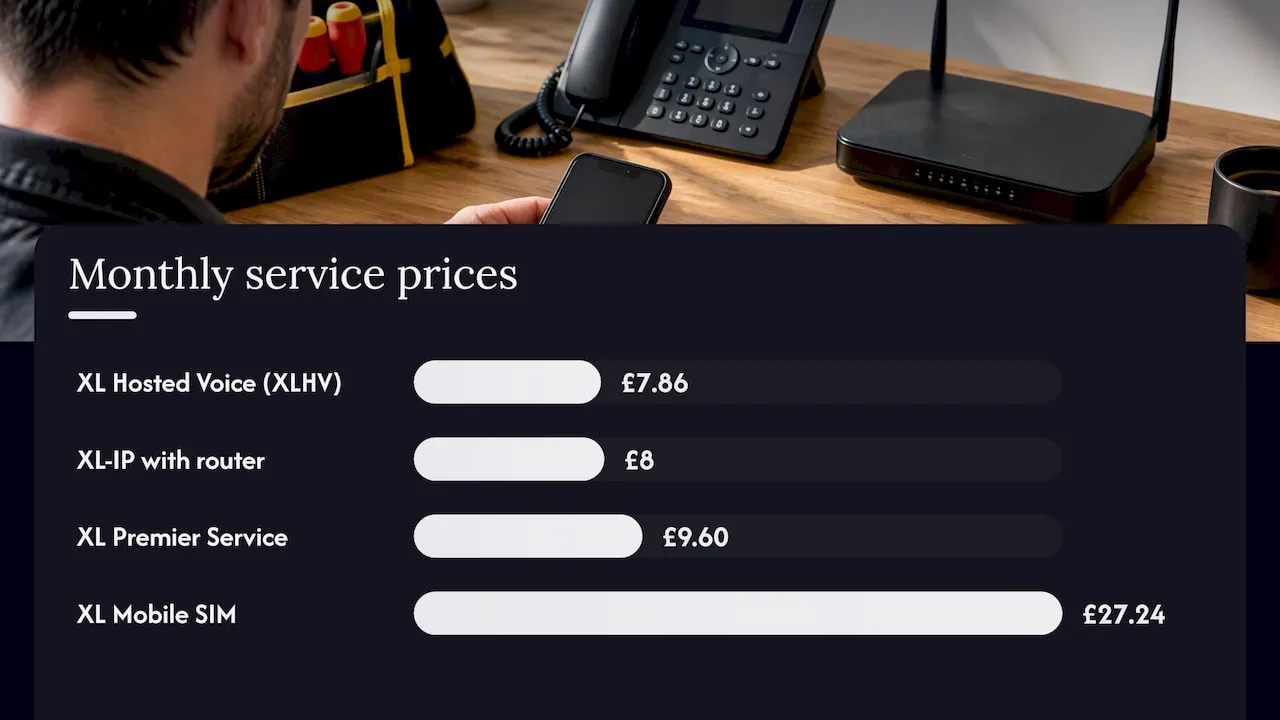
Once you have a number, there are several ways to put it to work. These are our published prices:
| Service | Set-up | Monthly |
|---|---|---|
| XL Premier Service | £14.40 one-off | £9.60 |
| XL Hosted Voice Service with a VoIP phone (XLHV) | £30 one-off | £7.86 |
| XL-IP, with router | £99 one-off | £8 |
| XL Mobile SIM | none listed | £27.24 |
XL-IP lets you keep an existing BT number and phone and use it through your broadband router. Call bundles on that page run from 250 minutes at £3.50 a month to 5000 minutes at £24.00 a month, covering calls to 01, 02 and 03 numbers and your top 4 mobile numbers. Taxi firms can also look at Taxi Connect Direct.
Not sure where to start? Search the full range of memorable numbers and reserve your favourite while you decide.
FAQ
What is a caller ID number?
It is the telephone number sent by the caller’s network and shown on the recipient’s screen as the call rings. In UK regulation it is called CLI, or Calling Line Identification. It may also carry a display name.
How do I make my number show on someone’s phone?
Outbound calls show your number by default unless it is withheld. If you use a business phone system, ask your provider to set your chosen business number as the one presented on outbound calls, then test it from a mobile. If you previously dialled 141 or set a permanent block, switch that off or dial 1470 before the number.
Can a caller ID number be faked?
Yes. Scammers can falsify the number to look like a trusted organisation, which is called spoofing. Ofcom and the NCSC both advise not treating the displayed number as proof of identity, and Ofcom’s rules now expect providers to block many spoofed calls from abroad.
Why do some calls show “No Caller ID”?
Usually the caller withheld the number, or the network could not pass it on, for instance on some international or payphone calls. It is not automatically a scam, but be cautious if the caller asks for payment or personal details.
Can I choose which number my business shows?
Often yes. With a business phone system or hosted service you can set the presentation number for outbound calls, provided you have the right to use that number. Use a number you own or rent, and keep it consistent.
Sources
- Ofcom: CLI Guidance on Calling Line Identification facilities
- GOV.UK: Spoofed numbers blocked in crackdown on scammers
- Ofcom: Number spoofing scams
- NCSC: Business communications, SMS and telephone best practice
- Ofcom: New blocking requirements to protect consumers from scam calls from abroad