
TL;DR:
- Short dial numbers are abbreviated codes used to speed up calls and messages in business and public services. They include speed dial, mobile dial, and SMS short codes, each serving different functions and requiring specific infrastructure. Proper planning ensures effective use, avoids costly mistakes, and enhances communication efficiency.
A short dial number is a condensed telephone code that enables faster voice calls or text messages, used by businesses and public services alike to simplify communication. The term covers three distinct categories: speed dial codes of 1–2 digits, mobile dial codes of 3–10 digits using symbols such as * or #, and SMS short codes of 5–6 digits designed for bulk messaging. UK organisations rely on these codes to reduce friction in customer service, internal operations, and mass communications. Understanding the differences between each type prevents costly mistakes and helps you choose the right code for the right purpose.
What is a short dial number and how does it work?
A short dial number is any abbreviated telephone code that replaces a full-length phone number to speed up a call or message. The industry term for the broader category is “abbreviated dialling,” though “short dial number” and “short dial code” are widely used in business contexts to describe the same concept.
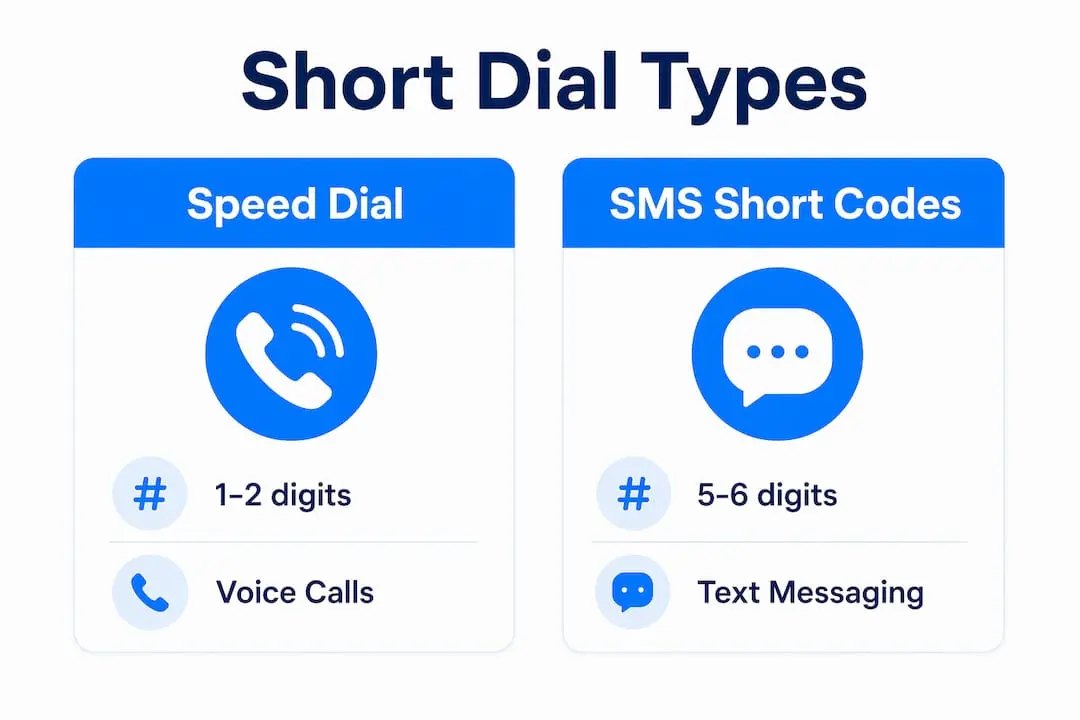
The three main types operate very differently. Speed dial codes are 1–2 digit shortcuts stored either on a handset or within a business phone system. Mobile dial codes use symbols like * or # followed by 3–10 digits to trigger service commands or send messages. SMS short codes are 5–6 digit numbers leased from carriers specifically for high-volume text messaging, two-factor authentication, and marketing campaigns.
UK public services use well-known short numbers that sit outside the business category entirely. 999 and 111 are government-assigned emergency and non-emergency medical numbers. These are not leased or configured by businesses. They exist to illustrate that short numbers span both public and commercial use, but the two worlds operate under entirely separate regulatory frameworks.
For UK businesses, the practical question is which category fits your communication goal. A contact centre routing calls internally needs speed dial. A retailer sending order confirmations needs an SMS short code. A field team accessing voicemail uses a mobile dial code. Each type serves a specific function, and none is interchangeable.
What are the different types of short dial numbers and how do they operate?
The three categories of short dial numbers differ in digit length, technical capability, and the infrastructure required to run them.
Speed dial codes
Speed dial codes are 1–2 digit shortcuts that connect a caller to a pre-assigned full number without dialling all the digits. They exist at two levels. Device-level speed dial stores the mapping on the handset itself, which means it does not transfer when you switch phones. Network-level abbreviated dialling works across any office phone connected to a PBX or VoIP system. That portability makes network-level codes far more practical for organisations with multiple staff or locations.
Mobile dial codes
Mobile dial codes combine a symbol (* or #) with a sequence of 3–10 digits. Carriers and service providers use these to trigger specific functions: checking your account balance, activating call forwarding, or accessing voicemail. Businesses rarely create these codes themselves. They are typically assigned by the network operator and accessed by customers or staff as part of a service package.
SMS short codes
SMS short codes are 5–6 digit numbers leased from telecom carriers for text-based communication at scale. SMS short codes handle high-throughput messaging but cannot receive voice calls. This is the single most common source of confusion for businesses. A short code that works perfectly for sending appointment reminders will not accept an inbound phone call. The two functions require entirely separate number types.
The table below summarises the key differences.
| Type | Digit length | Primary use | Voice capable? |
|---|---|---|---|
| Speed dial code | 1–2 digits | Internal calling via PBX or VoIP | Yes |
| Mobile dial code | 3–10 digits (with * or #) | Service commands, voicemail, call forwarding | Varies |
| SMS short code | 5–6 digits | Bulk messaging, 2FA, marketing alerts | No |
Pro Tip: Never publish an SMS short code as a contact number for voice enquiries. Customers who try to call it will get an error, and you will lose their trust immediately.
What are the benefits and limitations of short dial numbers for UK businesses?
Short dial numbers deliver real efficiency gains, but they come with constraints that businesses must plan around before committing.
Key benefits
- Faster connectivity. Staff reach colleagues or external contacts in one or two key presses rather than dialling full numbers.
- Easier recall. A five-digit SMS short code is far simpler for customers to remember than an 11-digit mobile number.
- Higher message throughput. SMS short codes process over 100 messages per second, making them the only practical option for time-sensitive mass alerts.
- Improved customer experience. Short, consistent contact points reduce call abandonment and message drop-off.
- Internal efficiency. Network-level speed dial codes let teams reach departments instantly without consulting a directory.
Limitations to plan around
- Cost. Leasing a dedicated SMS short code carries significant monthly fees, making it unsuitable for low-volume messaging needs.
- Setup time. Provisioning a dedicated short code takes 8–12 weeks due to carrier coordination requirements. Standard 10-digit numbers activate near-instantly by comparison.
- Voice restrictions. SMS short codes do not support voice calls. Businesses that need both voice and text must provision separate numbers.
- Security exposure. Short codes are targets for spoofing. Legitimate carrier registration is the primary defence against being blacklisted or associated with spam.
- Portability limits. Device-stored speed dial codes do not transfer between handsets, creating gaps when staff change phones.
Pro Tip: If your budget does not support a dedicated short code, a memorable landline number can serve customer-facing voice needs at a fraction of the cost, with no setup delay.
How can UK organisations implement and manage short dial numbers effectively?
The right implementation approach depends entirely on which type of short dial code you are deploying.
Setting up speed dial within PBX and VoIP systems
For internal speed dial, your PBX or VoIP administrator assigns short codes to extensions or external numbers within the system’s dial plan. Network-level abbreviated dialling means any phone connected to the system can use the code, regardless of the handset model. This is the correct approach for organisations with more than a handful of staff. Device-level speed dial is only practical for sole traders or very small teams.
Leasing and activating SMS short codes
The process for obtaining an SMS short code involves applying through a carrier or aggregator, submitting use-case documentation, and waiting through a provisioning period. Carrier coordination for short codes typically adds 8–12 weeks to the activation timeline. Plan this well in advance of any campaign launch date.
Implementation best practices
- Register your short code through a legitimate carrier or approved aggregator. Unregistered codes face blocking and spam classification.
- Document every number type in your system clearly, specifying whether it handles voice, SMS, or both.
- Test codes across multiple handsets and networks before going live with customers.
- Review usage logs regularly to catch unexpected traffic patterns that may indicate misuse.
- Brief customer-facing staff on which numbers handle which functions to prevent misdirection.
Pro Tip: When integrating short dial codes into a VoIP setup, confirm that your platform supports abbreviated dialling for businesses at the network level. Some entry-level VoIP packages only support device-stored shortcuts, which limits portability across your team.
How do short dial numbers fit into modern UK communication strategies?
The role of short dial numbers has shifted considerably as smartphone technology and VoIP platforms have matured.
Handset-based speed dial has declined sharply. Smartphones handle fast calling through favourites lists, recent calls, and voice commands. Few users programme 1–2 digit speed dial codes onto their personal phones any more. The function has not disappeared, but it has migrated almost entirely into organisational phone systems where it remains genuinely useful.
Network-level abbreviated dialling within PBX and VoIP environments is, if anything, more relevant now than a decade ago. Organisations running distributed teams across multiple sites depend on short internal codes to maintain fast, consistent communication without staff needing to know full extension numbers.
SMS short codes have grown in importance as text-based customer engagement has expanded. Two-factor authentication, delivery notifications, appointment reminders, and marketing opt-in campaigns all rely on short codes for their reliability and throughput. Businesses that boost customer engagement with SMS consistently report higher open rates than email for time-sensitive messages.
The most effective communication strategies treat short dial numbers as one layer within a broader system. They work alongside full geographic numbers, freephone lines, and digital channels rather than replacing them. A business might use a memorable 01 or 02 landline number as its primary public contact point, an SMS short code for outbound alerts, and internal speed dial codes for team routing. Each serves a distinct purpose, and the combination covers both inbound and outbound communication needs.
Key takeaways
Short dial numbers fall into three distinct types, and choosing the wrong type for a given task causes communication failures that damage customer trust.
| Point | Details |
|---|---|
| Three distinct types exist | Speed dial, mobile dial codes, and SMS short codes each serve different functions and cannot substitute for one another. |
| SMS short codes cannot handle voice | Businesses must provision separate numbers for voice and text to avoid customer-facing errors. |
| Setup takes time and budget | Dedicated SMS short codes require 8–12 weeks to activate and carry significant monthly leasing costs. |
| Network-level beats device-level | PBX and VoIP-based abbreviated dialling works across all connected phones, unlike handset-stored speed dial. |
| Security requires carrier registration | Legitimate registration protects short codes from spoofing, spam classification, and carrier blocking. |
Why most businesses get short dial numbers wrong from the start
The confusion I see most often is businesses treating SMS short codes as all-purpose contact numbers. A marketing team leases a five-digit code for a campaign, then someone publishes it on the website as the main contact number. Customers try to call it, get nothing, and assume the business is unreachable. That single mistake undoes the entire investment in the code.
The second most common error is underestimating setup time. Businesses plan a campaign launch for a specific date, then discover the short code will not be active for another two months. Standard phone numbers activate almost immediately. Short codes do not. If you need a number fast, a memorable geographic number is almost always the better starting point.
What I find genuinely underused is network-level speed dial for internal teams. Organisations spend considerable effort on customer-facing numbers and almost none on internal routing. A well-configured PBX with logical short codes for departments reduces call transfer time, cuts misdirected calls, and makes new staff productive faster. The branding benefits of easy-dial numbers get most of the attention, but internal efficiency gains are just as real.
My honest advice: map your communication needs before you choose a number type. Voice or text? Inbound or outbound? Internal or customer-facing? Answer those four questions and the right type of short dial code becomes obvious.
— Rob
Memorable UK numbers for your business from Phonenumbers
Short dial codes solve specific problems, but every UK business also needs a primary contact number that customers can find, remember, and trust.
Phonenumbers is the leading provider of memorable UK landline and mobile numbers, covering 01, 02, and 07 ranges. Numbers are no longer tied to local areas, so you can use a Leeds 0113 number or a Nottingham 0115 number from anywhere in the country. Browse available numbers including 0113 255 0000 and 0115 928 8888, or search by area code, town, or number sequence to find the right fit for your business. A number customers can recall without saving it is one of the simplest improvements you can make to your inbound communication.
FAQ
What is a short dial number in simple terms?
A short dial number is an abbreviated telephone code, typically 1–6 digits, used to make calls or send messages more quickly than dialling a full number. The three main types are speed dial codes, mobile dial codes, and SMS short codes.
Can I use an SMS short code to make voice calls?
No. SMS short codes are designed for text messaging only and cannot handle voice calls. Businesses that need both voice and text contact must use separate number types for each function.
How long does it take to set up a short code for my business?
Dedicated SMS short codes require carrier registration and typically take 8–12 weeks to activate. Standard geographic or mobile numbers activate far more quickly and are a practical alternative for businesses with urgent timelines.
What is the difference between device-level and network-level speed dial?
Device-level speed dial stores shortcuts on a single handset and does not transfer to other phones. Network-level speed dial, configured within a PBX or VoIP system, works on any phone connected to that system.
Are short dial codes safe to use for customer communications?
Short codes are safe when registered legitimately through an approved carrier or aggregator. Unregistered codes are vulnerable to spoofing and risk being classified as spam, which can result in carrier blocking and reputational damage.