
TL;DR:
- City dialling codes are numeric prefixes assigned to UK regions, regulated by Ofcom, and vary in length based on city size. Despite technological changes, these codes remain important for signaling regional identity and ensuring correct call routing, especially when used with proper international formatting. Misusing or inconsistently formatting these codes can lead to failed calls and diminished trust from customers.
City dialling codes are the numeric prefixes that identify specific geographic regions within the UK telephone network, enabling efficient routing of landline communications. Explaining city dialling codes properly means understanding how Ofcom’s National Telephone Numbering Plan assigns these prefixes, why their length varies by location, and how the national trunk prefix ‘0’ changes when you dial internationally. Whether you are a business choosing a number to signal local presence or an individual trying to call a new city, knowing how these codes work prevents errors and builds confidence in every call you make.

What are city dialling codes and how do they work?
City dialling codes, formally known as area codes or geographic codes, are the numeric sequences that precede a local subscriber number on a UK landline. They fall under the 01 and 02 prefix families and are governed by Ofcom’s numbering plan, which allocates codes to regions based on population, geography, and available number capacity. The code tells the telephone network where to route the call before the local number identifies the specific line.
Every UK geographic number follows a predictable structure: the trunk prefix ‘0’, followed by the area code, followed by the local subscriber number. The total length of a complete UK number, including the leading ‘0’, is typically 11 digits. That consistency is deliberate. Ofcom maintains it so networks and databases can parse numbers reliably across the country.
How do code lengths vary across UK cities?
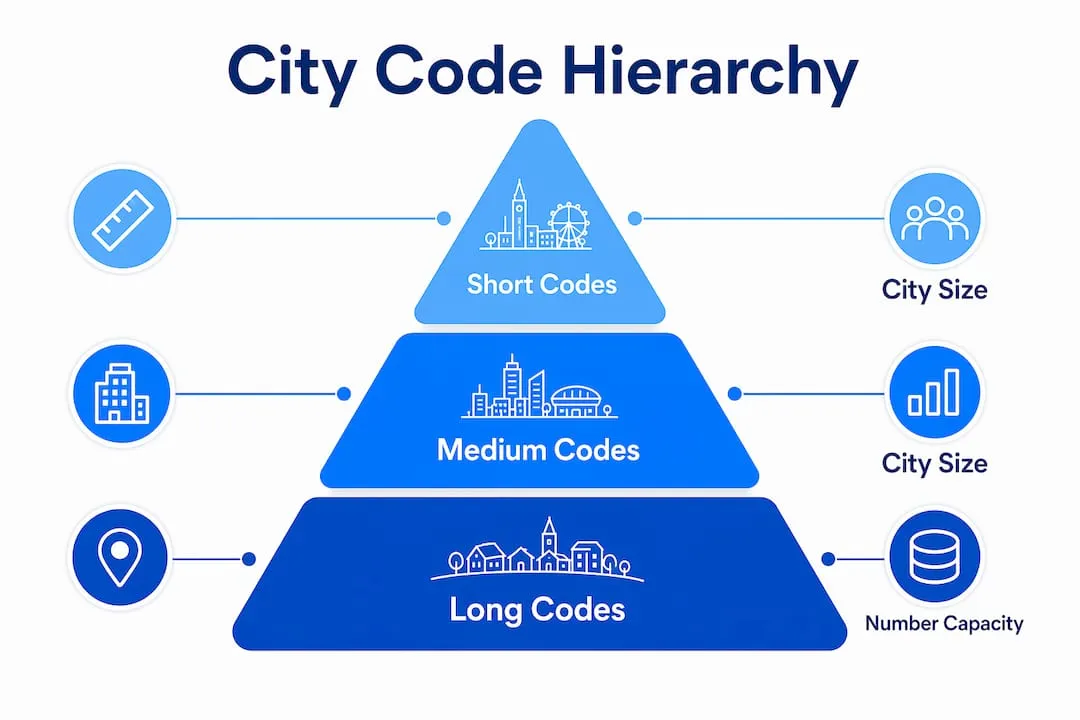
UK geographic area codes vary in length from 2 to 5 digits after the leading ‘0’. Shorter codes are assigned to larger cities because they need more subscriber numbers, and a shorter code leaves more digits available for the local number segment. Longer codes appear in rural or lower-density areas where fewer lines are needed.
London is the clearest example. Its area code is 020, a 2-digit code, which leaves 8 digits for the local number. A small market town in, say, the Scottish Borders might carry a 5-digit code, leaving only 5 or 6 digits for the subscriber number. The logic is purely mathematical: the network needs enough combinations to serve every line in the area.
The table below summarises how code length relates to city size and number capacity.
| Area code | City or region | Code digits | Local number digits |
|---|---|---|---|
| 020 | London | 2 | 8 |
| 0121 | Birmingham | 3 | 7 |
| 0131 | Edinburgh | 3 | 7 |
| 01865 | Oxford | 4 | 6 |
| 01539 | Kendal | 4 | 6 |
Pro Tip: When you save a contact, always include the full area code. Dropping it causes failed calls, especially when dialling from a mobile or a VoIP system that does not assume a local exchange.
What is the national trunk prefix and why does it matter?
The leading ‘0’ in every UK geographic number is the national trunk prefix. It signals to the network that the call is leaving the local exchange and routing to a different area. Without it, a domestic call to a number outside your local area will not connect correctly.
The rules change when you dial from abroad. The trunk prefix ‘0’ is dropped and replaced by the UK country code, +44. So the London number 020 7946 0000 becomes +44 20 7946 0000 when dialled internationally. A common mistake is writing ‘+44 (0) 20…’ and dialling it literally. Calling with +44 020 often fails on international networks and many VoIP systems, because the ‘0’ is redundant once +44 is present.
The difference between UK and US conventions trips people up regularly. In the US, the country code is +1 and there is no trunk prefix to drop. UK callers used to always dialling ‘0’ first sometimes carry that habit into international formats by mistake.
Correct formats at a glance:
- Domestic call to London: 020 7946 0000
- International call to London: +44 20 7946 0000
- Incorrect international format: +44 (0) 20 7946 0000
Pro Tip: Experts recommend storing all UK numbers in E.164 format, which means +44 followed by the number without the leading ‘0’. This format works on every network and every device without adjustment.
How do businesses and individuals use geographic codes today?
Geographic codes still carry real weight in how callers perceive a number, even though technology now allows city codes to be used anywhere. A business based in Manchester can hold a London 020 number and route calls to its Manchester office via VoIP. The code signals location to the caller, not the physical address of the business.
This matters for trust. Businesses use geographic numbers to build local credibility, even when their team works remotely or operates nationally. A London number on a website signals to a London customer that the business is accessible and familiar. The same logic applies to Birmingham, Edinburgh, Bristol, and every other major city with a recognisable code.
UK mobile numbers start with 07 and carry no geographic information at all. Mobile numbers convey nothing about where the caller or the business is based. That distinction makes 01 and 02 landline codes the only reliable signal of regional identity in the UK numbering system.
Number portability adds another layer. Ofcom allocates numbers in blocks of 1,000 but ports individual numbers between providers without moving the entire block. A number can change hands while keeping its original area code. The code therefore signals routing history and regional association, not a guaranteed physical address.
Practical uses of geographic codes for businesses include:
- Displaying a city code on a website to signal local presence to customers in that area
- Using a city-specific number to support regional marketing campaigns
- Routing calls from multiple city codes to a single team, giving national coverage with local appearances
- Maintaining consistent number formats across CRM systems to avoid failed outbound calls
How do you find and interpret city dialling codes correctly?
Finding the correct code for a UK city is straightforward when you use the right sources. Ofcom publishes its full numbering plan, and resources such as The Business Hub maintain updated lists of area codes by city and region. Phonenumbers lets you search by area code or town to find available numbers directly.
Interpreting codes correctly is where many people go wrong. The most persistent misconception concerns London. London’s area code is 020, not 0207 or 0208. The digit ‘7’ or ‘8’ that follows is the first digit of the local subscriber number, not part of the area code. Writing or storing a number as 0207 XXXX XXXX is technically incorrect and can cause formatting errors in databases and directories.
Steps to find and validate a UK city dialling code:
- Identify the city or region you need.
- Check Ofcom’s National Telephone Numbering Plan or a verified directory such as The Business Hub’s area code guide.
- Note the full area code including the trunk prefix ‘0’.
- Count the digits: the area code plus local number should total 11 digits including the ‘0’.
- Convert to E.164 format for international use by dropping the ‘0’ and adding +44.
- Test the number format in your CRM or contact system before bulk importing.
Maintaining accurate contact lists requires discipline. A number stored as 0207 rather than 020 7 will still dial correctly in most cases, but it will fail format validation in many modern systems and create inconsistency across databases. Standardising to the correct format from the start saves time and prevents errors at scale.
Key takeaways
City dialling codes are geographic prefixes regulated by Ofcom that signal regional routing, and understanding their structure prevents costly dialling errors for both individuals and businesses.
| Point | Details |
|---|---|
| Code length reflects city size | Larger cities like London use shorter codes (020) to allow more subscriber numbers. |
| The trunk prefix ‘0’ is domestic only | Drop the ‘0’ and add +44 when dialling UK numbers from abroad. |
| London’s code is 020, not 0207 | The ‘7’ or ‘8’ after 020 is part of the local number, not the area code. |
| Geographic codes no longer fix location | VoIP means a business can hold any city code regardless of its physical address. |
| E.164 format prevents international errors | Store numbers as +44 followed by the number without the leading ‘0’. |
Why city dialling codes still matter more than people think
People assume that because mobile phones and VoIP have made geography less relevant, area codes have become decorative. That view is wrong, and I have seen it cause real problems for businesses.
The most common error I encounter is companies storing numbers in inconsistent formats across their CRM, website, and printed materials. One branch lists a London number as 0207 XXX XXXX. Another uses 020 7XXX XXXX. Neither is catastrophically wrong in isolation, but the inconsistency breaks automated dialling systems, fails format validation, and looks unprofessional to anyone who notices.
The second issue is international callers. A business that trades with Europe or the US and lists its number as ‘+44 (0) 20…’ is setting up a portion of its inbound calls to fail silently. The caller hears nothing, assumes the number is wrong, and moves on. That is a lost contact, and it is entirely avoidable.
What I find most underappreciated is the trust signal that a well-chosen city code carries. A geographic number for UK businesses is not just a routing tool. It is a credibility marker. Customers in Leeds respond differently to a 0113 number than to an 0800 or a mobile. The local code says: we are here, we are accessible, and we are part of this community.
Understanding how codes work is not a technical exercise. It is a communication decision with real commercial consequences.
— Rob
Get the right city code number for your business
Phonenumbers is the UK’s leading provider of memorable 01 and 02 landline numbers, as well as 07 mobile numbers. If you want a number that signals the right city to your customers, the Phonenumbers database lets you search by area code, town, or county to find exactly what you need.
Numbers are no longer tied to physical locations, so you can use any city code from anywhere in the UK. Whether you want a London 020 number, a Birmingham 0121, or a smaller regional code to serve a local market, Phonenumbers makes it straightforward to find, choose, and secure the right number. Visit Phonenumbers to browse available city code numbers and get set up quickly.
FAQ
What is a city dialling code?
A city dialling code is the numeric prefix that identifies a geographic region within the UK telephone network. It precedes the local subscriber number and is regulated by Ofcom’s National Telephone Numbering Plan.
How many digits does a UK area code have?
UK area codes range from 2 to 5 digits after the leading ‘0’, depending on the size and population of the region. London uses a 2-digit code (020), while smaller towns may use 4 or 5 digits.
Do I drop the ‘0’ when dialling a UK number from abroad?
Yes. The leading ‘0’ is the national trunk prefix for domestic calls only. When dialling from abroad, replace the ‘0’ with the UK country code +44.
Is London’s area code 020 or 0207?
London’s area code is 020. The digit ‘7’ or ‘8’ that follows is the first digit of the local subscriber number, not part of the area code. Storing numbers as 0207 is a common formatting error.
Can a business use any city code regardless of location?
Yes. Due to VoIP and number portability, businesses can hold and use any UK geographic code from any physical location. The code signals regional identity to callers, not the business’s actual address.