
Small business owners across the UK often find themselves puzzled by area codes, unsure whether to display a local 01 number or opt for a national 03 code on their marketing materials. This confusion isn’t trivial: the wrong choice can erode customer trust and reduce response rates. Understanding UK area codes is essential for trades like taxi firms and plumbers who rely on local credibility to win business. This guide clarifies the structure of UK area codes, explains dialling rules, and shows you how to select numbers that enhance your business communication and marketing effectiveness.
Table of Contents
- Key takeaways
- Understanding the structure and history of UK area codes
- How to dial UK area codes correctly for your business
- Choosing the right area code to boost your small business marketing
- Special cases and regional nuances in UK area codes
- Explore business phone number options at PhoneNumbers.store
- Frequently asked questions
Key Takeaways
| Point | Details |
|---|---|
| Geographic codes vary | Geographic UK area codes start with 01 or 02 and the total ten digit number length varies by region. |
| Local codes boost trust | Using local area codes in marketing materials enhances customer trust and response rates. |
| Dialling rules differ | Domestic calls use the trunk prefix 0 followed by the area code and local number, while international calls drop the 0 and start with +44. |
| Full dialling sometimes required | Bournemouth 01202 mandated full dialling from 2012 onwards, meaning locals must dial the complete area code for local calls. |
Understanding the structure and history of UK area codes
UK area codes are part of the National Telephone Numbering Plan managed by Ofcom. Geographic codes start with 01 or 02, followed by a local subscriber number, totalling 10 digits including the trunk prefix 0 domestically. This structure ensures every UK landline has a unique identifier that signals its geographic origin to callers.
Code lengths vary significantly across regions, which can confuse business owners trying to format numbers correctly. London uses a 3-digit area code (020) followed by an 8-digit local number. Leeds operates with a 4-digit code (0113) plus a 6-digit local number. Some rural locations like Sedbergh use 5-digit codes (01539) with 4-digit local numbers. Understanding these variations prevents formatting errors that frustrate customers trying to reach your business.
Area codes evolved from historical STD letter mappings, seeing reforms on PhONEday in 1995 and the Big Number Change in 2000. These reforms standardised the system and freed up numbering capacity as demand grew. Ofcom now allocates blocks of numbers to telecommunications providers, who then assign them to businesses and residential customers. This historical context explains why some codes seem illogical: they reflect legacy infrastructure rather than modern geographic boundaries.
Key structural elements include:
- Geographic codes (01 and 02) indicate a physical location tied to traditional telephone exchanges
- The trunk prefix 0 is used only for domestic calls within the UK
- Total number length is always 10 digits for standard geographic numbers
- Area code length determines local number length, maintaining the 10-digit total
- Non-geographic codes (03, 08, 09) serve different purposes beyond location identification
Pro tip: Always verify the specific area code length for your target region before printing marketing materials. A misformatted number can cost you customer calls and damage your professional image. Check UK area codes facts to ensure accuracy before going to print.
How to dial UK area codes correctly for your business
Domestic calls use a trunk prefix ‘0’, then area code and local number. This format is what UK customers expect to see on your website, van signage, and business cards. International calls drop the initial ‘0’ and prefix the number with the +44 country code. Understanding both formats ensures your business remains accessible to local customers and international clients alike.
A London number (020 xxxx xxxx) dials domestically as 020 followed by the eight-digit local number. The same number appears internationally as +44 20 xxxx xxxx, dropping the trunk prefix 0 but retaining the area identifier 20. This dual format can confuse small business owners who aren’t sure which version to display prominently.
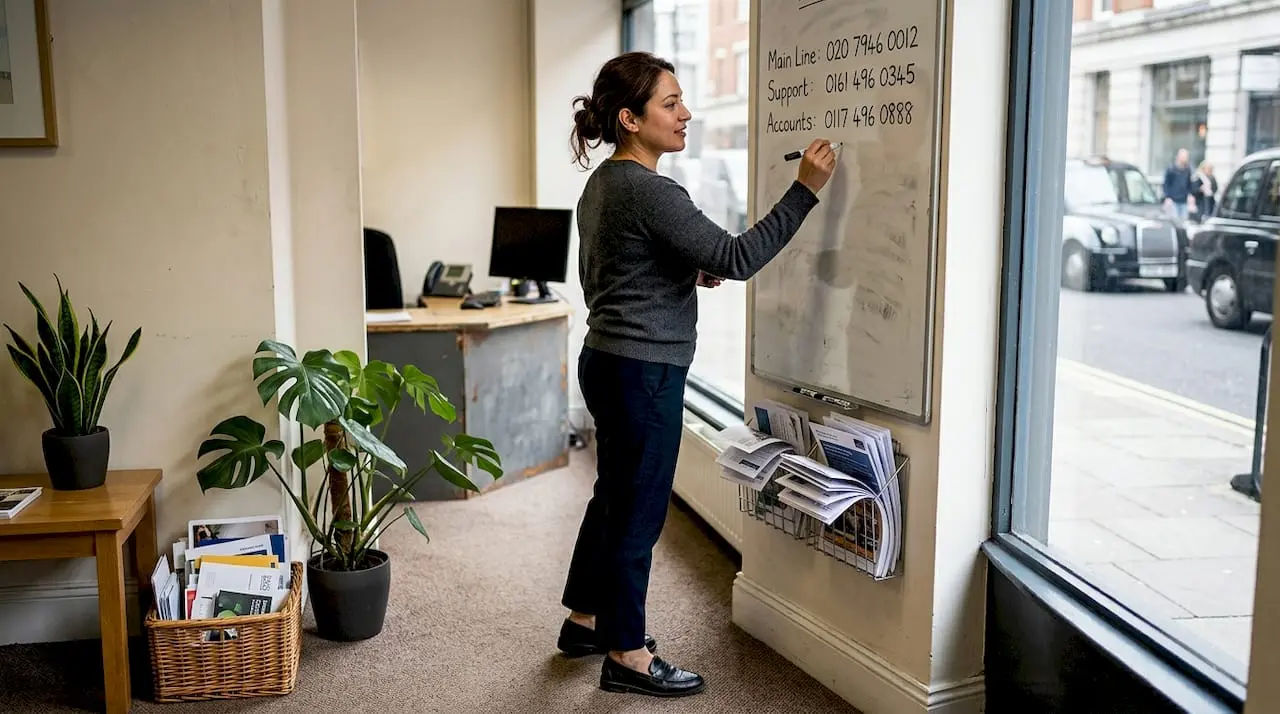
Some areas require full area codes even for local calls due to local numbering conventions introduced during telephone system reforms. Bournemouth (01202), for example, mandated full dialling from 2012 onwards, meaning callers within Bournemouth must dial the complete area code rather than just the local number. This affects how you instruct local customers to reach you and may require clearer signage.
Correct dialling improves accessibility and creates a professional business impression. Customers who encounter engaged tones or wrong numbers due to formatting errors quickly lose confidence in your business. Clear, accurate number display demonstrates attention to detail and operational competence.
Follow these steps for proper number formatting:
- Identify your area code length (3, 4, or 5 digits) to determine correct spacing
- Display domestic format with trunk prefix 0 for UK-based marketing materials
- Include international format (+44) on websites and digital platforms accessible globally
- Group digits logically (area code, then local number in readable chunks)
- Test your number from both mobile and landline to confirm correct routing
- Update all marketing collateral consistently to avoid customer confusion
Pro tip: Display phone numbers on websites and marketing with international format to accommodate all customers. This single approach works for both domestic and international callers, eliminating the need for multiple versions. Learn more about setting up a UK business line with proper formatting from the start.
Choosing the right area code to boost your small business marketing
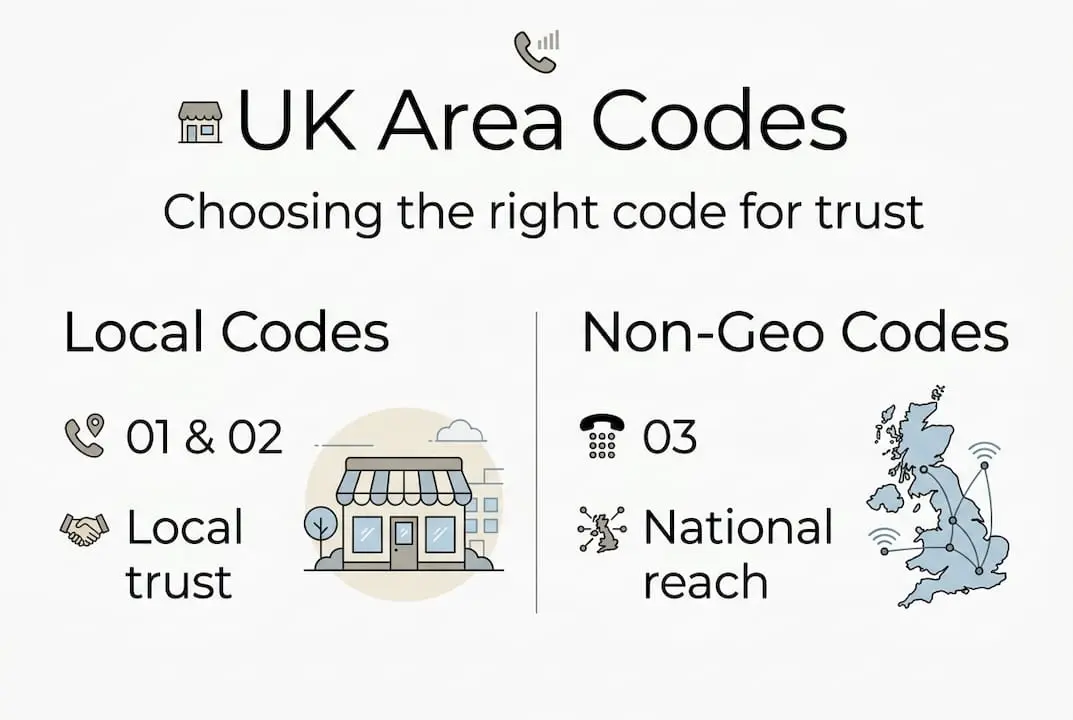
Local geographic area codes foster trust and better response rates compared to mobiles and freephone numbers. Small businesses in trades like plumbing and taxi services benefit enormously from displaying local 01 or 02 numbers because customers perceive them as established, reliable, and genuinely local. A Manchester plumber with an 0161 number immediately signals local presence and community connection.
Non-geographic numbers like 03 provide national reach but may reduce local credibility for trades such as plumbers or taxi firms. These numbers work well for businesses serving customers across multiple regions or those wanting to project a larger corporate image. However, a taxi firm operating solely in Bristol may find customers hesitate to call an 03 number, suspecting a call centre rather than a local operator.
| Number type | Cost to caller | Business perception | Best use case |
|---|---|---|---|
| Local 01/02 | Standard rate | Established local presence | Trades, local services, community businesses |
| Non-geographic 03 | Standard rate | National operation | Multi-region businesses, larger firms |
| Freephone 080 | Free to caller | Customer-focused | Support lines, high-volume enquiries |
| Premium 09 | Higher cost | Specialist service | Information lines, paid consultations |
Factors to consider when selecting your business number:
- Customer location and whether they value local presence over national reach
- Branding consistency across marketing materials and how area codes support your positioning
- Call cost implications for customers, particularly for trades where customers compare quotes
- Competitive landscape and what numbers similar businesses in your area display
- Future expansion plans and whether a local code limits perceived service area
Pro tip: Use local numbers on advertising and websites to underscore your local presence and credibility. Customers searching for “plumber near me” or “local taxi firm” expect to see area codes matching their location. Discover more about local phone numbers benefits and explore tips for choosing phone numbers that align with your marketing strategy. Understanding local vs non-local numbers helps you make informed decisions.
Special cases and regional nuances in UK area codes
Some area codes serve multiple places through the Exchange Local Numbering Scheme (ELNS), requiring precision when marketing to specific localities. For example, the 01204 code covers Bolton but also surrounding areas, so simply stating “Bolton number” may not accurately reflect your exact service location. This matters when customers search for hyper-local services.
Certain codes are unused or reserved, so verifying numbers before purchase is crucial. Ofcom maintains lists of allocated and unallocated number ranges, and attempting to use an invalid code can result in technical issues and customer frustration. Always confirm with your telecommunications provider that your chosen number is active and properly routed.
Since 2012, places like Bournemouth (01202) require full dialling even locally, affecting call handling and customer instructions. This change eliminated the shortcut of dialling just the local number within the same area, meaning all callers must now dial the complete area code. Small businesses must educate local customers about this requirement to prevent connection failures.
Island territories like the Channel Islands and Isle of Man use UK codes but have unique numbering contexts separate from mainland UK telecommunications regulation. Jersey uses 01534, Guernsey 01481, and Isle of Man 01624. While these codes appear in UK format, they operate under different regulatory frameworks and may incur different call costs for mainland customers.
| Special case | Area code example | Business implication |
|---|---|---|
| ELNS areas | 01204 (Bolton area) | Specify exact locality in marketing |
| Unused codes | 01201 | Verify number validity before purchasing |
| Mandatory full dialling | 01202 (Bournemouth) | Instruct all callers to use full code |
| Island territories | 01534 (Jersey) | Clarify call costs for mainland customers |
Handling these special cases in marketing and customer communication:
- Research your specific area code to identify any unusual dialling requirements
- Display clear dialling instructions on marketing materials if your area requires full codes locally
- Specify your exact service area rather than relying solely on area code to define coverage
- Inform customers upfront if your number may incur different charges due to island or special status
- Test incoming calls from various locations to ensure proper routing and connection
Pro tip: If operating in an ELNS area or special dialling zone, add a brief note on your website explaining any unique dialling requirements. This transparency prevents customer frustration and demonstrates your attention to accessibility. Learn about using non-local numbers when special circumstances apply to your business location.
Explore business phone number options at PhoneNumbers.store
Now that you understand how UK area codes work and their impact on customer trust, it’s time to secure the right number for your business. PhoneNumbers.store specialises in providing memorable UK phone numbers, including 01 and 02 landline codes and 07 mobile numbers tailored for small businesses like yours.
Whether you’re a taxi firm wanting a memorable local number or a plumber seeking to establish credibility in your service area, you can search the database by number sequence, area code, or specific town and city. Numbers are no longer tied strictly to local areas, so you can use them anywhere while still benefiting from the local trust they generate. Explore options to buy a phone number that enhances your marketing effectiveness, or visit the PhoneNumbers.store homepage to browse available memorable numbers. Discover the advantages of local numbers and how they transform customer perception of your business.
Frequently asked questions
What are UK area codes and why do they matter for small businesses?
UK area codes are the initial digits of a phone number that identify its geographic origin, starting with 01 or 02 for landlines. They matter because customers associate local codes with established, trustworthy businesses in their community. Displaying the right area code can increase response rates and build credibility, particularly for trades and local services.
Can I use a London area code if my business is outside London?
Technically yes, as numbers are no longer strictly tied to physical locations, but this approach may reduce local trust if your customers are outside London. A taxi firm in Birmingham using a 020 London code might confuse customers or appear less locally rooted. Consider your target market’s location and expectations when selecting area codes to maximise trust and response.
How do non-geographic numbers like 03 compare to local codes?
Non-geographic 03 numbers offer national reach and cost the same as standard calls, making them suitable for businesses serving multiple regions. However, local 01 and 02 codes generally inspire more trust and higher response rates from customers seeking local services. Choose 03 if you want to project a national presence, but stick with local codes if community connection drives your business.
What is the correct format to display my business phone number on marketing materials?
Use the full area code with trunk prefix 0 (e.g., 0161 xxx xxxx) for UK-focused marketing materials like flyers and van signage. Include the international +44 format (e.g., +44 161 xxx xxxx) on your website to accommodate international visitors and mobile users. Consistent formatting across all platforms prevents customer confusion and ensures accessibility.
Are some UK area codes considered more prestigious or trustworthy?
Local codes that match your service area are most trustworthy because they link your business to the community you serve. Prestigious perceptions vary by region: a 020 London code may signal established business in some contexts, but a local code always outperforms for trades and local services. Focus on alignment between your area code and your target customer base rather than chasing perceived prestige.