
TL;DR:
- Proper management of business number changes is crucial to maintain customer trust, marketing compliance, and communication continuity.
- It involves detailed inventory, careful sequencing, proactive notifications, and thorough post-change validation to prevent lost calls or online visibility issues.
Picture this: a customer needs a plumber urgently, finds your details on an old flyer, dials the number, and gets a dead tone. They ring the next firm on the list. That job, and potentially every future job from that customer, goes to your competitor. Phone number changes happen to almost every small business at some point, whether you’re upgrading to VoIP, switching providers, or moving from a personal mobile to a proper business line. This guide walks you through every stage of the process, from planning and porting to customer communication and post-change checks, so you never lose a call you should have answered.
Table of Contents
- Why number changes matter for small businesses
- Planning your number change: Inventory and readiness
- Step-by-step process for handling number changes
- Communicating number changes to customers and partners
- Validating your number update: Post-change checks
- What most guides miss about handling business number changes
- Take the next step with reliable business phone solutions
- Frequently asked questions
Key Takeaways
| Point | Details |
|---|---|
| Treat number changes as projects | A disciplined, checklist-driven approach ensures a smooth transition with minimal disruption. |
| Don’t cancel the old line too soon | Retain the original service until porting is confirmed to avoid losing your number permanently. |
| Update every touchpoint | Synchronise your new number across websites, listings, and printed materials for continued visibility. |
| Communicate proactively | Notify customers and partners promptly to maintain trust and avoid missed opportunities. |
| Validate post-change | Test all call routes and security access to confirm full operational readiness after the switch. |
Why number changes matter for small businesses
Having outlined the issue, let’s clarify why handling number changes well is crucial for small business success.
For a taxi firm or a sole-trader plumber, your phone number is often your single most important marketing asset. Customers who have stored your number, seen it on a van, or bookmarked it online expect it to work every single time. When it doesn’t, they don’t wait around.
Number changes affect your business in three distinct ways:
- Customer trust: A consistent, reachable number signals professionalism. An outdated or disconnected number signals the opposite.
- Marketing compliance: If you make outbound marketing calls, you are legally required to display a valid number and comply with opt-out registers. The ICO direct marketing guidance states clearly that businesses must provide valid contact details and comply with opt-outs such as TPS and CTPS when conducting telephone marketing.
- Inbound and outbound continuity: Both directions matter. Customers calling in and your team calling out need the correct number active and functioning.
“Your phone number is not just a contact detail. It is a trust signal, a marketing channel, and a compliance requirement rolled into one.”
One important thing many business owners don’t realise is that you don’t have to lose your existing number when switching providers. Number portability is regulated by Ofcom, and understanding how it works is a critical first step before any transition. Understanding number portability importance could save you from starting from scratch with a brand new number and all the disruption that brings.
Planning your number change: Inventory and readiness
Now that you understand why number changes matter, it’s time to get organised before making the switch.
The most common mistake small business owners make is diving straight into the technical side of a number change without first taking stock of every single place their current number appears. This is where costly gaps happen.

Start by creating a complete inventory. You will be surprised how many touchpoints exist once you sit down and list them properly.
| Touchpoint category | Examples |
|---|---|
| Digital presence | Website, Google Business Profile, social media bios |
| Online directories | Yell, Checkatrade, TrustATrader, 192.com |
| Printed materials | Business cards, flyers, van signage, invoice headers |
| Internal systems | CRM records, voicemail greeting, IVR (interactive voice response) menu |
| Third-party accounts | Online banking, HMRC portal, supplier accounts |
| Security and 2FA | Two-factor authentication for email, banking, business software |
Once your inventory is complete, focus on sequencing. A critical operational point from porting landline guidance is that you must not cancel your old service before the port completes. If you do, the number goes dead and cannot be transferred. Keep the old line active until you have written confirmation that the port is finished and the new number is live.
Building your readiness checklist also means lining up backup communication channels. Let regular customers know in advance via email or SMS. Set up call forwarding on the old number where possible. Brief any staff who answer calls.
Pro Tip: Book your number change for a Tuesday or Wednesday. Mondays are hectic for customers chasing jobs, and Fridays risk carrying unresolved issues into the weekend when support lines are reduced.
The business number update guide and the specific taxi firm porting steps resource are both worth reviewing before you begin, as they cover industry-specific nuances that generic guides often skip.
Step-by-step process for handling number changes
With preparation complete, follow these steps to ensure a smooth transition and minimise disruption.
-
Confirm your porting eligibility. Check with your new provider whether your number qualifies for porting. Most UK landline and mobile numbers can be ported, as governed by Ofcom’s numbering framework, but there are exceptions for some legacy services.
-
Submit a porting request to your new provider. Your new provider handles the process. You will need your account details and possibly a PAC (Porting Authorisation Code) or STAC (Service Termination Authorisation Code) from your current provider.
-
Keep the old line active until cutover. This bears repeating because it is so frequently overlooked. Do not cancel. Do not suspend. Keep it running until confirmation arrives.
-
Activate call forwarding on the old number. During the transition window, forward calls from the old number to your mobile or a colleague’s line so no enquiries are missed.
-
Update all digital touchpoints. Work through your inventory list. Start with high-traffic areas: your website, your Google Business Profile, and your most active directories. This is where most potential customers will find you.
-
Update internal systems. Change the number in your CRM, update your voicemail greeting, and revise any IVR scripts. These are often forgotten because they are internal, but a customer calling and hearing the wrong number read back to them will be confused.
-
Notify customers and partners proactively. Don’t wait for people to discover the change. Send a message. More on this in the next section.
-
Update all security and 2FA pathways. This is genuinely important and very often overlooked. Many business banking platforms, HMRC accounts, and software logins use SMS codes sent to your registered phone number. If your old number goes dead before you update these, you can be locked out entirely. GOV.UK One Login has a dedicated process for this, including guidance for situations where you’ve already lost access to the old number.
| Task | Priority | When to complete |
|---|---|---|
| Keep old line active | Critical | Until port confirmed |
| Update website | High | Day of cutover |
| Update Google Business Profile | High | Day of cutover |
| Update security/2FA | High | Before deactivating old number |
| Update printed materials | Medium | Within one week |
| Notify regular customers | High | Day of cutover or before |
Pro Tip: When porting your number in the UK, request written confirmation from your new provider once the port is complete. Keep this confirmation on file. If anything goes wrong later, you will need it.
If you’re considering keeping your landline number rather than moving to a new one entirely, the guide on how to retain your landline number covers the specific steps for UK businesses in detail.
Communicating number changes to customers and partners
Having changed your number, clear communication will help prevent lost business and confusion.
Customers don’t read your terms and conditions. They won’t notice a small footer update on your website. If you want people to actually use your new number, you need to tell them directly and clearly.
Here is a structured approach to communication:
- Email your existing customer list with a short, friendly message. Include the new number in large, bold text. Make it impossible to miss.
- Send an SMS to regular customers. For a taxi firm or a tradesperson, this is the most direct channel. A short text saying “Our new number is 0115 928 8888. Please save it” will do exactly what it needs to.
- Update your Google Business Profile immediately. This is where most new customers will look first. A mismatch between what Google shows and what’s on your website creates instant doubt. Maintaining consistent NAP (name, address, phone) across your digital footprint is a fundamental part of remaining visible and credible online.
- Post a notice on social media. A simple post on Facebook or Instagram mentioning the new number takes two minutes and can reach hundreds of existing followers.
- Update all directory listings. Yell, Checkatrade, TrustATrader, and any trade-specific directories need to reflect the change promptly.
- Revise email signatures. Everyone in your team should update their email signatures the same day the number goes live.
For businesses that need to send structured notifications to a large number of contacts, GOV.UK Notify offers a useful model of how templated, reliable communications can be sent at scale once contact data is in place.
The updating numbers UK visibility guide goes deeper on maintaining search engine visibility through the transition, which is particularly important if your business relies on local search traffic.
Validating your number update: Post-change checks
To close the process, ensure your updated number works everywhere it’s meant to and customers can successfully reach you.
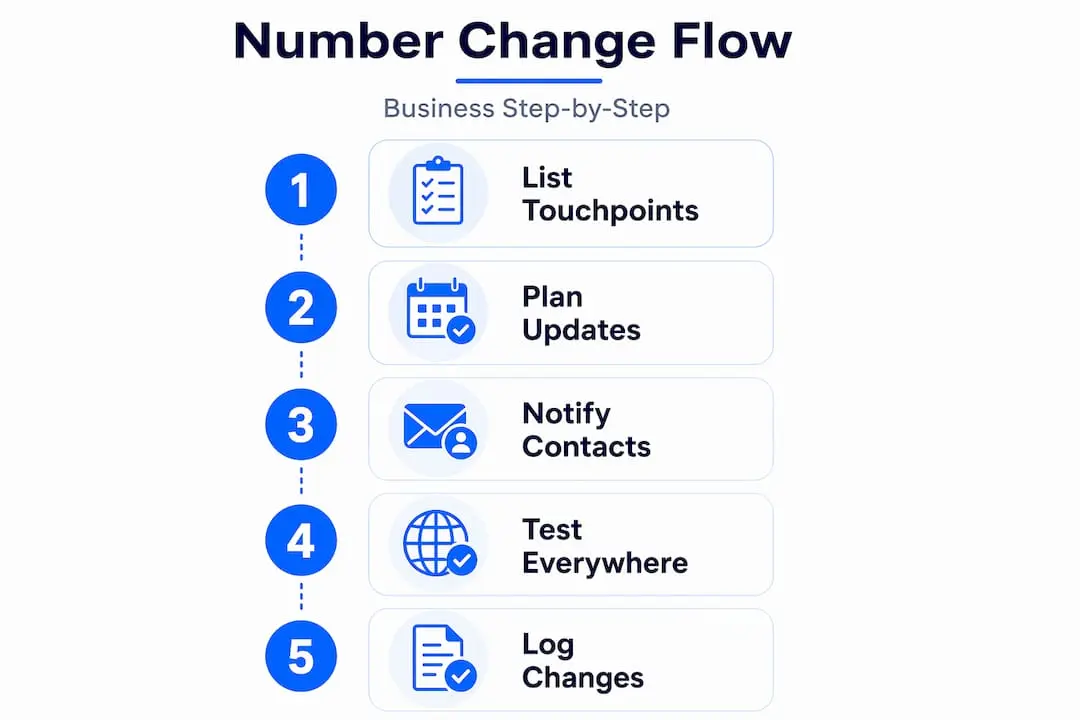
Many businesses assume the job is done once the number is ported and a few listings are updated. The reality is that the post-change validation step is where problems are caught before they cost you real money. Treat this as a formal quality check, not an afterthought.
Your validation sweep should cover:
- Test inbound calls from multiple sources. Call your new number from a mobile, from a landline, and from a withheld number. Confirm calls connect properly, ring to the right handset or team, and are answered with the correct greeting.
- Check online listings one by one. Google your business name. Check every directory in your inventory. Look for any instances where the old number is still displayed.
- Verify transactional messages and security codes arrive correctly. Log in to your business banking, HMRC account, and key software platforms. Trigger a test SMS code and confirm it arrives on the new number. This is especially important before deactivating the old line.
- Look for signs of number blocking or spam flags. New numbers can occasionally be flagged by spam-detection services, particularly if you make a high volume of outbound calls early on. If customers report seeing “Spam” warnings when you call, contact your provider immediately.
- Check printed materials. Order new business cards, update van signage quotes, and set a reminder to replenish any printed stock that carries the old number.
A practical methodology recommended by UK visibility specialists is to treat the entire number change as a project with three phases: an inventory audit, a controlled transition window with call forwarding and IVR announcements, and a post-cutover validation sweep. Following all three phases is what separates a smooth changeover from a chaotic one.
Pro Tip: Keep a dedicated note or spreadsheet from your phone number management guide showing the date each touchpoint was updated and confirmed. If a customer later reports reaching an old number, you can pinpoint exactly where the gap is rather than starting the search from scratch.
What most guides miss about handling business number changes
Most articles about changing business phone numbers treat it as a purely administrative task. Update your listings, tell your customers, done. But from years of working with small businesses across the UK, the reality is considerably messier, and the stakes are higher than most guides acknowledge.
The risk of permanent number loss is real and almost entirely avoidable. The most heartbreaking scenario we see is a business owner who cancels their old provider in excitement about their new service, only to discover the port hadn’t completed yet. The number goes dead. According to VoIP porting guidance, once a number is released back into the pool, recovery is extremely difficult, sometimes impossible. A number that a customer base has used for ten years, printed on thousands of flyers, can be gone in an afternoon because of one impatient phone call to the old provider.
NAP consistency is quietly destroying the local search rankings of small businesses who change numbers carelessly. When your phone number appears as three different versions across Google, Yell, and your website, search algorithms register the inconsistency as a reliability signal. You drop in results. New customers can’t find you. This is a slow, invisible problem that takes months to repair. Understanding why retaining existing numbers matters so much comes down to exactly this kind of long-term visibility issue.
The businesses that handle number changes best treat it as a project, not a task. They assign someone ownership, set a timeline, and work through the checklist systematically. The ones who struggle treat it as something to sort out between jobs. One missed listing, one unupdated security path, one customer who reaches a dead line, can each create disproportionate damage to a small business reputation.
The mindset shift is simple but powerful: your phone number is infrastructure, not admin.
Take the next step with reliable business phone solutions
Now that you have a clear process for handling number changes, the next logical question is whether your current number is actually working as hard as it should for your business.
At Phonenumbers.store, we specialise in helping UK small businesses find and secure memorable 01, 02, and 07 numbers that customers can actually remember. Whether you are a taxi firm wanting a number that stands out in a local area, or a plumber looking to buy a phone number that builds instant credibility, our database lets you search by number sequence, area code, town, or county. You can browse our full range at Phonenumbers.store, or take a look at a genuinely memorable number like 0115 928 8888 to see what a standout business number looks like in practice. Numbers are no longer tied to a specific location, so you can use any UK number anywhere.
Frequently asked questions
Can I keep my existing number when switching providers?
Yes, in the UK you can retain your current number when switching providers using number portability, which is regulated by Ofcom and applies to most landline and mobile numbers.
What should I do if I lose access to my old phone number used for account security?
You should use backup authentication methods or complete additional identity verification as guided by GOV.UK One Login, which covers this exact scenario including when access to the old number is already lost.
How can I quickly notify all my customers about a new business number?
Send a direct SMS or email to your customer list and update all listings immediately. GOV.UK Notify offers a useful model for how structured, reliable contact-change communications can be organised and sent at scale.
Why is NAP consistency important after a number change?
NAP consistency, meaning matching name, address, and phone across all online listings, ensures customers find the correct details and prevents search engines from registering conflicting information, which can harm your local visibility.
Does changing my phone number affect my compliance for marketing calls?
Yes, you must update your number everywhere and ensure your new number is valid and visible before making outbound marketing calls, as the ICO requires businesses to comply with TPS and CTPS opt-out lists and display a legitimate contact number at all times.