You can change your mobile number in the UK in three ways. You can ask your current network for a new number on the same SIM. You can move to a new network and take your number with you using a PAC. Or you can move to a new network and start with a new number using a STAC. Which one is right depends on whether customers already know your number. If you run a taxi firm or work as a plumber, they almost certainly do, so the plan matters as much as the switch.
This guide covers the official steps, the order to do things in, and the accounts that break if you get the order wrong. It also covers a route many tradespeople miss: keeping your personal mobile private and giving customers a separate memorable number instead.
TL;DR
- To keep your number on a new network, text PAC to 65075. To leave with a new number, text STAC to 75075. Both come from Ofcom’s switching guidance.
- A PAC stays valid for 30 days, and the switch should complete within one working day of giving the code to your new provider.
- Before you drop an old number, update every account that sends security codes to it: banking, GOV.UK, business registries. Old numbers can be reissued to strangers.
- If your number is on vans, cards and ads, changing it costs you calls. A separate memorable business number that forwards to your mobile avoids that.
- Tell customers early, in several places, and keep the old number alive for a while if you can.
Table of Contents
- First decide: keep the number or change it
- Changing network and keeping your number: the PAC route
- Changing network and getting a new number: the STAC route
- Changing number with the same provider
- What to do before the old number goes
- Telling customers you have a new number
- Perspective: keep the number customers call, change the one you carry
- Comparing the options
- A separate business number for taxi firms and plumbers
- A checklist for the week of the change
- FAQ
- Sources
First decide: keep the number or change it
Most people who search for this want one of two outcomes, and they are opposites.
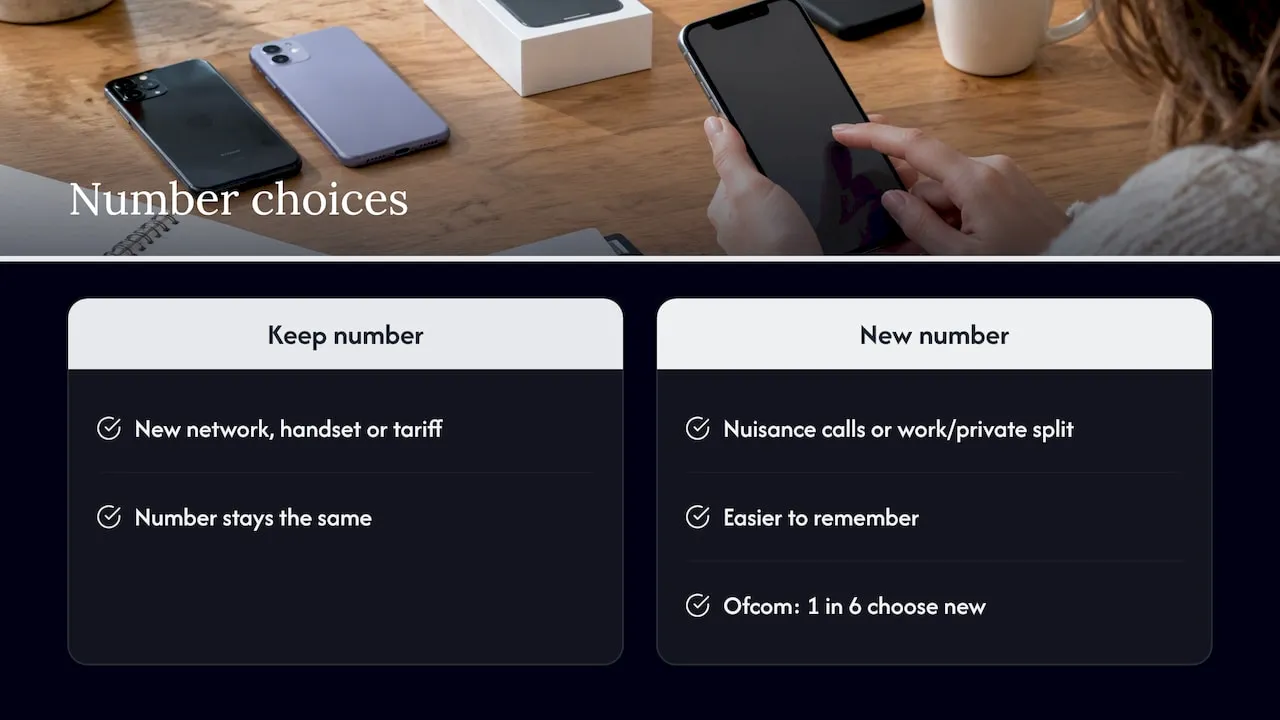
You want to keep your number but change something else. Perhaps a new network, a new handset, or a cheaper tariff. Nothing about your number needs to change. You port it.
You want a different number. Perhaps you are getting nuisance calls, you want to separate work from private life, or you want something easier to remember. Then you ask for a new number or take a STAC.
The second group is smaller than you might think. Ofcom’s own figures, as given in its mobile switching guide, suggest roughly one in six UK users choose a new number rather than porting. Most people value the number they have.
For a sole trader the calculation is sharper. Your number is on your van, your website, your Google listing, old invoices and in the phones of years of customers. A change is not a tidy-up. It is a small rebrand.
Changing network and keeping your number: the PAC route
This is called porting. Ofcom’s steps, as set out on its switching mobile page, are short.
- Check your contract. If you are still in a minimum term, leaving early can trigger charges. Ask your provider for the exact figure before you commit.
- Text PAC to 65075. Your current provider replies with your Porting Authorisation Code and details of any early termination charges. If you ask by phone, the code should be given immediately. By text or online it should arrive within two working days.
- Give the PAC to your new provider. You can do this when you sign up for the new SIM.
- Wait for the switch. The number should move within one working day of the new provider receiving the code. Your old service then ends automatically.
The code lasts 30 days. If you do not use it in that window, request another.
Ofcom also says you can keep your number for up to one month after cancelling your old service. This matters if a contract lapsed and you think a valued number has gone. Contact the old provider and ask for a PAC. It is worth trying before you assume the number is lost.
Nothing here should leave you without a phone for long. Which? notes that text-to-switch has made switching easier, and that fear of losing service puts many people off. If your port does slip past a day, we explain the common causes in why mobile ports miss the one day target.
Changing network and getting a new number: the STAC route
If you want to leave the number behind, do not just cancel. Text STAC to 75075. Per Ofcom, this Service Termination Authorisation Code ends the old contract properly, so you avoid double billing and you do not need to argue with your old provider.
Give the STAC to your new provider when you sign up, and they give you a fresh number.
Changing number with the same provider
If you are happy with your network and only want a different number, contact your provider and ask for a number change. Policies vary by network, and some charge a fee or limit how often you can do it, so ask before you assume it is free. This is the honest answer to the common question about changing your number for free: the porting codes cost nothing, but a same-network change depends on your provider’s terms.
Be aware that your new number may not be new. The Which? investigation into recycled numbers found that many numbers handed out by UK providers are recycled from earlier owners, because the pool of 07 numbers is finite. A recycled number can bring calls meant for someone else. If that matters, ask for a different one.
What to do before the old number goes
This is where people get hurt. The number change itself takes a day. The clean-up takes a week.
Move your security codes first
Your mobile number is probably the recovery route for your bank, email, GOV.UK account and any business registry login. Update these before you give up the number, not after.
- GOV.UK One Login: sign in, go to Security, and change the phone number under your sign-in details. The steps are in the GOV.UK guidance.
- Transport for London accounts: if you hold one, TfL explains that the contact number can differ from your authentication number, so check both on its account protection page.
- Council accounts: many let you change numbers under personal details once signed in, as Brighton & Hove’s MyAccount help shows. Taxi licensing portals often work the same way, so check your own council’s.
The reason for the urgency: once a number is deactivated, a provider can reissue it. Which? warns that a stranger who inherits your old number could end up receiving codes for accounts linked to it.
Consider app-based authentication
The Information Commissioner’s Office has covered SIM swap fraud, where an attacker persuades a provider to port a victim’s number to their own SIM. The practical lesson is to use an authenticator app instead of text messages for important accounts where the service allows it. A number change is a good moment to do that, because you are visiting each account anyway.
Do not let the old number lapse by accident
If you keep a second SIM as a backup, note that providers deactivate inactive numbers after different periods. Which? reports the range runs from about three to nine months. A text, call or small amount of data within your provider’s window usually keeps it live. Put a recurring reminder in your calendar.
Telling customers you have a new number
For a private person, a group message does the job. For a business it needs a plan.
Start before the switch, not after. Then repeat the message in every place a customer might look:
- Your website header, contact page and footer.
- Your Google Business Profile, social pages and any directory listings.
- Email signatures, invoices, quotes and receipts.
- An email or text to existing customers, with a clear date.
- Van signage, uniforms and business cards, which is where the real cost sits.
If your emails and customer records are scattered, it helps to update your client records and email in one sitting, so no old number is left in a template or an automated message. Set a voicemail or auto-reply on the old number for as long as you can keep it, pointing people to the new one.
A taxi firm faces a harder version of this. Regulars ring the number from memory or from a sticker in the kitchen. For months you will lose some of those calls. A plumber has the same problem with the fridge magnet from three years ago. That is a strong reason to avoid changing the number customers use at all.
Perspective: keep the number customers call, change the one you carry
We sell memorable UK numbers for a living, so we see this problem constantly. Someone gives out their personal mobile for years, the calls come at all hours, and then they want out. Their instinct is to change their mobile number. Usually that is the wrong fix.
The number customers call and the SIM in your pocket do not have to be the same thing. A separate business number can sit in front of your mobile and forward calls to it. You can change phones, networks or even your private number later, and customers never notice, because the number on the van stays put. Numbers are also no longer tied to a local area, so a 01 or 02 number can be used anywhere in the UK, whatever your postcode.
It also helps with recall. A number that is easy to say and remember is easier to ring again. For taxi firms and plumbers, where the winner is often the first firm a customer manages to dial, that is worth planning for. If you want to see what is possible, read how to choose a UK number and keep it with Ofcom porting steps.
The rule we give people: treat your business number as an asset you own, not a by-product of a contract. Own it in a way that lets you move it.
— Rob
Comparing the options
| Situation | Best route | What to do |
|---|---|---|
| New network, same number | PAC | Text PAC to 65075, give code to new provider |
| New network, new number | STAC | Text STAC to 75075, give code to new provider |
| Same network, new number | Number change | Ask your provider, check for fees |
| Keep private mobile, public business number | Separate business number | Forward calls to your mobile |
| Lost number after cancelling | Late PAC request | Contact old provider within one month |
A separate business number for taxi firms and plumbers
If your reason for changing is that your mobile is also your business line, a dedicated number removes the need to change anything. We offer 01 and 02 landline numbers, 07 mobile numbers and 03 and 08 non-geographic numbers. You can search by number, sequence, area code or town, county or city. You can also look at alphanumeric phone names.
What the number connects to is up to you:
- Call forwarding: point the number at any mobile or landline.
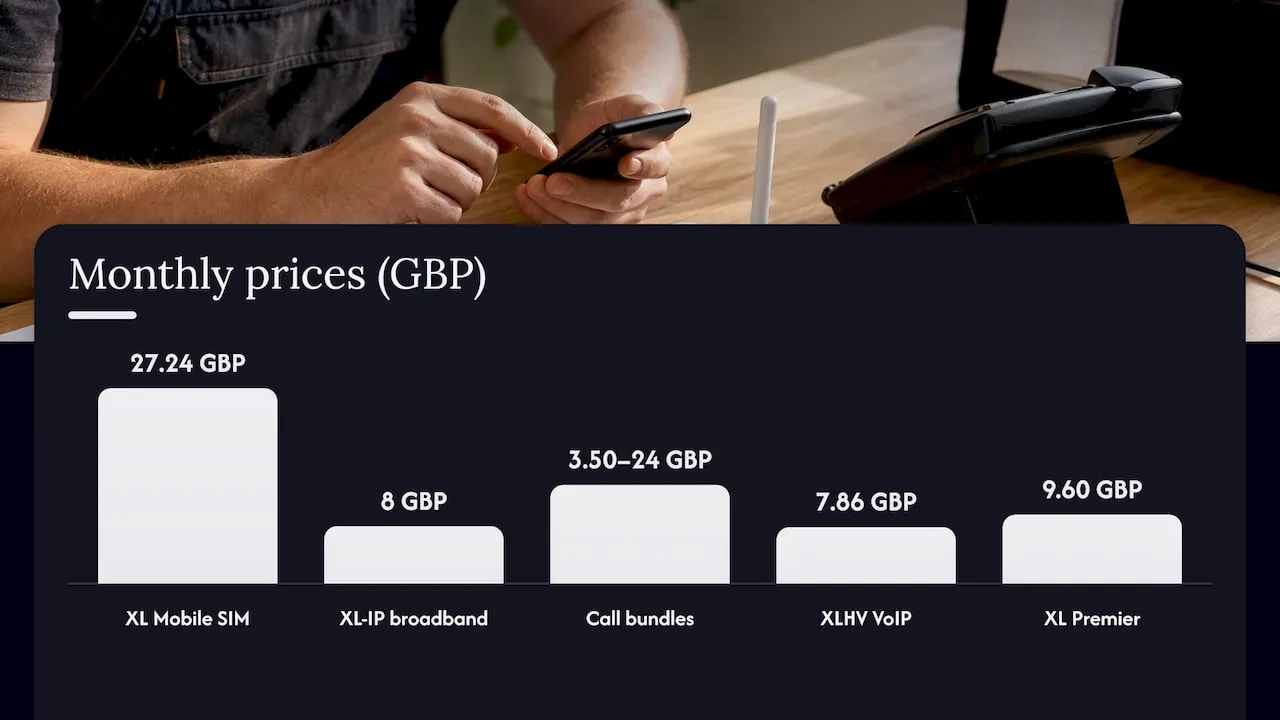
- A SIM: the XL Mobile SIM is listed at 27.24 GBP per month. Taxi firms can also look at Taxi Connect Direct on the same page.
- Your broadband: XL-IP is 8 GBP per month, with a 99 GBP one-off router and set-up charge. Call bundles on that page run from 250 minutes at 3.50 GBP per month to 5000 minutes at 24.00 GBP per month.
- A VoIP phone: XLHV is 7.86 GBP per month with a 30 GBP one-off set-up charge.
- A managed service: XL Premier Service is 9.60 GBP per month with a 14.40 GBP one-off set-up fee.
Not sure yet? You can hold a number with a 30 day reservation for a 10 GBP one-off fee while you decide. You can buy a memorable number or rent one, and all numbers are portable if you later move provider. If you already hold a number you want to keep, see what you need to transfer a memorable business number.
A mobile-based option is covered in how to set up a business number on your mobile. If you are weighing landline against mobile, our note on what callers pay to reach each type is a good place to start.
A checklist for the week of the change
Before
- Check your contract for early termination charges.
- List every account that uses the old number for codes.
- Update those accounts and move key ones to an authenticator app.
- Tell customers the date.
On the day
- Request your PAC or STAC by text.
- Give the code to your new provider.
- Keep the old SIM in until the new service is live.
After
- Test calls and texts both ways.
- Check bank and GOV.UK logins still send codes.
- Update listings, signage and templates.
- Keep a voicemail or forward on the old number as long as practical.
FAQ
Can I change my mobile number for free?
PAC and STAC requests cost nothing, and Ofcom says providers cannot charge notice periods after your switch date. Changing the number on your existing network is up to your provider, so ask about fees first. If you are still in contract, early termination charges can apply when you leave.
How long does it take to switch and keep my number?
Once your new provider has your PAC, the port should complete within one working day. The PAC itself arrives immediately by phone or within two working days by text or online, and it stays valid for 30 days.
Can I get my old number back after cancelling?
Ofcom says you can keep your number for up to one month after cancelling the old service. Contact your previous provider and ask for a PAC. After that window, the number may be lost and could be reissued.
How do I tell people I have a new number?
Start before the change and use every channel: a message to contacts, your email signature, your website and online listings. For a business, add invoices, signage and an automatic reply on the old number. Repeat the message more than once.
What happens to my accounts that use text codes?
They may lock you out or send codes to a stranger if the number is reissued. Update each account while you still hold the old number, and use an authenticator app where you can.
Sources
- Ofcom: Switching mobile
- Ofcom: Switching mobile phone provider
- Which?: Recycled phone numbers
- Which?: Why you’re wrong about switching mobile network provider
- ICO: PECR breach reporting outcomes report
- GOV.UK: Changing the sign in details for your One Login
- Transport for London: Protecting your account
- Brighton & Hove City Council: MyAccount support