
Your main business line is the single activity that generates the most revenue or best describes your company’s principal purpose. For most UK companies, the immediate action is straightforward: confirm or update your primary SIC code at Companies House via your next confirmation statement, or file one early if your activity has changed.
HMRC defines revenue for regulatory tests as income arising from a group’s ordinary activities, which are the core activities such as producing goods or rendering services. That top-line figure, before any deduction for cost of sales or operating expenses, is the starting point for identifying which activity truly drives your business.
Table of Contents
- What does ‘main business line’ mean in the UK?
- How do you identify your main business line?
- How do SIC codes and Companies House record your main business line?
- Why does accurate classification matter for lenders, investors and grants?
- Common mistakes, red flags and quick fixes
- When should you change your recorded main business line?
- Worked examples: sample main business line statements with SIC codes
- Why you can trust this guidance
- Key takeaways
- Why your main business line shapes how the world sees you
- Useful sources
- FAQ
What does ‘main business line’ mean in the UK?
The phrase does not have a single statutory definition, but UK practice draws on two overlapping frameworks: HMRC’s revenue-focused approach and Companies House’s SIC-centric classification. Together, they point to four practical criteria.
- Revenue contribution. The activity that produces the largest share of top-line income.
- Ordinary activities. The work your business was set up to do and does routinely, not one-off projects.
- Contractual focus. Where the majority of your customer contracts and service agreements sit.
- Customer-facing operations. What clients actually pay you for, as opposed to internal processes.
That distinction matters in practice. A law firm’s main business line is legal services, not the finance team that invoices clients. A manufacturer’s main line is production, not the HR department that recruits the factory floor. Internal cost centres support the main line; they do not define it.
HMRC’s approach and Companies House’s approach overlap considerably but differ in one key respect. HMRC measures revenue at the top line using accounting standards, and cost of sales are not deducted when assessing ordinary activities for regulatory tests. Companies House, by contrast, asks you to pick the SIC code that best describes your trade, regardless of precise revenue splits. Both, however, anchor on what the business does rather than how it is organised internally.

The UK SIC system uses a five-digit classification with over 600 codes divided into 21 industry categories. You may supply up to four codes, but the first code is your principal activity.
How do you identify your main business line?
A six-step method works for most UK businesses, from sole traders to limited companies.
- Gather revenue data. Pull your most recent management accounts or annual accounts. Use top-line figures before any deductions.
- List your ordinary activities. Write down every activity the business performs regularly for paying customers.
- Rank by revenue and strategic importance. Which activity accounts for the largest share of income? Which is central to your long-term plan?
- Choose the activity that best matches your external description. How would a customer, lender, or investor describe what you do in one sentence?
- Select the appropriate SIC code. Use the Companies House SIC search tool to find the code that most closely matches your trade description.
- Document your evidence. Keep the management accounts, contracts, and invoices that support your choice.
Worked example. A small professional services firm provides management consultancy to SMEs and also runs occasional training workshops. Consultancy generates the largest share of revenue; training generates the rest. The main business line is management consultancy, and the appropriate SIC code is 70229 (Management consultancy activities, other). The training activity can be listed as a secondary code if it is material.
Pro Tip: When applying for a grant or a business loan, keep a one-page summary that shows your top three revenue lines, the percentage each contributes, and the SIC code you have filed. Lenders and grant assessors use this to verify fit quickly, and having it ready avoids delays.
How do SIC codes and Companies House record your main business line?
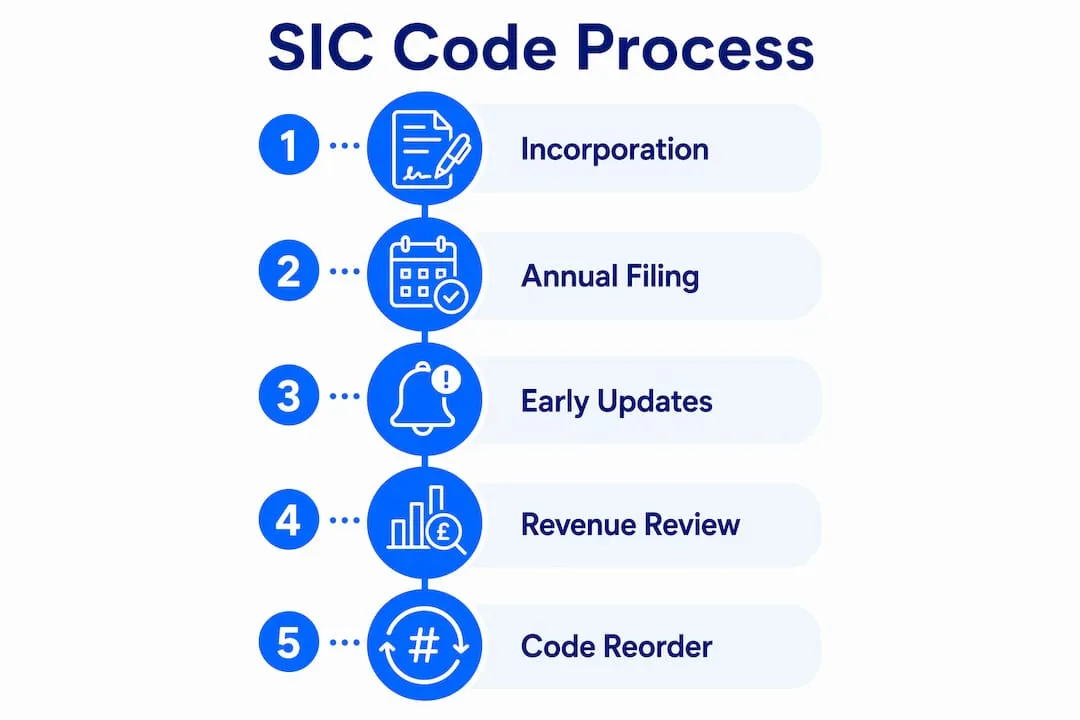
Companies House requires at least one SIC code at incorporation and an annual confirmation via the confirmation statement. The first-listed code is treated as the principal activity, so the order in which you list multiple codes carries real weight.
| Action | When | How |
|---|---|---|
| Provide initial SIC code | At incorporation | WebFiling or paper form IN01 |
| Confirm or update SIC code | Annually via confirmation statement | Companies House WebFiling or authorised agent |
| File early confirmation statement | Any time after a material change | WebFiling — no fee for early filing |
| Update dormant status to active | When trading begins | File confirmation statement with active SIC code |
If your business pivots, you do not have to wait for the annual filing window. A confirmation statement can be filed early whenever the nature of your business changes materially. The process takes minutes via Companies House WebFiling, and there is no additional fee for filing ahead of schedule.
Why does accurate classification matter for lenders, investors and grants?
Getting this right has consequences well beyond form-filling.
- Lending decisions. Banks and alternative lenders cross-reference your declared SIC code against your stated activity. A mismatch raises an immediate flag during credit assessment.
- Investment fit. Investors use SIC codes to screen for sector exposure. An incorrect code can exclude you from funds that would otherwise be a natural fit.
- Grant eligibility. Many government and sector-specific grants are ring-fenced by SIC code. Filing the wrong code means your application may never reach the right assessor.
- National statistics. Companies House and the Office for National Statistics use SIC codes to track economic activity and emerging sector trends. Inaccurate codes distort the data that informs sector support programmes.
Accurate SIC coding helps ensure government support and market data remain relevant to evolving sectors. That is not a bureaucratic nicety; it is the mechanism by which your industry gets counted and funded.
Common mistakes, red flags and quick fixes
Most classification errors fall into a handful of patterns, and all of them are fixable.
Listing a support function as primary. HR, finance, and IT are cost centres, not business lines. If your SIC code describes an internal function rather than what you sell to customers, update it.
Using outdated codes. The SIC framework is updated periodically. A code that was accurate at incorporation may no longer reflect your activity or may have been superseded.
Leaving a company marked dormant while trading. This is one of the most common errors. A dormant status when actively trading creates delays during loan or investment assessment and can raise questions about accounting compliance.
Quick fixes. Reorder your SIC codes so the primary activity appears first. File an early confirmation statement if you have pivoted. Check the current SIC list against your trade description at least once a year.
When should you change your recorded main business line?
Three signals suggest it is time to update.
- Material revenue shift. A new activity now accounts for the majority of your income.
- New contract base. Your customer agreements have moved to a different sector or service type.
- Strategic pivot. The board has formally changed the company’s direction and the public record no longer reflects it.
When any of these applies, the process is:
- Identify the new primary SIC code using the ONS SIC 2026 framework.
- Log in to Companies House WebFiling.
- File an early confirmation statement with the updated SIC code.
- Retain the evidence: invoices, contracts, and management accounts that support the change.
Lenders and investors prefer to see at least three months of management accounts, a sample of contracts, and a brief narrative explaining the change. Preparing this before you approach them saves time on both sides. Keeping your business contact details consistent alongside your Companies House record also reduces friction during due diligence.
Worked examples: sample main business line statements with SIC codes
| Business type | Main business line statement | Likely primary SIC code |
|---|---|---|
| Management consultancy firm | Provides strategic and operational advice to SME clients | 70229 — Management consultancy activities, other |
| Independent retailer | Sells specialist outdoor clothing and equipment to consumers | — |
| Plumbing and heating installer | Installs and services domestic and commercial heating systems | — |
| Digital marketing agency | Delivers paid search, SEO and social media campaigns for clients | — |
A few practical points on code selection:
- Match your trade description as closely as possible; a near-match is better than a broad catch-all code.
- Add secondary codes for material activities that fall outside the primary code, but keep the primary code as the one that best describes what you actually do.
- If two activities are genuinely equal in revenue, choose the one that best reflects your strategic direction and external identity.
Why you can trust this guidance
This article was written by Rob, author at Phonenumbers and a regular contributor to the PhoneNumbers.Store blog on UK business telephony and company administration.
[Rob’s professional background and credentials related to UK telephony]
Phonenumbers is the leading provider of memorable UK phone numbers, specialising in 01, 02, and 07 numbers. [Proprietary data or case studies evidencing PhoneNumbers Store market leadership]. The guidance above draws on primary sources including Companies House, HMRC, and the Office for National Statistics.
Key takeaways
The main business line is the activity that generates the most revenue or best describes your principal purpose, and the first SIC code filed at Companies House is its public record.
| Point | Details |
|---|---|
| Define by revenue first | Identify the activity producing the largest share of top-line income before cost deductions. |
| First SIC code is primary | The first code listed at Companies House is treated as your principal activity — order matters. |
| File early after a pivot | You can file a confirmation statement at any time; do not wait for the annual window after a material change. |
| Keep supporting evidence | Retain invoices, contracts, and management accounts to back your classification for lenders and grant assessors. |
| Review at least annually | Check your SIC code against your current trade description each year, ideally at the same time as your confirmation statement. |
Why your main business line shapes how the world sees you
There is a gap between how businesses think about their main activity and how they present it publicly, and that gap costs money. A company that has quietly shifted from product sales to managed services but still files under a manufacturing SIC code will find lenders confused, grant applications rejected, and sector data that simply does not reflect reality.
The more interesting point is that your main business line is not just a regulatory box. It is the single sentence that tells a bank, an investor, or a new client what you do. Getting it right on the Companies House record is the same discipline as getting it right on your website or your phone number. A memorable business number tied to a clearly stated main activity reinforces the same message at every touchpoint.
My suggestion: build a quarterly management review that checks three things together — your revenue split, your SIC code, and your public contact details. They should all tell the same story.
Useful sources
- Companies House: Keeping your SIC code accurate — guidance on when and how to update your code.
- Companies House: Choosing a SIC code — practical advice on selecting the right code at incorporation and beyond.
- Companies House SIC code search tool — searchable condensed list for finding your code.
- GOV.UK: Standard industrial classification of economic activities — the official condensed SIC list used by Companies House.
- ONS: UK SIC 2026 — the full classification framework maintained by the Office for National Statistics.
- HMRC: MTT11040 — Meaning of revenue — HMRC’s definition of revenue and ordinary activities for regulatory tests.
FAQ
What is the definition of a main business line in the UK?
Your main business line is the activity that generates the most revenue or best describes your company’s principal purpose. For Companies House purposes, it is represented by the first SIC code listed on your public record.
How do I find the right SIC code for my business?
Use the Companies House SIC search tool and match your trade description as closely as possible to the available codes. The full ONS framework lists over 600 five-digit codes across 21 industry categories.
How often do I need to update my main business line at Companies House?
You must confirm or update your SIC code at least annually via the confirmation statement. If your business activity changes materially before the annual deadline, you can file an early confirmation statement at any time with no additional fee.
Can a support function like HR or finance be my main business line?
No. Support functions that do not generate revenue for external customers are not main business lines. Your primary activity must reflect what clients pay you for, not internal operations.
Does my main business line affect grant and loan eligibility?
Yes. Lenders and grant providers use your SIC code to verify sector fit and eligibility. An incorrect or outdated code can delay credit assessments or exclude you from funding programmes designed for your actual sector.