A UK mobile business number uses the 07 range and is shown domestically as 07XXX XXXXXX and internationally as +44 7XXX XXXXXX. These are illustrative examples: a real number is always 10 digits long and sits inside the 071, 072, 073, 074, 075, 077, 078 or 079 ranges, which Ofcom and the ITU allocate specifically for mobile services.
TL;DR:
- UK mobile numbers are always 10 digits long and sit within the 071 to 075 and 077 to 079 ranges, while 070 and 076 are designated for personal and legacy services.
- Memorable numbers often feature repeated digits or easy groupings and should be verified via an MNP lookup before purchase, with preference for standard mobile ranges.
- Use consistent formatting: 07XXX XXXXXX domestically and +44 7XXX XXXXXX internationally, with identical spacing across all marketing channels to improve clarity.
- Cost to callers depends on their tariffs, typically 10 to 20 pence per minute from landlines and 3 to 65 pence from mobiles, with 070 numbers costing more and generally avoided for customer-facing lines.
- Number portability allows switching providers without changing the number, provided the transfer process follows proper steps and any early-exit fees are checked beforehand.
Table of Contents
- What a UK mobile number example looks like (ranges and rules)
- How to choose a memorable 07 mobile number for your business
- How to display and format the number across website, invoices, vehicles and SMS
- What customers will pay to call your 07 number
- How to buy or rent and set up a UK business mobile number on a handset within hours
- Keeping your number: Ofcom porting and practical portability steps
- Valid Russian mobile phone number prefixes and their allocation by mobile operators
- How to format Russian mobile numbers for international dialing (+7 country code)
- Common distinctions between Russian mobile and landline number formats
- Guidelines for presenting Russian mobile numbers for readability and clarity
- Author perspective: why a memorable 07 mobile number matters for UK SMEs
- How we can help: search, reserve or rent a memorable UK 07 mobile number
- FAQ
- Sources
What a UK mobile number example looks like (ranges and rules)
Every genuine UK mobile number falls inside a defined set of ranges, and knowing them helps you spot a usable business number from one that will cause problems. According to ITU numbering data for the UK, mobile services sit in the 071 to 075 and 077 to 079 ranges, and a mobile number excluding the country code runs to 10 digits.
Two ranges that look similar are not meant for ordinary customer calls:
- 070 numbers are personal numbering services, not standard mobiles, and often carry higher call charges.
- 076 numbers are allocated to radiopaging, a legacy service unsuited to a modern customer-facing line.
A correctly formatted domestic example reads 07XXX XXXXXX, and the same number written for an international audience reads +44 7XXX XXXXXX, dropping the leading zero after the country code. Both are illustrative examples rather than live numbers, but they show the shape your customers should expect to see on your website, invoices and vehicles.
How to choose a memorable 07 mobile number for your business
A number that is easy to recall drives more calls than one picked at random, and a handful of simple patterns make the biggest difference.
- Look for repeated digits or doubled pairs, such as 07 222 33 444, which the ear picks up faster than a random sequence.
- Favour groupings that are easy to say aloud in three or four beats rather than reading as one long string.
- Check how the number looks printed small on a van door or an invoice footer before committing to it.
- Run an MNP lookup against the MNP lookup service to confirm the number is a genuine mobile-service number and not a 070 or 076 range.
- Reserve the number before paying in full, since availability on memorable sequences changes quickly.
Pro Tip: Say the number out loud to three people before you buy it. If any of them mishears a digit, pick a different pattern.
Cost and availability often trade off against each other: the most repetitive patterns tend to be scarcer and priced accordingly, so decide in advance how much memorability is worth to your business.
How to display and format the number across website, invoices, vehicles and SMS
Consistency matters as much as the number itself. Customers who see one format on your van and a different one on your invoice can end up unsure which digits to dial, especially when a sequence is read out over the phone rather than typed.
- Use 07XXX XXXXXX for UK-facing materials: website headers, local adverts, printed invoices.
- Use +44 7XXX XXXXXX for anything aimed at international customers, suppliers or directories.
- Test the number on a small mobile screen, on vehicle signwriting and inside an SMS message before rolling it out everywhere.
- Keep the spacing pattern identical across every channel so the same number always looks the same.
A number that passes a quick legibility check at normal reading distance, and sounds unambiguous when spoken, will cause fewer wrong numbers and fewer support queries about which digits are correct.
What customers will pay to call your 07 number
Calls to standard UK mobile numbers cost roughly 10p to 20p a minute from landlines and 3p to 65p a minute from mobiles, depending on the caller’s own tariff. That range matters because customers often assume mobile calls are expensive or free, when in fact the price depends entirely on their own contract.
070 personal numbers sit outside this pattern and frequently cost more to call, which is one more reason to avoid them for a customer-facing line. A short, honest note on your marketing, such as “Standard mobile call charges apply”, sets expectations without promising a price you cannot control from your end of the call.
How to buy or rent and set up a UK business mobile number on a handset within hours
Getting a new number working is faster than most businesses expect, provided you follow the steps in order.
- Search and reserve a candidate number, using a 30 day reservation to hold it while you decide.
- Choose whether to buy outright or rent over 12 or 24 months; a 24-month rental plan often works out more affordable than a large upfront fee for a memorable sequence.
- Complete the verification step required before the number is activated on your account.
- Select how the number routes: a physical SIM, such as an XL Mobile SIM, or call forwarding to an existing handset.
- Test an inbound call and check voicemail before publishing the number anywhere.
Pro Tip: Call the new number from a different network straight after activation. If caller ID and voicemail both work, you are ready to publish it.
Once the basics work, run a short checklist: inbound call connects, voicemail records and plays back correctly, caller ID shows the right name or number, and the format matches across every piece of marketing. Our own guide to setting up a business number on a mobile within hours walks through each of these checks in more detail.
Keeping your number: Ofcom porting and practical portability steps
Number portability means you can normally keep your mobile number when you switch provider, so changing supplier does not force a change of number on your customers. Industry rules describing how number portability works set out that routing now relies on live database checks rather than assuming a prefix still belongs to its original network.
In practice, porting involves a few clear steps:
- Your current provider (the donor operator) releases the number once you confirm the request.
- Your new provider (the recipient operator) submits the port and updates the routing database.
- The number typically becomes active on the new network within a short, defined window agreed between operators.
Before starting, check whether your current contract carries any early-exit charges, and keep a note of your account details in case the receiving provider asks for them. Our checklist for transferring and retaining a business number covers the paperwork most businesses forget, and our guide to choosing and keeping a number is worth reading before you commit to a new provider.
Valid Russian mobile phone number prefixes and their allocation by mobile operators
Russian mobile numbers are allocated across a defined set of prefixes administered by the national numbering plan, with specific three-digit codes assigned to the country’s main mobile network operators. These allocations sit alongside the UK’s own 07 structure covered above, and the two systems are entirely separate: a UK business choosing a memorable 07 number is not affected by how Russian operators distribute their prefixes.
Russian numbers follow the country’s own numbering plan, administered separately from the UK and ITU rules that govern 07 allocations. For a UK business buying or renting a number for customers in Britain, the relevant rules remain the Ofcom and ITU ranges already described, since a Russian-format number has no bearing on a UK customer-facing line.
Businesses operating only in the UK do not need to apply Russian prefix rules to their own numbering choices, and mixing the two systems in marketing material risks confusing customers who expect a standard 07 format.
How to format Russian mobile numbers for international dialing (+7 country code)
International formatting conventions generally require a country code prefix, with Russian numbers using +7 in place of the leading zero used domestically. This mirrors the principle already described for UK numbers, where +44 replaces the leading zero on a 07XXX XXXXXX number to produce +44 7XXX XXXXXX.
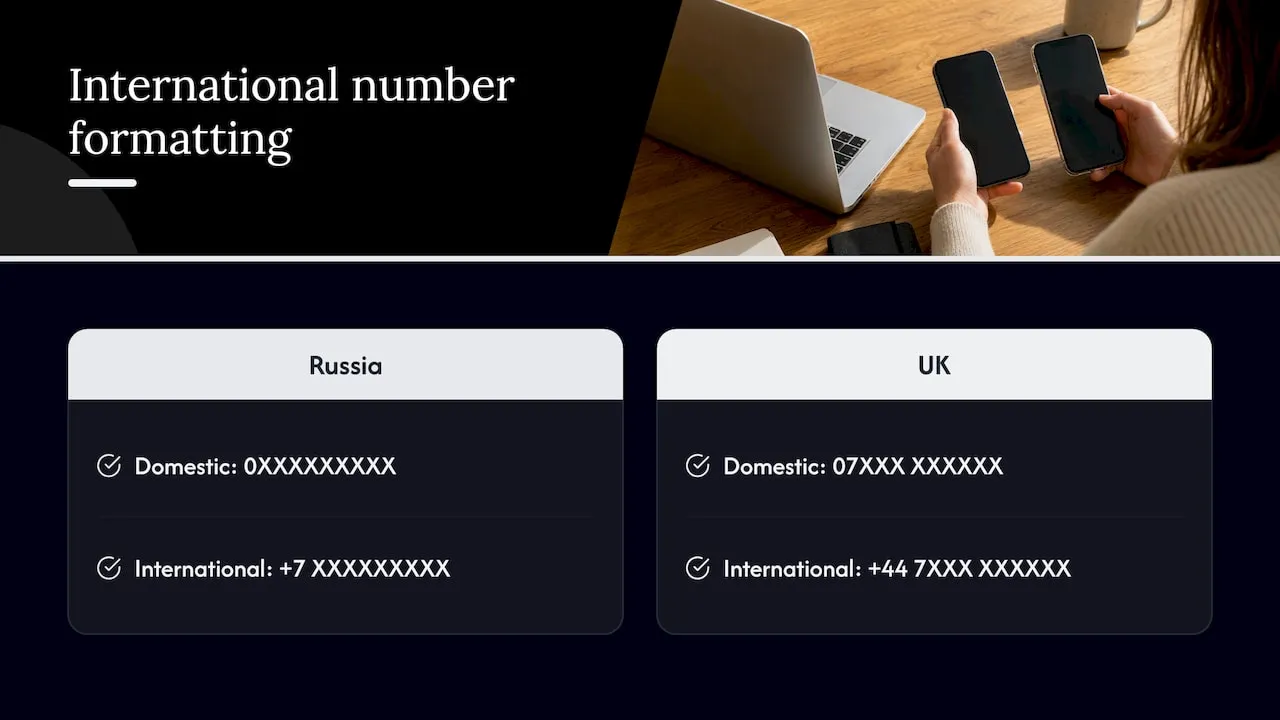
For a UK business, the practical takeaway is the same formatting discipline covered earlier in this guide: present your own number consistently, with the correct country code for international audiences and the domestic format for UK customers. Whichever country’s numbering system a number belongs to, the underlying rule holds: the country code replaces the leading zero, and the remaining digits stay in the same order.
A UK business with international customers should format its own 07 number as +44 7XXX XXXXXX on any material aimed outside the UK, exactly as described in the formatting section above, rather than adopting formatting conventions from another country’s numbering plan.
Common distinctions between Russian mobile and landline number formats
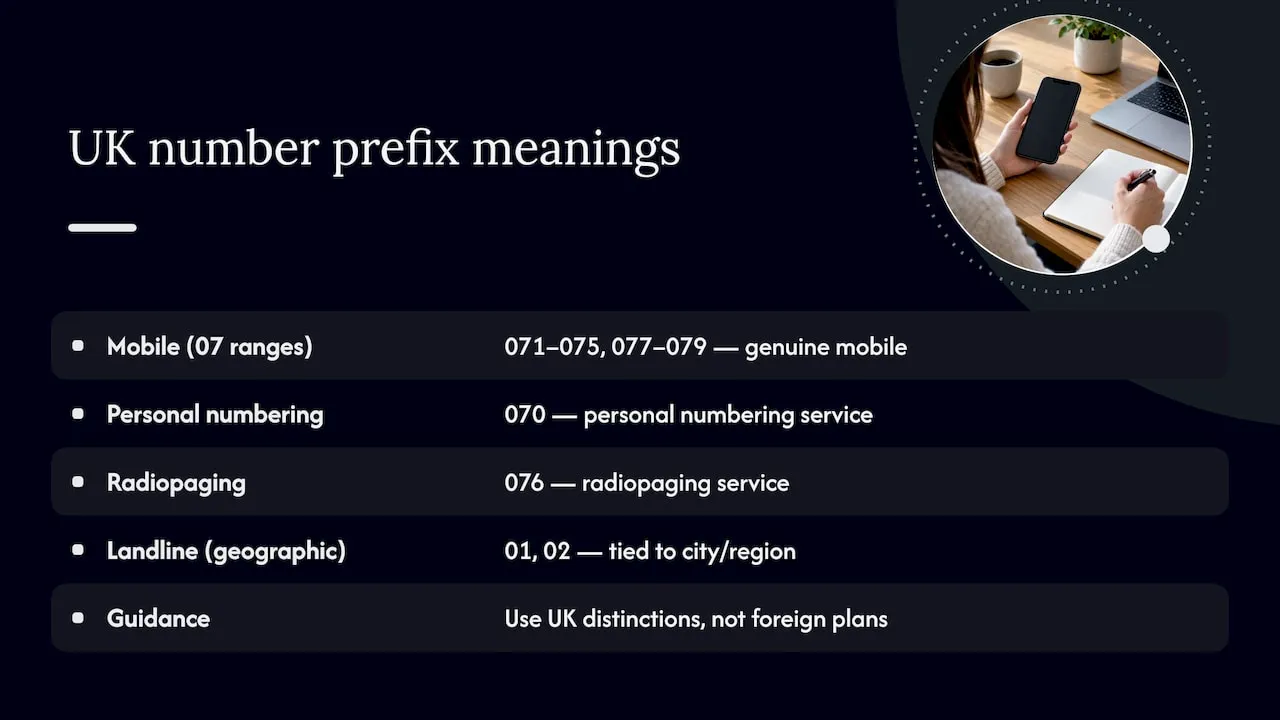
Mobile and landline numbers in most numbering systems, including Russia’s, are distinguished by their prefix ranges, with mobile prefixes allocated separately from geographic landline codes tied to a city or region. The same principle applies in the UK, where 07 numbers are mobile and 01 or 02 numbers are landlines tied to a geographic area, as our own database of UK numbers reflects across landline, non-geographic and mobile categories.
For a UK business weighing up a mobile number against a landline number, the practical distinction that matters is the one Ofcom sets out for 07 ranges: 071 to 075 and 077 to 079 for genuine mobile service, 070 for personal numbering and 076 for radiopaging. That structure, not a foreign numbering plan, is the one relevant to a UK customer-facing choice.
Businesses sourcing numbers for UK customers should rely on the UK’s own mobile and landline distinctions rather than drawing comparisons from another country’s numbering plan, since the two systems are administered independently and are not interchangeable.
Guidelines for presenting Russian mobile numbers for readability and clarity
General readability guidance for any country’s mobile number, Russian numbers included, favours grouping digits into short, speakable blocks rather than presenting them as one unbroken string. This is the same principle recommended earlier in this guide for UK 07 numbers: group digits in threes, fours or fives so a customer can repeat the sequence back accurately after hearing it once.
For a UK business, the practical application remains the formatting guidance already set out for 07 numbers: domestic format as 07XXX XXXXXX, international format as +44 7XXX XXXXXX, with identical spacing used across your website, invoices, vehicle signage and text messages. Readability principles travel well between numbering systems, but the format itself does not, so a UK business should present its own number using the UK conventions covered above rather than borrowing presentation habits from a different country’s system.
Author perspective: why a memorable 07 mobile number matters for UK SMEs
A number people remember after one glance is worth more to a small business than almost any other piece of contact detail, because it turns a missed call into a callback days later. Search a proper database, verify what you are buying, and set it up properly from day one.
— Rob
How we can help: search, reserve or rent a memorable UK 07 mobile number
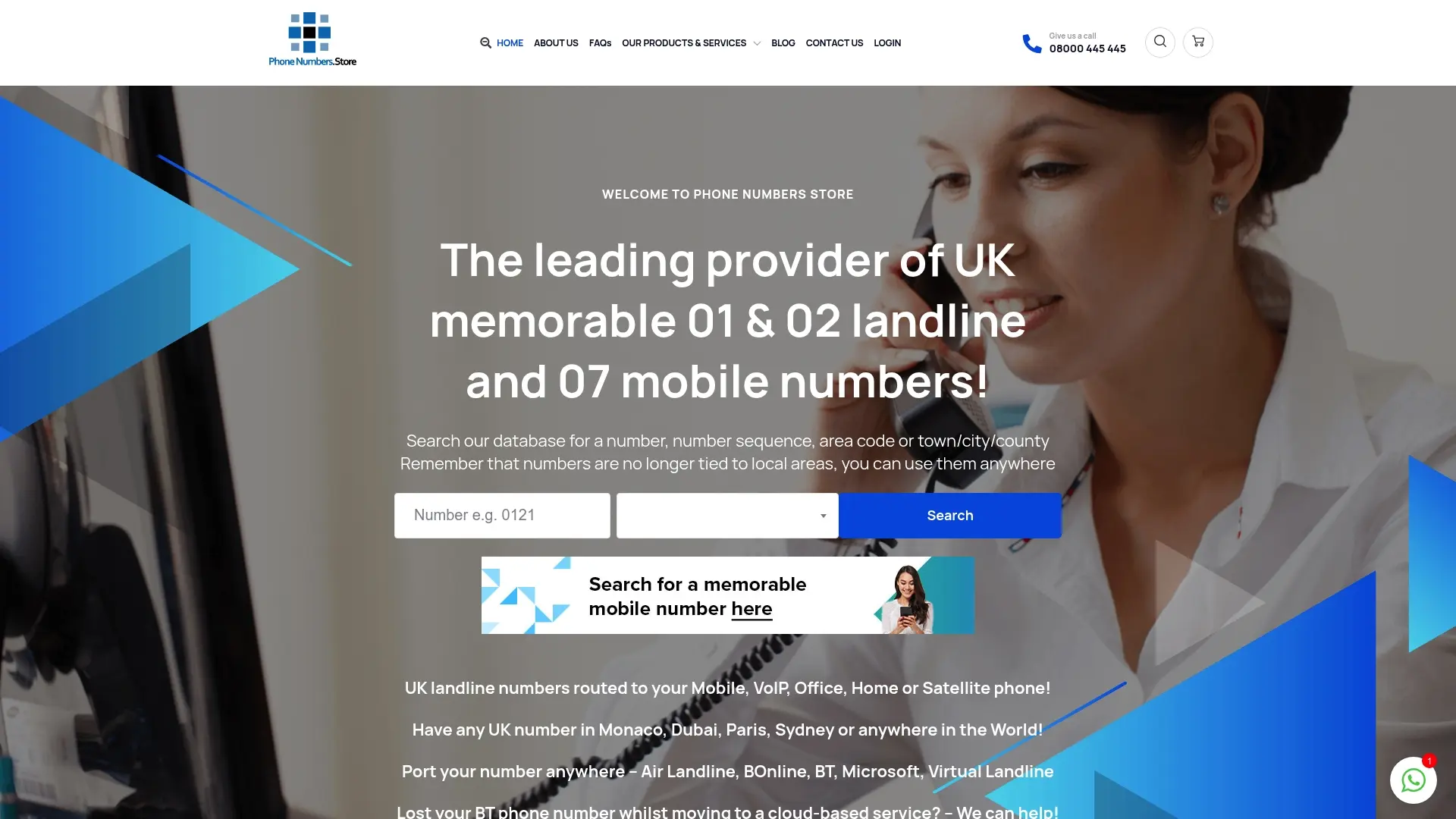
We run a searchable database of UK landline, non-geographic and mobile numbers, built so you can look up a sequence, an area code or a town and see what is actually available rather than guessing. Once you find a number worth having, you can reserve it, buy it outright or rent it over 12 or 24 months, and route it to a SIM or forward it straight to a handset you already use.
- Buy or rent over flexible terms via our rental and purchase plans.
- Pair your new number with routing or a VoIP handset through XL Hosted Voice Service.
If you also want calls answered automatically outside office hours, AIM Agency’s AI receptionist service is worth a look alongside your new number. Search our database today and reserve the number that fits your business before someone else takes it.
FAQ
What is a valid UK mobile number example?
A valid example is a 10-digit number in the 071 to 075 or 077 to 079 ranges, shown domestically as 07XXX XXXXXX and internationally as +44 7XXX XXXXXX. These are illustrative formats rather than a specific working number.
Can I keep my mobile number if I switch provider?
Yes, number portability lets you move your existing number to a new provider in most cases, with the donor and recipient operators handling the transfer between them under UK portability rules. Check for any early-exit charges with your current provider before you start the process.
How much will it cost customers to call my 07 number?
Costs vary by the caller’s own tariff, with typical UK ranges around 10p to 20p a minute from landlines and 3p to 65p a minute from mobiles. A simple note such as “Standard mobile call charges apply” on your marketing sets the right expectation.
Can I buy or rent a memorable 07 number through Phonenumbers?
Yes, we sell and rent memorable UK mobile numbers through our searchable database, with options to buy outright or rent over 12 or 24 months. Numbers can be routed to a SIM or forwarded to a handset you already use.
Is a 070 number the same as a standard mobile number?
No, 070 is a personal numbering service rather than a standard mobile range, and it often carries higher call charges, according to Ofcom’s numbering data. Genuine mobile service numbers sit in the 071 to 075 and 077 to 079 ranges instead.