
TL;DR:
- Phone number compliance involves meeting legal standards for consent, DNC scrubbing, and call recording to avoid fines and build customer trust. UK businesses must verify opt-outs within 10 days, scrub lists monthly, and implement secure payment and caller ID protocols like DTMF masking and STIR/SHAKEN. Establishing clear ownership, integrated processes, and daily operational practices ensures ongoing compliance and resilience against regulatory challenges.
Phone number compliance is the practice of adhering to legal standards and operational best practices that govern how businesses use telephone numbers in marketing, customer service, and payment processing. For UK businesses, the regulatory picture spans domestic rules under Ofcom and the ICO alongside international frameworks including the Telephone Consumer Protection Act (TCPA), Do Not Call (DNC) registry obligations, and PCI DSS v4.0.1. Getting these phone number compliance tips right protects your organisation from fines, builds customer trust, and keeps your calls from being blocked before they even connect.
What are the main regulatory requirements for phone number compliance?
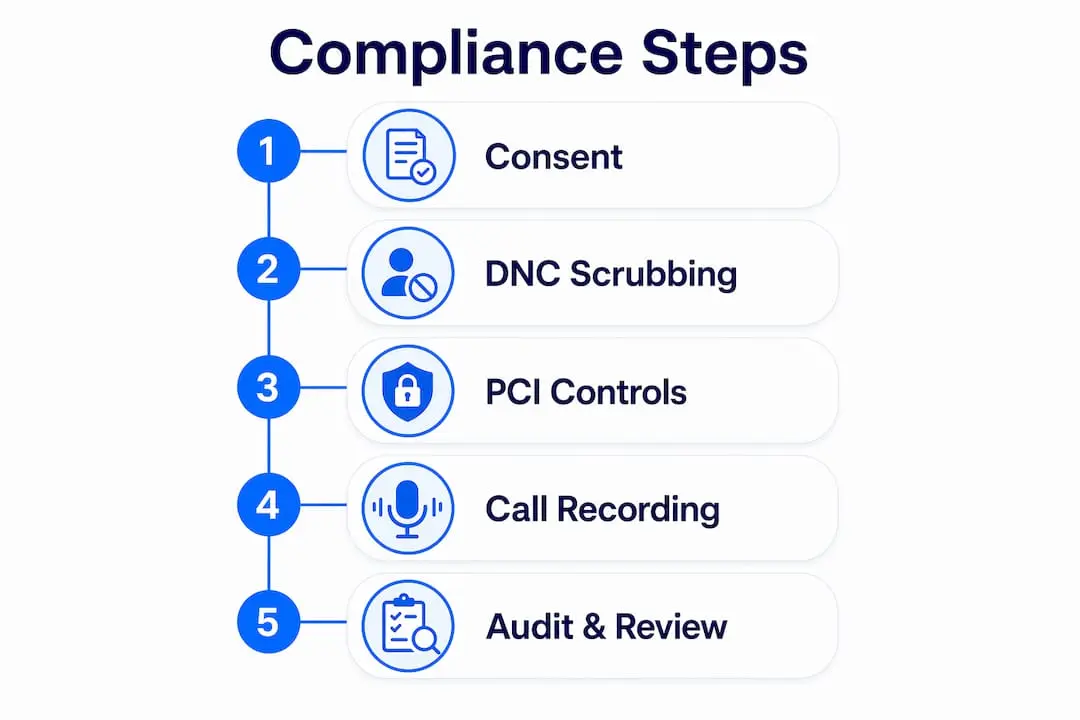
The core telephone number regulations every UK business must understand fall into four categories: consent, do-not-call obligations, payment security, and call recording.
Consent and opt-out rules
Consent is the foundation of compliant outbound calling and SMS. Under TCPA rules that apply to any business reaching US consumers, and under UK PECR for domestic marketing, you must obtain prior express written consent before sending promotional messages. Critically, consumers can revoke consent by any reasonable method, including email, voicemail, or informal language. It is not limited to replying STOP. Businesses must process these opt-out requests within 10 business days. Missing that window is a direct compliance failure with measurable legal consequences.
Do Not Call registry scrubbing
Outbound calling lists must be scrubbed against the National Do Not Call Registry at least every 31 days. Any number that has been on the registry for 31 or more days cannot be called for marketing purposes unless a specific exemption applies, such as an existing business relationship. This is a non-negotiable timeline, not a guideline.
PCI DSS v4.0.1 for phone payments
If your business takes card payments over the phone, PCI DSS v4.0.1 requires multifactor authentication for all non-console access to systems holding cardholder data. This standard became mandatory on 31 March 2025 and is strictly audited. Any business processing telephone payments without meeting this standard is exposed to both financial penalties and reputational damage.
Call recording disclosures
Call recording disclosures should state “this call may be recorded for quality and training purposes” at the very start of the call. Legal consensus is shifting towards treating all calls as requiring two-party consent for recordings as the safest practice, regardless of jurisdiction. This protects you across UK, EU, and US regulatory environments simultaneously.
| Regulation | Requirement | Key deadline |
|---|---|---|
| TCPA / PECR | Prior express written consent for marketing | Before first contact |
| DNC registry | Scrub calling lists every 31 days | Rolling monthly |
| PCI DSS v4.0.1 | Multifactor authentication for cardholder data access | Mandatory since March 2025 |
| Call recording | Disclosure at call start, two-party consent assumed | At every call |
Pro Tip: Assign a named control owner to each of these four regulatory areas. Compliance without accountability is just paperwork. When one person owns DNC scrubbing and another owns consent records, gaps close faster.

How do operational best practices support ongoing phone compliance?
Understanding the rules is step one. Building processes that execute them reliably every day is where most businesses either succeed or fail. These are the operational steps that separate compliant organisations from those that only think they are compliant.
-
Maintain an internal DNC list alongside national registries. Your internal list captures opt-outs from customers who have not registered nationally. Both lists must be checked before any outbound campaign runs.
-
Scrub for reassigned numbers before every campaign. Lists older than six months contain 3 to 5% reassigned numbers, creating TCPA violation risk even when the original number holder consented. Verify against reassigned number databases before each campaign, not just at list acquisition.
-
Integrate consent tracking into your CRM and dialler. Consent records must be auditable, timestamped, and linked to individual contact records. If your dialler cannot read a consent flag and suppress a contact automatically, you are relying on human memory, which fails.
-
Run quarterly agent training with 100% call audits. Training must include quarterly refreshers and auditing of 100% of calls for missing disclosures and consent gaps, rather than spot-checks. Spot-checks create a false sense of security. Full audits reveal systemic problems before regulators do.
-
Deploy DTMF masking for phone payments. DTMF (Dual-Tone Multi-Frequency) masking prevents card numbers entered on a keypad from being recorded or heard by agents. This is the technically superior alternative to manual pause-and-resume methods, which carry high failure rates due to human error.
-
Implement STIR/SHAKEN caller ID authentication. STIR/SHAKEN is essential to prevent legitimate business calls from being blocked or flagged as spam by carrier networks. Compliance is not only about avoiding fines. It is also about call deliverability and whether your customers actually receive your calls.
Pro Tip: When updating your business phone numbers, document every change with a date stamp and notify your compliance team. Number changes can inadvertently reset consent records if your CRM is not configured to carry them forward.
What common compliance challenges do UK businesses face with phone numbers?
Most compliance failures are not caused by ignorance of the rules. They are caused by process gaps that allow known requirements to go unexecuted. These are the pitfalls that generate the most complaints and enforcement actions.
-
Reassigned number risk. A previous owner of a number may have consented to your communications. The new owner has not. Without proactive database verification, you are calling someone who never agreed to hear from you. This is one of the most common sources of TCPA complaints and one of the easiest to prevent.
-
Delayed opt-out processing. Receiving an opt-out request and processing it within 10 business days sounds straightforward. In practice, opt-outs received via email, social media, or informal conversation often sit in inboxes rather than being routed to the suppression list. Automate the routing wherever possible.
-
Manual pause-and-resume for PCI compliance. Manual pause-and-resume methods have high failure rates due to human error. An agent who forgets to resume recording, or who pauses too late, creates both a compliance gap and an audit liability. DTMF masking removes the human variable entirely.
-
Missing call recording disclosures. Agents who skip the opening disclosure, even occasionally, create legal exposure. Without 100% call auditing, these gaps go undetected until a consumer complaint surfaces them.
-
No named control owners. Compliance requires designated control owners for key regulatory requirements to ensure operational accountability. When everyone is responsible, no one is. Assign specific individuals to DNC scrubbing, consent management, PCI controls, and call recording compliance.
“The businesses that face enforcement action are rarely those that ignored the rules entirely. They are the ones that had policies on paper but no one accountable for executing them day to day.”
For a practical starting point, a telephone number compliance checklist helps compliance officers map current processes against each of these risk areas before conducting a formal audit.
How can UK businesses integrate phone compliance into everyday operations?
Compliance embedded into daily workflows is far more reliable than compliance treated as a periodic review exercise. The goal is to make the right action the default action, not an additional step.
Written policies and call handling protocols
Every business that makes or receives calls for commercial purposes needs a written policy covering consent collection, opt-out handling, call recording disclosure, and payment data protection. Policies do not need to be lengthy. They need to be specific enough that an agent can follow them without interpretation.
Scheduled audits and documentation
Audit your calling lists, consent records, and call recordings on a fixed schedule. Monthly for list scrubbing, quarterly for agent compliance reviews, and annually for a full policy review. Document every audit with a date, scope, findings, and actions taken. This documentation is your first line of defence in any regulatory investigation.
Technology for real-time compliance
Real-time opt-out removal, automated DNC scrubbing, DTMF masking, and STIR/SHAKEN authentication are not optional extras for large enterprises. They are the baseline for any business making outbound calls at scale. The cost of these tools is substantially lower than the cost of a single enforcement action.
Cross-functional ownership
Compliance, IT, and operations must each have defined responsibilities. IT owns the technical controls. Operations owns agent behaviour. Compliance owns policy and audit. When these three functions collaborate, phone number management becomes a shared discipline rather than a siloed function that gets ignored until something goes wrong.
| Integration area | Recommended action |
|---|---|
| Policy documentation | Write specific protocols for consent, opt-out, recording, and payments |
| List management | Automate DNC and reassigned number scrubbing on a monthly cycle |
| Agent training | Quarterly refreshers with 100% call auditing for disclosure compliance |
| Technology controls | Deploy DTMF masking and STIR/SHAKEN as baseline infrastructure |
| Audit readiness | Document every audit with date, scope, findings, and corrective actions |
For businesses in trades and services, a call handling guide tailored to UK SMEs provides a practical framework for embedding these processes without requiring a dedicated compliance department.
Key takeaways
Phone number compliance requires consent management, DNC scrubbing, PCI DSS controls, and 100% call auditing to function reliably across UK and international regulatory frameworks.
| Point | Details |
|---|---|
| Consent and opt-out | Process all opt-out requests within 10 business days regardless of the method used. |
| DNC scrubbing | Scrub calling lists against the National Do Not Call Registry at least every 31 days. |
| PCI DSS v4.0.1 | Use DTMF masking rather than manual pause-and-resume to protect card data in calls. |
| Reassigned numbers | Verify lists older than six months against reassigned number databases before campaigns. |
| Named control owners | Assign specific individuals to each compliance area to prevent accountability gaps. |
Why compliance culture matters more than compliance checklists
I have worked with enough UK businesses to know that the ones who treat compliance as a checklist exercise are the ones who end up in trouble. The checklist gets completed once, filed, and forgotten. The regulations, meanwhile, keep moving.
The shift I find most significant right now is the move towards treating STIR/SHAKEN not just as a fraud prevention tool but as a deliverability requirement. If your calls are being flagged as spam before they reach a customer, your compliance programme has failed commercially even if it has not failed legally. That distinction matters enormously for revenue-generating teams.
DTMF masking is another area where I see businesses making avoidable mistakes. The manual pause-and-resume approach feels like a reasonable workaround until you audit 100% of your payment calls and discover how often agents get it wrong. The technology solution is not expensive relative to the risk it eliminates.
My strongest recommendation for compliance officers managing phone number governance right now is to focus on control ownership before anything else. You can have the best policies in the industry. Without a named individual accountable for executing each one, those policies are decorative. Assign owners, set review dates, and build the audit trail that proves execution rather than just intention.
The businesses that will navigate the next wave of regulatory change, including FCC AI-generated call rules and evolving UK PECR guidance, are those building a compliance culture today rather than reacting to enforcement tomorrow.
— Rob
How Phonenumbers supports compliant business communications
Phonenumbers is the UK’s leading provider of memorable 01, 02, and 07 numbers, and the right number is the foundation of compliant, trustworthy business communications. A consistent, verified number supports STIR/SHAKEN authentication, reduces the risk of your calls being flagged as spam, and gives customers a recognisable point of contact they trust. Phonenumbers lets you search by number sequence, area code, or location, and numbers are no longer tied to a local area so you can use them anywhere in the UK. Browse memorable UK landline numbers or explore options like 0115-928-8888 to find a number that works for your brand and your compliance requirements.
FAQ
What does phone number compliance mean for UK businesses?
Phone number compliance means following legal and regulatory requirements governing how businesses use telephone numbers for marketing, customer service, and payment processing. In the UK, this includes obligations under PECR, Ofcom rules, and international frameworks such as TCPA and PCI DSS where applicable.
How often must businesses scrub their calling lists against the DNC registry?
Businesses must scrub outbound calling lists against the National Do Not Call Registry at least every 31 days. Any number registered for 31 or more days cannot be called for marketing purposes without a qualifying exemption.
What is DTMF masking and why does it matter for compliance?
DTMF masking is a technical control that prevents card numbers entered on a phone keypad from being captured in call recordings or heard by agents. It is the preferred method under PCI DSS v4.0.1 because manual pause-and-resume alternatives have high failure rates due to human error.
Can customers opt out of marketing calls by methods other than replying STOP?
Yes. Consumers can revoke consent by any reasonable method, including email, voicemail, or informal language. Businesses must process these requests within 10 business days under current FCC rules, and the same principle applies as best practice under UK PECR.
What is STIR/SHAKEN and does it apply to UK businesses?
STIR/SHAKEN is a caller ID authentication framework that verifies the legitimacy of outbound calls to prevent spoofing and spam flagging. UK businesses making outbound calls, particularly to US consumers, should implement it to protect call deliverability and demonstrate compliance beyond the legal minimum.