
TL;DR:
- Premium rate numbers are carefully regulated UK phone lines used for revenue-generating services like competitions and donations. Businesses must follow strict registration, transparency, and advertising rules to avoid fines and reputational damage. When used properly, PRNs offer significant commercial opportunities but require compliance and clear communication.
Premium rate numbers are widely misunderstood. Many UK businesses assume they are simply expensive phone lines that irritate customers, when in reality they represent a carefully regulated commercial tool with genuine revenue potential. Getting to grips with how they work, what they cost callers, and what compliance obligations apply is not optional for any business considering them. Whether you are exploring them for competitions, technical support, or charitable campaigns, understanding the full picture before you launch a service will save you from costly mistakes and missed opportunities.
Table of Contents
- What are premium rate numbers and how do they work?
- How to set up premium rate numbers for your business
- Benefits and risks of premium rate numbers for UK businesses
- Legal, compliance and advertising rules you must follow
- Our perspective: the real power (and pitfalls) of premium rate numbers for UK brands
- Choosing the right number for your business
- Frequently asked questions
Key Takeaways
| Point | Details |
|---|---|
| PRN costs are split | Premium rate numbers separate call charges into an Access Charge and a Service Charge, with only the latter paid to your business. |
| Compliance is mandatory | UK businesses must register PRNs with Ofcom, advertise full costs, and follow strict regulations to operate legally. |
| PRNs offer branding potential | Used wisely, PRNs can boost revenue and customer engagement, but misuse damages trust and attracts heavy penalties. |
| Alternatives exist | 03 numbers may better suit customer service or marketing, offering lower costs and higher customer trust. |
What are premium rate numbers and how do they work?
Premium rate numbers (PRNs) are telephone numbers where the caller pays a higher rate than they would for a standard call. Unlike calling an 01 or 02 number, dialling a PRN results in a charge that goes beyond the basic network cost. That extra charge is the mechanism through which businesses earn revenue from inbound calls. It sounds straightforward, but the pricing structure has a few layers worth understanding.
Call costs to PRNs are split into two parts: the Service Charge (set by the business or service provider, with a maximum of £3 per minute plus VAT for 09 numbers and a £5 per call cap) and the Access Charge (set by the caller’s own network provider). Revenue is then shared among the service provider, the originating network, and the terminating network, with the service provider receiving the bulk of the income.
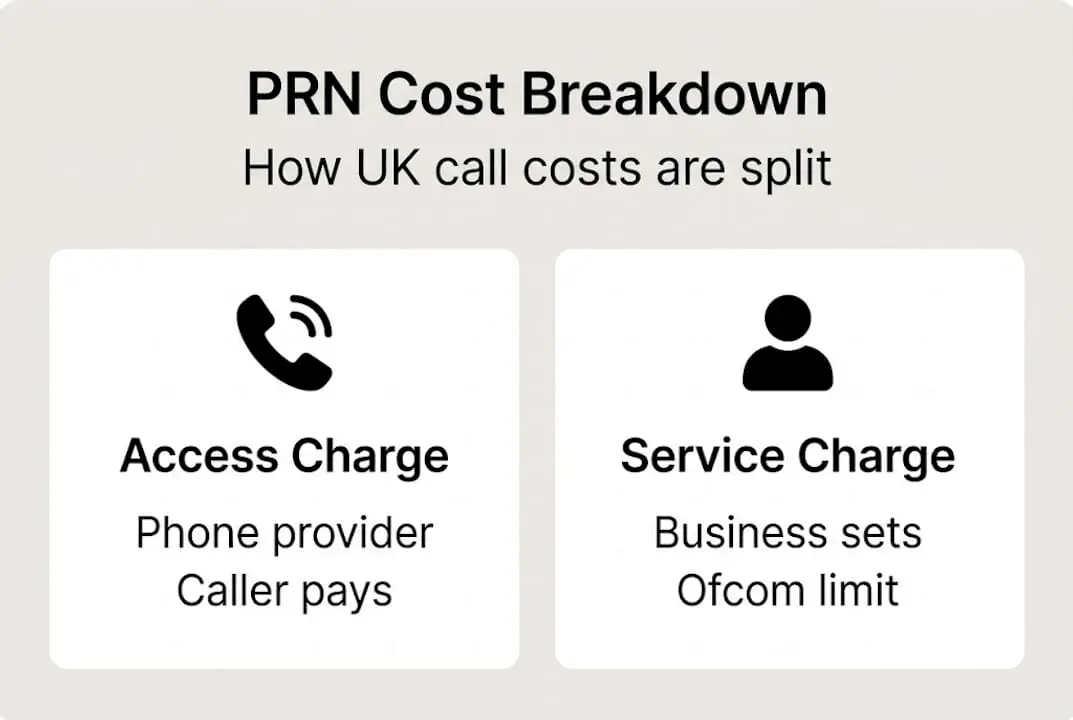
The most common PRN prefixes in the UK are 09 numbers, though 0871, 0872, and 0873 also carry premium rates. For a fuller breakdown of how premium rate numbers differ from other business number types, it helps to compare them against standard alternatives.
| Number type | Caller cost | Revenue share for business | Typical use |
|---|---|---|---|
| 09 number | Up to £3/min + VAT | Yes, via Service Charge | Competitions, content, voting |
| 087x number | Above standard rate | Partial | Info lines, support |
| 03 number | Standard rate | No | Customer service, helplines |
| 01/02 number | Standard rate | No | General business use |
Typical uses for PRNs include:
- Voting lines for TV programmes
- Charity donation campaigns
- Competition entry lines
- Technical support and content provision
- Adult content and entertainment services
“The key distinction between a PRN and a standard business number is that the caller funds part of the business model. That changes everything about how you communicate the service to your audience.”
For businesses that want memorable numbers for business purposes without the premium rate complexity, 03 numbers or geographic 01/02 numbers are often a cleaner fit. But for specific commercial use cases, PRNs offer a revenue model that simply cannot be replicated elsewhere. Understanding the cost breakdown for businesses in detail is a practical first step before making any decisions.
How to set up premium rate numbers for your business
Setting up a PRN is not as simple as calling your telecom provider and requesting a number. There is a regulatory process that must be followed before you go live, and skipping any step can result in fines or a forced shutdown of your service.
Providers must register with Ofcom at least five working days before launching, submitting the required forms to [email protected]. Compliance with the Regulation of Premium Rate Services Order 2024 is mandatory, covering transparency, fairness, and customer care rules. Numbers themselves are obtained through the National Numbering Scheme via telecom operators.
Here is a step-by-step checklist to follow:
- Define your service clearly. Know exactly what callers will receive and how much they will be charged before you apply for anything.
- Register with Ofcom using the correct forms, submitted a minimum of five working days before your planned launch date.
- Obtain your number from a telecom operator authorised to allocate from the National Numbering Scheme.
- Prepare your customer-facing materials. Every advert, website page, and on-hold message must clearly state the cost of calling.
- Set up customer care procedures. Complaints handling and refund processes must be in place before you go live.
- Review your advertising with an ASA-compliant lens before publishing anything.
For a wider overview of business number rules beyond PRNs, it is worth reading up on what applies across all business number types in the UK.
Pro Tip: Build in at least two additional working days beyond Ofcom’s minimum five-day requirement. Provider-side delays and documentation queries are common, and launching late is far less damaging than launching non-compliant.
If you are new to setting up business phone lines in the UK generally, understanding the broader landscape first will make the PRN registration process feel significantly less daunting.
Benefits and risks of premium rate numbers for UK businesses
PRNs are not a universal solution, and treating them as one is where businesses get into trouble. When implemented well, they offer genuine commercial value. When mishandled, they can erode customer trust faster than almost any other business decision.

The benefits are real. Phone-paid services are used by 20 million people in the UK, and major brands including Apple, Google, Spotify, ITV, and Comic Relief use PRNs for donations, voting, and digital content payments. The revenue share model means that a well-designed service can generate income from every inbound call, turning your phone line into a commercial channel.
| Consideration | PRN | 03 number |
|---|---|---|
| Revenue potential | High | None |
| Caller perception | Can be negative | Generally positive |
| Regulatory burden | High | Low |
| Included in call plans | No | Yes |
| Best for | Competitions, content | Customer service |
The risks, however, are equally significant:
- Callers are increasingly wary of premium rate charges post-2015 Ofcom reforms
- Non-compliance carries fines, bans, and serious reputational damage
- Misuse or lack of transparency damages customer goodwill quickly
- Some mobile networks bar PRN calls by default
For phone numbers for customer service purposes specifically, many businesses now choose 03 numbers because they are charged at standard rates and included in most callers’ monthly allowances. This matters enormously when customers are already frustrated and do not want to worry about per-minute charges on top of their problem.
Pro Tip: If your primary goal is customer service rather than revenue generation, a memorable 03 or 01/02 number will almost always serve your brand better than a PRN. Reserve PRNs for services where the caller genuinely expects to pay for access to content or a result.
Understanding the brand impact of memorable numbers can help you see how the choice of number type shapes customer perception long before anyone actually dials.
Legal, compliance and advertising rules you must follow
Since 2025, Ofcom has taken direct regulatory responsibility for premium rate services, replacing the previous oversight role held by the Phone-paid Services Authority (PSA). This shift has brought stricter enforcement and clearer accountability for businesses operating PRNs.
The Advertising Standards Authority (ASA) governs how PRNs can be promoted. Third-party information and connection services (ICSS) using PRN infrastructure must disclose that they are not official services. Scams using fake PRN numbers for fraudulent support lines are a known problem. Call barring is available for consumers. Strict ASA rules require full cost disclosure and prohibit misleading claims, including the use of the word “free” where a premium charge applies. PRNs cannot be used to claim prizes.
The legal requirements fall into four main areas:
- Transparency. Every promotional material must state the cost per minute and any connection charge before the caller decides to dial.
- Fairness. Services must deliver genuine value in exchange for the charge. Artificially prolonging calls to inflate revenue is a regulated offence.
- Consumer protection. Vulnerable consumers, including children, must be protected from services not suitable for them.
- Advertising standards. All ads must comply with ASA guidelines. Misleading copy, including vague cost references, is not permitted.
“Regulatory compliance is not a box-ticking exercise for PRNs. Ofcom and the ASA treat breaches seriously, and the consequences range from financial penalties to permanent bans on operating premium rate services.”
If you want to understand how to protect your numbers from fraud and avoid your business being impersonated through fake PRN scams, specialist guidance is available. It is also worth familiarising yourself with the industry jargon for PRNs so that you can communicate clearly with telecom providers and regulators from the outset. You can check the current Ofcom PRS register to confirm your registration is in order.
Our perspective: the real power (and pitfalls) of premium rate numbers for UK brands
Here is an uncomfortable truth that most articles on PRNs avoid: the revenue share model can quietly incentivise longer calls, which is precisely why the regulatory framework exists to prevent abuse. As Ofcom notes, revenue share incentivises engagement but strict rules prevent exploitation.
Our view is that PRNs are genuinely powerful for the right businesses in the right contexts. A charity using a PRN for a donation campaign is doing something commendable and commercially sensible. A tech brand routing general customer complaints through a £2-per-minute line is doing something that will cost it far more in lost trust than it gains in revenue.
The businesses that use PRNs well treat them as a trust exercise. They price fairly, communicate costs clearly, and only deploy them for services where the caller receives clear value. Compliance is not a nuisance for these brands; it is a competitive advantage, because their competitors who cut corners eventually face enforcement action. If you are considering boosting business revenue through your phone strategy, PRNs are one tool in a wider toolkit, not a standalone solution.
Choosing the right number for your business
Now that you have a clear picture of what premium rate numbers involve, the logical next step is finding the right number for your specific business goals. Whether that means a PRN for a competition line or a memorable 01/02 landline for your customer service team, the choice of number shapes how customers perceive your brand from the very first ring.
At phonenumbers.store, we specialise in helping UK businesses find and secure memorable numbers that work harder for their brand. From 01 and 02 landlines to 07 mobile numbers, our database lets you search by number sequence, area code, or location, and because numbers are no longer tied to specific geographic areas, you can use any number anywhere in the UK. Browse our full range and get guidance on registration and compliance as part of the process.
Frequently asked questions
What is the difference between a premium rate number and a standard business number?
A premium rate number charges callers above standard rates and shares that revenue with the business, while a standard 03 number is charged at normal rates and is typically included in callers’ monthly allowances.
How do I register a premium rate number for my UK business?
You must register with Ofcom at least five working days before launching your service and ensure full compliance with the 2024 regulatory requirements before going live.
What are typical uses for premium rate numbers?
PRNs are commonly used for voting, donations, games, competitions, charity fundraising, and content access lines where callers expect to pay for what they receive.
What regulations must businesses follow for premium rate numbers?
Businesses must meet Ofcom and ASA disclosure rules, including full cost transparency in all advertising and a strict prohibition on misleading claims or using PRNs for prize fulfilment.