
TL;DR:
- Location-based UK phone numbers (starting with 01 or 02) build local trust, improve SEO, and offer flexibility through VoIP.
- They signal geographic identity, leading to higher call answer rates and a professional image, essential for local businesses.
- Modern VoIP allows virtual geographic numbers to be used anywhere in the UK, ensuring continued relevance after the 2027 PSTN switch-off.
Not all business phone numbers are created equal. Many UK businesses assume that any number will do the job, but the type of number you display can directly affect how many customers call you, how much they trust you, and even how well you rank in local search results. Location-based numbers, those starting with 01 or 02, carry a specific geographic identity that non-geographic alternatives simply cannot replicate. Whether you run a plumbing firm in Leeds or a consultancy in Bristol, understanding this distinction could be one of the most straightforward and cost-effective decisions you make for your business this year.
Table of Contents
- What is a location-based number?
- How do location-based numbers work in practice?
- Location-based vs non-geographic numbers: Key differences
- Why UK businesses choose location-based numbers
- What most guides miss about location-based numbers
- Get started with your own location-based number
- Frequently asked questions
Key Takeaways
| Point | Details |
|---|---|
| Geographic numbers stand out | Numbers with 01/02 codes are directly tied to UK locations and build trust with customers. |
| VoIP unlocks location flexibility | Modern systems let you use location-based numbers anywhere, supporting remote business models. |
| Trust drives conversions | Landlines see 28% higher answer rates, making them a smart investment for local marketing. |
| Migration is future-proof | All numbers must move to VoIP by 2027, but local identity remains a core advantage. |
What is a location-based number?
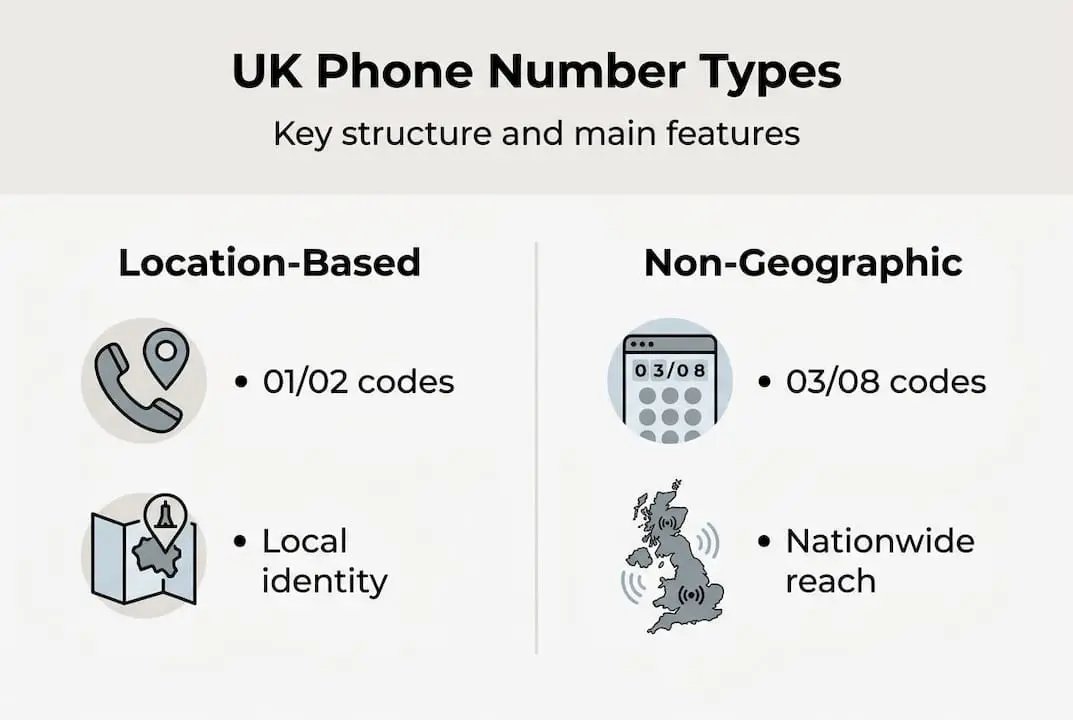
A location-based number, also known as a geographic or local phone number in the UK, is a telephone number starting with 01 or 02 that is associated with a specific geographic area. These numbers follow a structure that combines an area code with a local subscriber number. The area code signals to the caller exactly where the business is rooted, even if the actual call is routed somewhere entirely different.
The structure is straightforward. You have the area code, which is typically two to five digits long, followed by the local number. Together they form a complete dialling sequence. For example, Birmingham uses 0121, Manchester 0161, and London 020, each immediately recognisable to callers familiar with those cities.
Ofcom, the UK’s communications regulator, oversees the allocation and management of these numbers through the National Telephone Numbering Plan. This plan defines which codes belong to which regions, how numbers are assigned to operators, and what rules govern their use. It is a tightly regulated system designed to protect consumers and ensure fair access.
Here is a quick overview of some key UK area codes:
| City | Area code |
|---|---|
| London | 020 |
| Birmingham | 0121 |
| Manchester | 0161 |
| Leeds | 0113 |
| Glasgow | 0141 |
| Bristol | 0117 |
| Edinburgh | 0131 |
| Liverpool | 0151 |
Key facts about location-based numbers in the UK:
- They always begin with 01 or 02
- They are regulated by Ofcom under the National Telephone Numbering Plan
- They signal geographic identity to both callers and search engines
- They can now be used anywhere in the UK, not just in the area their code represents
- They are compatible with modern VoIP systems
For a deeper look at the geographic phone number jargon used across the telecoms industry, it is worth familiarising yourself with the terminology before you commit to a number type.
How do location-based numbers work in practice?
Understanding the mechanics behind location-based numbers removes a lot of the mystery and reveals just how flexible they have become for modern businesses.

Numbers are allocated in blocks of 1,000 or 10,000 and regulated for area use, but VoIP technology makes them far more flexible than the old copper-wire days ever allowed. A business in Newcastle can hold a London 020 number and receive calls on it via an internet connection. The geographic code stays intact; the physical location becomes irrelevant.
Here is how the process typically works for a UK business:
- Choose your area code. Decide which geographic region you want to represent, based on where your customers are or where you want to build a local presence.
- Select your number. Browse available numbers within that area code, including memorable sequences that are easier for customers to recall.
- Port or activate via VoIP. If you already have a number, porting transfers it to a new provider. New numbers are activated through a VoIP platform almost instantly.
- Set up call routing. Decide where incoming calls are forwarded, whether to a mobile, a desk phone, or a call centre.
- Go live. Your location-based number is ready to use, and callers will see a local code regardless of where you physically answer.
One important consideration for 2026 is the upcoming PSTN switch-off in 2027. The old public switched telephone network is being retired, and modern VoIP providers enable virtual geographic numbers that are fully compatible with this transition. Businesses that act now avoid the scramble later.
Pro Tip: When setting up call forwarding, test your routing thoroughly before publishing your number. A missed call because of a misconfigured forward can cost you a customer who will simply ring a competitor next.
For more detail on how virtual telephone numbers operate and what to look for in a provider, it is worth reviewing your options before committing. Good number management best practices will also help you stay organised as your business grows.
Location-based vs non-geographic numbers: Key differences
Non-geographic numbers, those starting with 03, 0800, or 0845, serve a different purpose. They are not tied to any location and are often used by national businesses, charities, and large call centres. Understanding the contrast helps you pick the right tool for the job.
“Geographic numbers are tied to a location and build local trust and SEO value, while non-geographic numbers offer national reach and flexibility but can imply a call centre environment to the caller.” Non-geographic telephone numbers in the United Kingdom
Here is a side-by-side comparison:
| Feature | Location-based (01/02) | Non-geographic (03/08) |
|---|---|---|
| Geographic identity | Yes | No |
| Local trust signal | Strong | Weak |
| Local SEO benefit | High | Low |
| National reach | Limited | High |
| Customer perception | Established, local | Corporate, call centre |
| Call costs for caller | Standard rate | Varies |
| Portability | Yes, via VoIP | Yes |
| Suited to | Local/regional businesses | National brands, charities |
For a local vs non-local numbers breakdown, the evidence consistently points to geographic numbers performing better in trust-sensitive industries such as trades, healthcare, legal services, and financial advice.
That said, non-geographic numbers are not without merit. A business operating across the whole of the UK with no single regional base may find that using non-geographic numbers suits their brand better. The key is alignment between your number type and your business identity.
For businesses that operate both locally and nationally, a blended approach works well. You might use a local 01 number on your regional landing pages and a national 03 number in your head office communications. For a full comparison of local vs national numbers, the differences in customer behaviour and call answer rates are worth examining closely.
Why UK businesses choose location-based numbers
The data behind location-based numbers is compelling. UK businesses using location-based numbers report enhanced customer trust, stronger perceived professionalism, and measurable local SEO improvements. Customers actively prefer them over mobile numbers because they signal stability and permanence.
Consider these advantages:
- Trust and credibility. A local area code tells a potential customer that you are an established presence in their community, not a transient operator.
- Higher answer rates. Calls from geographic numbers are answered at significantly higher rates than those from freephone or mobile numbers. Customers are more likely to pick up when they recognise the area code.
- Local SEO ranking. Search engines factor your phone number into local search signals. A consistent 01 or 02 number listed across your website, Google Business Profile, and directories strengthens your local ranking.
- Professional image. A landline-style number carries more weight than a mobile in sectors where professionalism matters, such as legal, medical, or financial services.
- VoIP flexibility. You get all the benefits of a geographic number without being physically tied to the area. Calls route to wherever you are.
78% of consumers say they prefer to call a business on a landline number rather than a mobile, viewing it as a stronger signal of legitimacy. That preference alone is reason enough to take location-based numbers seriously.
For businesses focused on boosting local SEO, a consistent local number is one of the simplest wins available. Pair it with solid number listing best practices and you have a foundation that supports both trust and discoverability.
What most guides miss about location-based numbers
Most articles stop at the stats and leave businesses with a surface-level understanding. Here is what we have observed working with UK businesses across every sector: the real value of a location-based number compounds over time in ways that are easy to underestimate at the start.
After the PSTN switch-off in 2027, many businesses assume that geographic numbers will lose their relevance. The opposite is true. Cloud routing preserves the local identity of these numbers while adding flexibility that the old copper network never offered. Your 0161 Manchester number does not disappear; it simply travels with you.
Local identity is increasingly critical for search, trust, and conversion. Customers searching for “plumber in Sheffield” are not just looking at your website copy; they are scanning your phone number for confirmation that you are genuinely local. A matching area code is a silent trust signal that works around the clock.
The businesses that choose virtual landlines early are the ones building durable local credibility. Missing out on a location-based number is not just a missed marketing opportunity; it is handing a simple, cost-effective advantage directly to your competitors.
Get started with your own location-based number
If the case for location-based numbers is clear, the next step is straightforward. At phonenumbers.store, we specialise in UK 01 and 02 landline numbers and 07 mobile numbers, giving you access to a wide range of geographic codes from every corner of the country.
You can search our database by number sequence, area code, or town, city, or county to find the perfect match for your business. Numbers are no longer tied to physical locations, so you can get a location-based number and route it anywhere via VoIP. Whether you want a memorable Leeds number like the 0113 255 0000 or a London 020 number for your consultancy, the process is quick and entirely online. Give your business the local credibility it deserves.
Frequently asked questions
Can I use a location-based number even if my business is not physically in that area?
Yes, with VoIP you can advertise a location-based number anywhere in the UK, regardless of physical presence. Modern VoIP providers enable virtual geographic numbers that route calls to any device or location.
Do UK location-based numbers work internationally?
Yes, but callers outside the UK should dial the number without the leading zero, replacing it with the UK country code +44. Note that not all non-geographic numbers are fully portable from abroad.
How do I choose the best location-based number for SEO?
Select a number with an area code that matches your target market. A consistent location-based number listed across your website and directories strengthens local search signals and builds credibility with nearby customers.
Will location-based numbers still work after the PSTN switch-off?
Yes, but they must be migrated to VoIP before 2027. Post-PSTN switch-off, geographic numbers retain their local identity and continue to function via cloud routing under Ofcom’s framework.