The best VoIP phone service is the one that keeps your number, answers every call you can’t, and still works when something goes wrong. For a plumber or a taxi firm, that usually means a simple service built around one memorable number rather than a feature-heavy office suite priced per seat. For a larger office, it means a hosted system with desk phones, an app and UK-based support. This guide shows you how to choose, what it should cost, and what to check before the UK landline network is switched off.
TL;DR
- Hosted VoIP for small UK businesses typically costs £7 to £20 per user per month, so be wary of anything far outside that range without a reason.
- The old landline network (PSTN) is due to be retired by January 2027, so a move to VoIP is not optional for most landline users.
- Keep your number. Porting is a regulated process, and a memorable number is worth more to a trade business than any feature.
- VoIP needs power and broadband. Plan a battery backup or a mobile fallback before you switch.
- Rolling monthly contracts suit sole traders better than long broadband bundles.
Table of Contents
- Why the question matters more in 2026
- What VoIP actually is, in plain terms
- What the best VoIP phone service looks like for a small business
- Power cuts, 999 and the mobile fallback
- What plumbers and taxi firms need that an office does not
- The main types of service compared
- Our perspective: start with the number, not the platform
- Setting up: a simple order of work
- Our VoIP options
- Mistakes to avoid when choosing
- FAQ
- Sources
Why the question matters more in 2026
For decades, a business landline just worked. The exchange powered it, and nobody thought about the technology. That is ending. The traditional analogue network is being phased out and replaced with digital services using VoIP, with the transition expected to complete in January 2027. The government confirmed that over two-thirds of lines had already moved by June 2025.
So the real choice is not whether to use VoIP. It is which kind, from whom, and on what terms. Many people will be moved by their existing provider whether they plan for it or not. Choosing deliberately, while there is still time, gives you control over price, contract length and number.
What VoIP actually is, in plain terms
VoIP (Voice over Internet Protocol) sends your calls over a broadband or mobile data connection instead of a copper phone line. BT’s version is called Digital Voice, and other providers use names like Sky Voice or TalkTalk Voice. They are all VoIP under the bonnet.
For a business, VoIP comes in several practical forms:
- A hosted phone system: desk phones or an app, with extensions, hunt groups and voicemail-to-email. Built for offices.
- A virtual number with forwarding: your business number rings your mobile or another line. Cheap and simple.
- A VoIP service on your own phone or router: you keep a familiar handset and the number, and calls travel over your broadband.
- A mobile number or SIM: a 07 number that rings a SIM, handy if you are out on jobs all day.
The best service for you is whichever form matches how your calls actually arrive and where you answer them.
What the best VoIP phone service looks like for a small business
Review sites tend to rank the big cloud suppliers by feature count. That is a fair guide for a 30-person office. For a sole trader or a small firm it can mislead you into paying for things you will never use. Judge any provider against these criteria.
1. Number portability
Your number is the asset. Customers have it on vans, invoices and fridge magnets. A good service lets you bring your existing number in and take it out again. Check that porting is included and ask what it costs to leave. If you want the process in detail, our guide to what you need to transfer a UK phone number covers the steps.
2. Honest, flat pricing
Hosted systems for small UK businesses typically run between £7 and £20 per user per month, with entry-level virtual numbers from around £4.50 a month and AI-integrated systems from £45 and up. Watch for setup fees, per-minute charges outside the bundle, and annual increases. Our piece on why a 24 month cost beats a cheap upfront fee shows how to compare total cost rather than headline price.
3. Contract length
Many bundled VoIP deals sold alongside broadband run for 36 to 60 months with fixed annual price rises. Standalone providers often offer rolling monthly terms. If your business might change, shrink, grow or move, flexibility is worth more than a small discount.
4. UK-based support
When a phone line fails, you lose jobs by the hour. Ask where support is based and what hours it covers. A provider that answers a technical question on the same day is worth a few pounds more per month than one that routes you to a ticket queue.
5. Resilience and emergency calls
This is the criterion people skip. We cover it next, because it affects safety as well as business.
Power cuts, 999 and the mobile fallback
A digital landline needs mains electricity. Ofcom explains that, unlike old copper phones powered from the exchange, a VoIP line will not work in a power cut unless a battery backup or another power source is in place. Under Ofcom’s General Condition A3, providers must make sure customers can reach 999 and 112, and landline-dependent customers should be offered a free battery backup of at least one hour.
Two practical points for a business:
- Your router and your phone both need backup power, not just the box where the line enters the building. A battery that keeps only one of them alive does not keep you reachable.
- Keep a charged mobile. For many tradespeople it is already the main phone, and in a power cut it is your safest route to emergency services.
If you or anyone who relies on your premises depends on the landline for emergency calls, for example someone vulnerable on site or at home, talk to your provider about the backup they supply before you switch, and check Ofcom’s guidance linked above.
What plumbers and taxi firms need that an office does not
An office has a receptionist and a fixed desk. A plumber has a pair of wet hands under a sink. A taxi firm has drivers on the move and peaks at 2am. Their call patterns are different, and so is the best service.
Answer fast or lose the job. Emergency callers ring the next firm quickly if you do not pick up. Plain forwarding to a mobile helps, but it does not capture a job when you cannot answer. Consider a service that rings several people in turn, or a voicemail you check at fixed times, and tell callers what to expect.
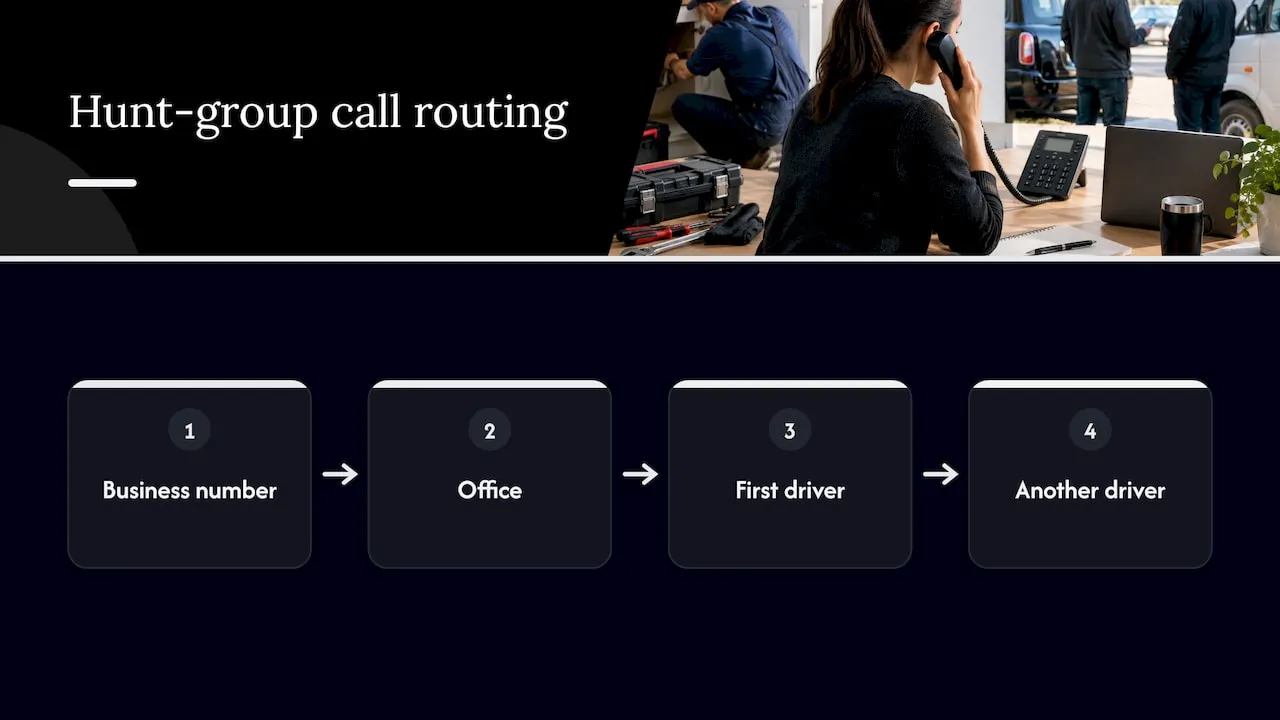
One number, many people. A taxi firm wants one number that rings the office, then a driver, then another. A plumber with two vans wants the same. That is a hunt group or a forwarding rule, and a decent VoIP service includes it.
A number people remember. This is where trade businesses win or lose. A number that is easy to say and easy to recall gets repeat calls without advertising spend. A local-looking 01 or 02 number also tells customers you are established nearby, though numbers are no longer tied to a place, so you can use one from any area anywhere.
Know where your calls come from. If you advertise on vans, leaflets and Google, you want to know which one works. A different number per channel and proper call tracking tells you. For a practical walkthrough, see this guide to setting up call tracking for local businesses, which covers keeping on top of urgent enquiries.
The main types of service compared
| Type of service | Best for | Typical cost | Watch out for |
|---|---|---|---|
| Full hosted phone system | Offices with several staff | £7 to £20 per user per month | Features you won’t use, per-seat costs |
| Virtual number with forwarding | Sole traders, side businesses | From around £4.50 a month | Callers hanging up before voicemail, no job capture |
| VoIP on your own router and handset | Firms that want to keep the old phone and number | Varies by provider | Router and power backup |
| Mobile number or SIM | People always on the move | Varies by provider | Mobile call costs for callers |
| Broadband bundle with VoIP | Those wanting one bill | Often locked in for 36 to 60 months | Annual rises, hard to leave |
No one row wins everywhere. A taxi firm with 12 drivers may use a hunt group plus mobile SIMs. A one-man plumber may be best served by a single memorable number that forwards to his mobile.
Our perspective: start with the number, not the platform
We sell memorable UK numbers, 01, 02 and 07, plus the services that connect them, so we see the same mistake again and again. A business shops for a phone system first and treats the number as an afterthought. Then it prints the number on a fleet of vans and discovers that switching provider means changing it.
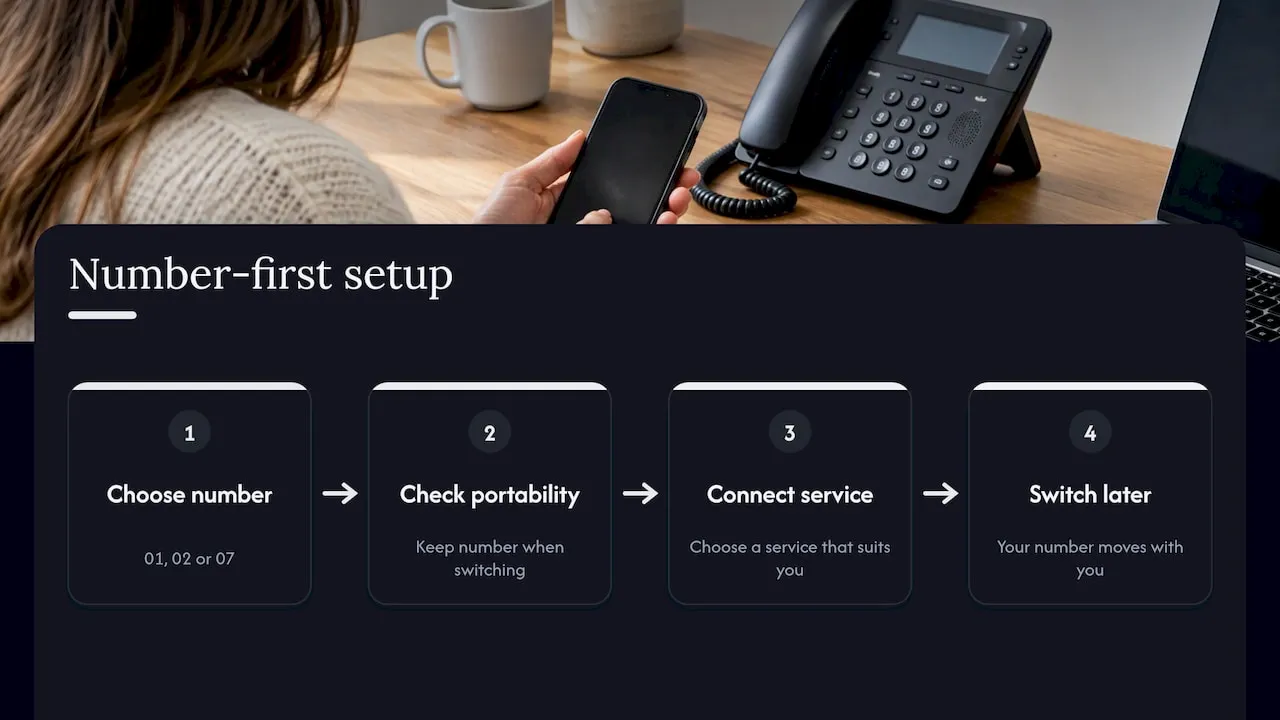
We turn that around. Pick the number first, make sure it is portable, and then connect it to whichever service suits you, now and later. Because numbers are no longer tied to local areas, a plumber in Leeds can hold a Manchester or London number if that serves the business, and route it anywhere. Because the number is yours to port, you are never trapped by the service behind it.
On the service itself, our view is plain. Most sole traders and small firms do not need a 30-seat cloud suite. They need a number people remember, a way to ring the right person, reliable power and a contract they can leave. If a bigger system makes sense for you later, your number moves with you.
— Rob
Setting up: a simple order of work
- List how calls arrive. Phone, van signage, directories, website. Count missed calls for a week.
- Choose or keep a number. If you already have one customers know, keep it and port it. If not, pick a memorable one. Our guide to choosing your own number and the Ofcom porting steps explains how.
- Decide where calls ring. One mobile, several mobiles, a handset, or a hunt group. Our guide to call divert types and the +44 setup mistake is worth reading before you set rules.
- Plan for power cuts. Battery backup for router and phone, plus a charged mobile.
- Check the contract. Monthly rolling terms, setup fees, minute bundles and what happens when you leave.
- Test before you advertise. Call from a landline and a mobile, at different times, and check the forwarding works.
If you need time to decide, a number you like can be held for you. A 30 day reservation costs £10 one-off, so nobody else takes it while you sort your service.
Our VoIP options
We offer several ways to connect a number, with prices published on each page:
- XL Hosted Voice Service with a VoIP phone (XLHV): £7.86 per month, with a one-off set-up charge of £30.
- XL Premier Service: £9.60 per month, with a £14.40 one-off set-up.
- XL-IP: £8 per month, with a router and set-up at £99 one-off. It is designed for people who want to keep their BT phone number and phone and use them through a broadband router. Optional call bundles run from £3.50 a month for 250 minutes to 01, 02 and 03 numbers and the top four mobile numbers, up to £24 a month for 5000 minutes.
- XL Mobile SIM: £27.24 per month, for a number that travels with you.
You can search for a memorable number by digits, sequence, area code or town, and buy or rent it. If you are a taxi firm, ask about Taxi Connect Direct on the same page as the SIM.
Mistakes to avoid when choosing
- Buying on feature count. More features mean a higher bill and a steeper learning curve. Match the service to your calls.
- Ignoring the exit. If you cannot port your number out, you are not a customer, you are a hostage.
- Forgetting the router. VoIP quality depends on your broadband. If the connection is poor, the best provider will still sound bad.
- Skipping power backup. The risk is rare but serious, and cheap to cover.
- Trusting caller ID blindly. Some callers fake local numbers over VoIP. Our guide to spotting UK VoIP caller spoofing shows how to report it.
FAQ
Is BT a VoIP provider?
Yes, in effect. BT’s Digital Voice service delivers calls over broadband, and Which? describes it as BT’s name for its VoIP service. Other major landline providers have their own branded versions. They are broadly the same technology with different packaging.
Is there a free VoIP service available in the UK?
Free app-based calling exists, but it rarely gives you a proper business number, portability or support. For a business, a paid service from around £4.50 a month for a virtual number is a more realistic starting point, as price comparisons suggest. A number you cannot port is a risk if customers know it.
What is the disadvantage of VoIP?
It depends on power and broadband. Ofcom notes that a digital landline will not work in a power cut without battery backup. Keep a charged mobile and make sure both your router and phone are covered.
Can I keep my existing business number if I switch?
Yes, in most cases. Number porting is a regulated process, so you can move your number to a new provider. Ask for the port to be arranged before cancelling the old line, so there is no gap in service.
Sources
- Ofcom: Your landline is going digital
- GOV.UK: Communication providers, ensuring telecom services are resilient
- Which?: Digital Voice and the landline switch-off
- Which?: Protecting telecare users in the shift from analogue to digital
- Compare Business Phone Systems UK