VoIP (voice over Internet Protocol) is a phone service that sends your voice as data over the internet rather than through the old copper network. It matters now because UK landlines are moving to digital, with the industry switchover expected by January 2027. You get clearer calls and more features, but your phone depends on mains power and broadband.
TL;DR:
- About 99% of existing home phones work with digital services, but very old handsets may need an adapter or replacement; ask your provider before switching.
- VoIP call quality depends on stable upload speed, low latency, and low packet loss; test your connection at different times and use wired connections when possible.
- VoIP stops when power fails; providers must offer customers relying solely on landlines for emergency calls a free backup, often lasting at least one hour.
- Before migration, list alarms, telecare devices, and card machines, and confirm they will work; specialist equipment may require provider configuration or replacement.
- VoIP calls may be bundled with broadband, but calls to UK geographic and mobile numbers can carry per minute charges; check your provider’s tariff.
Table of Contents
- How does VoIP work behind the scenes?
- What equipment and connection do you need for VoIP?
- What changes day to day compared with a traditional landline?
- How do you set up or switch to a VoIP phone service?
- What happens to VoIP in a power cut, and how do you stay reachable?
- What are the benefits and common features of VoIP?
- Why a memorable number matters when you move to VoIP
- How we can help you keep a memorable number on VoIP
- FAQ
- Sources
How does VoIP work behind the scenes?
When you speak into a VoIP handset or app, the device chops your voice into tiny digital packets. Each packet travels over your broadband connection, possibly by a different route, and the receiving device puts them back in order quickly. It feels like a normal conversation because the reassembly happens faster than you can notice.
A codec does the digital conversion. It compresses your voice so it fits down a broadband line, then unpacks it at the other end. Some codecs prioritise clarity, others save bandwidth. Call quality depends on three things: enough upload speed, low latency (the delay between speaking and being heard) and low packet loss (packets that never arrive). A busy home network where someone is streaming high-resolution video can make a call sound choppy for exactly these reasons.
To reach ordinary phone numbers, VoIP providers use gateways. A gateway is a bridge between internet voice and the public telephone network, which is how a VoIP call lands on a landline or a mobile. That interoperability is why you can swap service types without telling your friends or customers anything.
Services come in several forms. Some are PC to PC, some use an adaptor so a traditional phone works, and others run on mobile or Wi-Fi devices. Ofcom’s consumer advice on buying VoIP services also notes that some services can make and receive calls to the ordinary phone network while others only work inside their own app. Fixed services stay tied to one address, while nomadic ones let you take your number to wherever you have an internet connection.
What equipment and connection do you need for VoIP?
You need less than most people expect. A working broadband line, a router and something to talk into is the core of it. Ofcom’s guidance on digital landlines explains that customers usually plug their phone into the router, and that providers should explain what equipment you need.
For reliable calls, check these before you commit:
- Upload speed: voice needs little bandwidth, but it needs consistent bandwidth. A line that regularly collapses under load will make calls break up.
- Latency and packet loss: wired connections beat Wi-Fi here. If you can, connect your phone or adaptor to the router by cable.
- A router you control: you need to know where it is and how it is powered, because it is now part of your phone line.
- An IP phone or an analogue telephone adaptor (ATA): an IP phone connects directly, while an ATA lets your existing handset work.
- A smartphone or PC app: useful as a second way to take calls, with a headset for comfort.
Businesses may add a hosted PBX (a phone system run by the provider), SIP credentials (the login details that connect a device to the service) and SIP phones. Home users rarely need any of that.
The reassuring news is that your old handset probably survives. GOV.UK estimates that about 99% of existing home phones are compatible with new digital services. Very old models may need an adapter or replacement, and your provider can tell you which.
What changes day to day compared with a traditional landline?
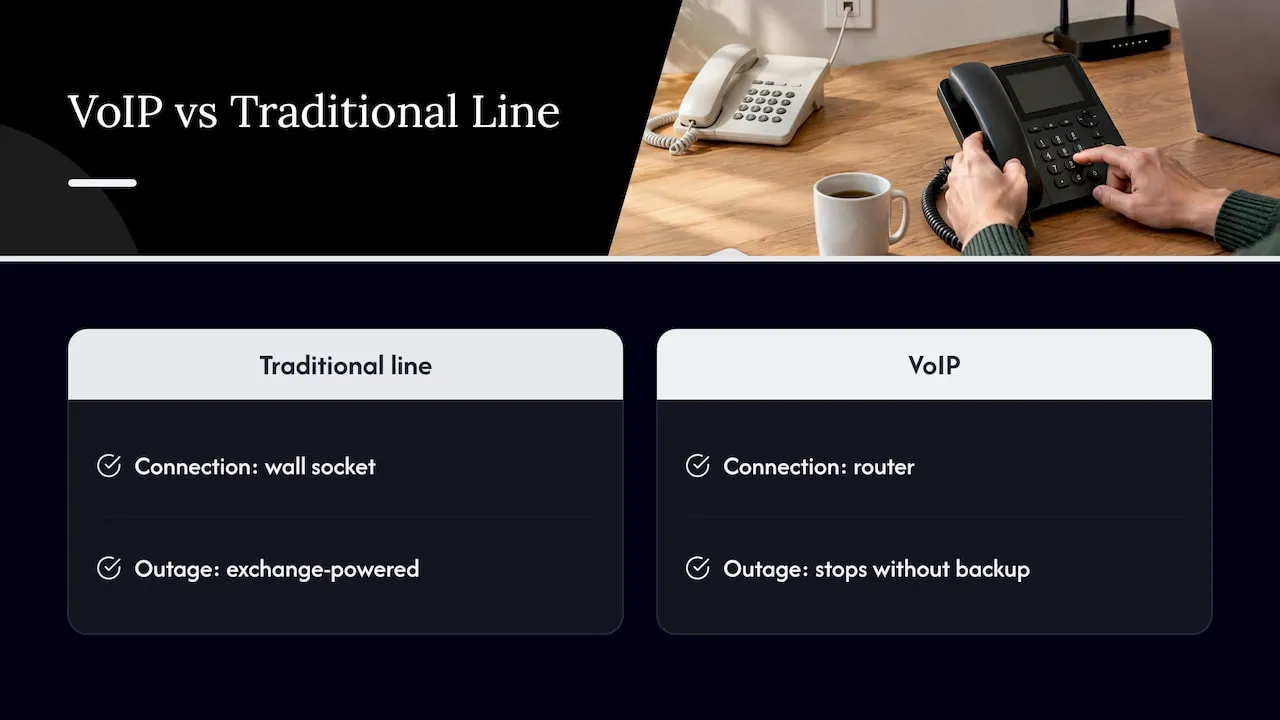
For most people, very little. You still hear a dial tone, you keep the same number, and you pick up the handset as usual. The main physical difference is where the phone plugs in: the router, not the wall socket. Which? reports that providers such as BT, Sky and TalkTalk brand their versions as Digital Voice, Sky Voice and TalkTalk Voice, and for many users the experience is very similar to an analogue line.
Quality often improves. Calls tend to sound clearer on fibre and with modern codecs, and extras such as nuisance-call blocking become possible. Cost changes shape rather than simply dropping: voice is frequently bundled with broadband, and calls between users on the same VoIP service can be cheaper or free, while calls to other numbers follow your provider’s tariff. Check whether your plan includes calls to UK geographic and mobile numbers or charges for them by the minute.
Resilience is the real difference. An old copper line was powered from the exchange, so it kept working when your electricity went off. A VoIP line uses your router, so a power cut ends the call unless you have back-up. That is not a reason to avoid VoIP, but it is a reason to plan, and the section on power cuts below shows how.
How do you set up or switch to a VoIP phone service?
Switching is usually a matter of a few conversations and one hardware swap. Before you start, work through this short check:
- Test your broadband speed at different times of day.
- List anything that relies on your landline, such as telecare pendants, alarms or a fax.
- Confirm your current handsets will work, or whether you need an adaptor.
Your provider then typically contacts you, arranges to keep your number (number porting), sends or configures hardware and tests the service with you. Expect letters, texts or calls explaining when your line will move. Moving the number is a standard process, and if you need a walkthrough, our guide on what you need to transfer your phone number covers it step by step. Our piece on setting up call forwarding helps if you want calls reaching a mobile while the new line settles in.
Questions worth putting to any provider before migration:
- Will I keep my current number, and on what date does it move?
- What equipment is supplied, and is there any charge?
- How does the service behave in a power cut, and is a battery back-up included?
- Will my alarm, telecare device or card machine still work?
- What happens to my calls if my broadband drops?
If you are a business owner, you can also get a number running on a mobile quickly, as we explain in our guide to a business number on your mobile phone.
What happens to VoIP in a power cut, and how do you stay reachable?
VoIP stops in a power cut because your router needs mains electricity to work. GOV.UK’s guidance for providers states that this resilience gap is the primary disadvantage of VoIP compared with analogue phones, and that Ofcom expects providers to offer protection to those who need it most.
Ofcom requires communications providers to give customers who rely solely on their landline for emergency calls a free resilience solution during a power cut, often a battery back-up designed to last at least one hour. That is the minimum expectation, and it is why you should ask your provider what they offer.
Practical ways to stay reachable:
- Fit a battery back-up for the router and the phone or adaptor, and test it now and then. Practitioners recommend testing rather than assuming it works.
- Keep a charged mobile as a secondary fail-safe, especially for 999 calls.
- Use a hybrid arrangement where calls fall back to a mobile SIM when the line goes down.
- Tell your provider if you are vulnerable. They must take extra steps for people who depend on the landline.
If you use telecare or another specialist device, contact your communications provider before migration, because the equipment may need configuration or replacement. The Telecare National Action Plan sets out how users are protected through the switchover, and the non-voluntary migration checklist says providers must prioritise restoring service for vulnerable customers if devices stop working.
What are the benefits and common features of VoIP?
The everyday case for VoIP is simple: you get more from the same phone line. GOV.UK highlights clearer call quality, the ability to keep your number and features such as nuisance-call blocking as reasons people choose it.
- Clearer calls on fibre and modern codecs.
- Voice and data together, so one connection and one supplier can handle both.
- Lower marginal costs for calls between VoIP users.
- Call forwarding, so your landline number rings on your mobile.
- Voicemail to email, useful if you are rarely at a desk.
- Hunt groups, which ring a set of phones in turn until someone answers.
- Number portability, so you keep the number people already know.
Businesses value VoIP because it can match the features of a traditional PBX at lower cost and makes remote working far easier. A team member at home can answer the office number as if they were at their desk. Firms that handle high volumes of outbound calls also benefit from dialling tools, as this partner article on power dialler benefits explains for sales teams.
Pro Tip: Watch out for spoofed caller IDs. Because VoIP numbers can be set up quickly, scammers sometimes show a fake local number, so read our guide to spotting VoIP caller spoofing and use your provider’s blocking tools.
Why a memorable number matters when you move to VoIP
Moving to VoIP is the best moment to take a hard look at the number printed on your van, your website and your invoices. Numbers are portable, and they can be routed to a VoIP service, a mobile SIM or both, which means you do not lose continuity whatever technology sits behind them. That makes the number, not the line, the real asset.
Most small businesses underrate how much recall a number carries. A customer who remembers it dials you; one who cannot find it dials someone else. Choosing a memorable sequence during the migration, rather than after it, saves you reprinting everything twice. Our own explainer on virtual phone calls shows how a number can stay reachable through the switchover.
My view: treat the switch as a brand decision first and a technical one second. The wiring will be sorted by your provider. The number is what customers will keep.
— Rob
How we can help you keep a memorable number on VoIP
We sell and rent UK memorable landline and mobile numbers, and we can route them to VoIP or to SIMs, so your customers keep reaching you however your phones are connected. If you want hosted VoIP with help getting set up, we offer that too, with prices listed on each service page.
- Hosted VoIP: XL Hosted Voice Service with a VoIP phone (XLHV) costs £7.86 per month, with a one-off set-up charge of £30.
- Keep your BT number: XL-IP costs £8 per month, with a one-off router and set-up fee of £99.
- Call minutes: add 250 minutes to 01, 02 and 03 numbers and the top four mobile numbers for £3.50 per month.
Ready to start? Search our numbers, reserve one for 30 days for £10, and tell us how you want it connected.
FAQ
Why would someone have a VoIP phone?
People choose VoIP for clearer calls, useful features such as call forwarding and nuisance-call blocking, and the ability to keep their existing number. GOV.UK lists these as the main reasons. Businesses also like how easily it supports remote working.
What is a disadvantage of using VoIP?
The main drawback is resilience. VoIP needs your router, so a power cut or broadband outage can stop calls unless you have a back-up. Ofcom expects providers to give vulnerable customers a free solution, often a battery back-up lasting at least one hour.
Can any phone be used as a VoIP phone?
Most can. Your existing handset will usually work with an adaptor or your provider’s router, and GOV.UK estimates about 99% of home phones are compatible. Very old models may need replacing.
Do I need a landline if I have VoIP?
No. A VoIP line replaces the old landline and carries your number over broadband. Many people also rely on mobile coverage and Wi-Fi calling, as House of Commons Library analysts note, but keep a charged mobile as a fallback for power cuts.