Unconditional call forwarding, shown on many handsets as “Call Forwarding Unconditional” or CFU, sends every incoming call to another number straight away, without your own phone ringing. In the UK it is usually called call diversion. If you see the phrase on an Android or iPhone settings screen, it simply means: all calls go somewhere else, whatever state your phone is in.
This guide explains what the setting does, how it differs from other diverts, the codes to switch it on and off, what it can cost, and where small firms such as taxi operators and plumbers get caught out.
TL;DR
- Unconditional call forwarding diverts all incoming calls to a number you choose, without ringing the original phone.
- Conditional forwarding is different: it only acts when you are busy, unanswered or unreachable.
- On UK networks you typically switch it on with
*21*plus the destination number and#, and off with#21#.##002#cancels every divert on a mobile. - The forwarded leg of the call is often charged to you, and active call barring can stop the divert from being set.
- If you want a memorable business number that you can point anywhere, a number you own is more flexible than a handset setting.
Table of Contents
- What unconditional call forwarding means
- Unconditional versus conditional forwarding
- How to turn it on and off in the UK
- What it costs
- Common problems and how to avoid them
- When unconditional forwarding makes sense for a small firm
- Our view: the number matters more than the handset setting
- Putting it into practice with a memorable number
- Quick checklist before you switch it on
- FAQ
- Sources
What unconditional call forwarding means
The word “unconditional” is the key. There is no condition attached: no “if I am busy”, no “if I do not answer in 15 seconds”. Once the divert is on, every call is intercepted and sent to the destination number you chose. BT describes the service as letting you divert calls to almost any phone, including a mobile, and it can also divert calls while your line is in use.
The instruction is held by the network, not by your handset. That has two practical consequences:
- Your phone does not need to be switched on, charged or in signal for the divert to work.
- The divert stays in place until someone cancels it. Plenty of people forget they set it, then wonder why nobody can reach them.
So when someone asks what “call forwarding unconditional” on Android means, the answer is the same as on any phone. Android labels the options “Always forward”, “Forward when busy”, “Forward when unanswered” and “Forward when unreachable”. The first is the unconditional one. The wording differs a little between handset makers and networks, but the behaviour is the same.
Unconditional versus conditional forwarding
There are four common types of divert. Only one of them is unconditional.
| Type | When it triggers | Typical use |
|---|---|---|
| Unconditional (all calls) | Every call, immediately | Office closed, you are on holiday, a number that only exists to route calls elsewhere |
| On busy | Your line is engaged | Overflow to a colleague when you are on another call |
| On no reply | You have not answered after a set time (often 15 seconds) | Backup when you cannot get to the phone |
| Not reachable | Phone is off or out of signal | Catching calls while you are in a dead spot |
The codes on a UK mobile follow this pattern. BT’s mobile guidance lists 21 for all calls, 61 for calls not answered after 15 seconds, 62 for when the phone is switched off and 67 for when it is engaged.
A useful rule of thumb: use conditional forwarding when you still want to answer first, and unconditional forwarding when you never want the original phone involved.
How to turn it on and off in the UK
The codes are standard across most UK landlines and mobile networks, though you should check your own provider’s help page before relying on them.
Switching it on
- Pick up the handset on the line you want to divert (or open the dialler on your mobile).
- Dial
*21*, then the full destination number, then#. For example,*21*07700900123#. - Press call. You should hear or see a confirmation.
- Ring your number from another phone to test it.
Vodafone’s business guidance gives the same *21* code for diverting all calls immediately. Use the full UK number, and if you are diverting abroad, check the format carefully, because a wrong international prefix is one of the commonest reasons a divert silently fails. Our guide to avoiding the +44 mistake when setting up call forwarding walks through it.
Switching it off
Dial #21# and press call to cancel the unconditional divert. To clear every divert at once on a mobile, dial ##002#. Both are covered in BT’s call diversion help.
If you are not sure whether a divert is active, dial *#21# on a mobile to check. Be aware that the result can look odd. We explain why it can show voicemail rather than anything sinister in our piece on the *21 and *#21# codes.
Pay as you go limits
Not every plan lets you divert to any number. Vodafone’s help page says that Pay as you go customers can only divert incoming calls to voicemail. Check your tariff before you build a plan around forwarding to a colleague’s mobile.
What it costs
The feature itself may be free or paid depending on the line, and the forwarded leg of the call is a separate matter.
- Feature charge. On some older business line products a monthly rental applies. As one example, Vodafone’s published price guide lists customer-controlled call forwarding on ISDN 2 lines at £1.69 a month. Other providers and packages differ.
- The forwarded call. BT’s business guide is the place to check how the diverted leg is billed. As a general principle, the account holder, meaning you, is usually the one charged for the onward call. A flat-rate bundle does not always cover it, particularly when you divert to a mobile.
- Concurrent calls. Confirm with your carrier whether the plan limits how many calls can be forwarded at once. That matters if you are a busy taxi office.
Ofcom’s page on managing landline costs is worth reading for the wider point: check what is and is not included in a bundle before you assume it is free. Our article on who pays when you forward calls goes through the cost side in more detail.
Common problems and how to avoid them
Call barring blocks the divert
If call barring is active on a landline, you generally cannot set a divert. BT’s guide says to turn the barring off, apply the forwarding, then reapply the barring. If your divert code seems to do nothing, this is the first thing to check.
The caller’s number may not arrive intact
When a call is forwarded, the number displayed at the other end depends on the network path. Ofcom’s guidelines on calling line identification set out the rights and rules around number display, and in practice a forwarded call may show a different number from the original caller’s. For a taxi firm sending calls to drivers, that can mean the driver sees the office line rather than the customer. Test it before relying on it. We cover the three checks in which number shows when you forward calls.
Callers hear no ringing at your premises
Because the call never rings your own phone, the person who dials may be unsure they have reached the right business. If the destination is a mobile, answer with your company name every time. For a plumber working alone, a short greeting such as the firm’s name and “how can I help?” avoids confusion.
Forgotten diverts
The divert persists until cancelled. Make switching it off part of your routine when you return to the office, or put a reminder in your diary. If customers say your phone “goes straight to someone else”, check for an active divert first.
Hosted services work differently
If your business uses an internet-based phone system, forwarding is often a setting in the provider’s portal rather than a dial code. Our note for UK small firms on hosted forwarding being a provider setting explains how to tell which type you have.
When unconditional forwarding makes sense for a small firm
It is a blunt tool, but it suits some situations well.
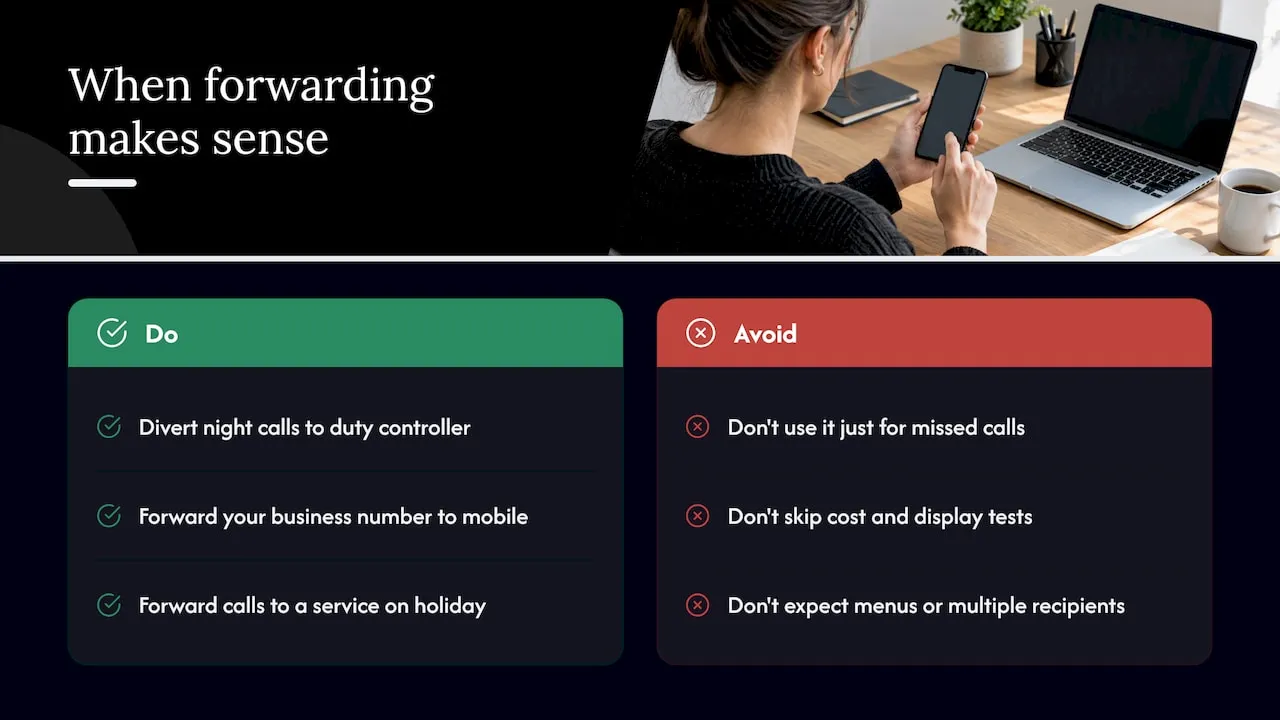
Taxi firms. A booking line that rings in an office nobody staffs at night can be diverted to the duty controller’s mobile. Every call lands with a person. The risk is the cost of the forwarded leg and the number display issue above, so test both before the first busy weekend.
Plumbers and other trades. If you work alone, you cannot answer a landline from under a sink. Forwarding the business number to your mobile means customers dial one number and you pick up wherever you are. Remember that your mobile then carries the forwarded charges, and that you need to answer as the business, not as yourself.
Holidays and closures. Forward all calls to a colleague or a call-answering service for a week. Switch it off when you are back.
Where it falls short. If you only want to catch calls you miss, use conditional forwarding instead. If you want calls to ring several people, route by time of day or play a menu, you need more than a divert code: a hosted service or a business telephony set-up.
Our view: the number matters more than the handset setting
We sell memorable UK numbers every day, and the pattern we see is simple. Firms spend time perfecting a divert on a number nobody remembers. The divert is the plumbing. The number is what customers actually keep in their heads, write on vans and type into their phone.
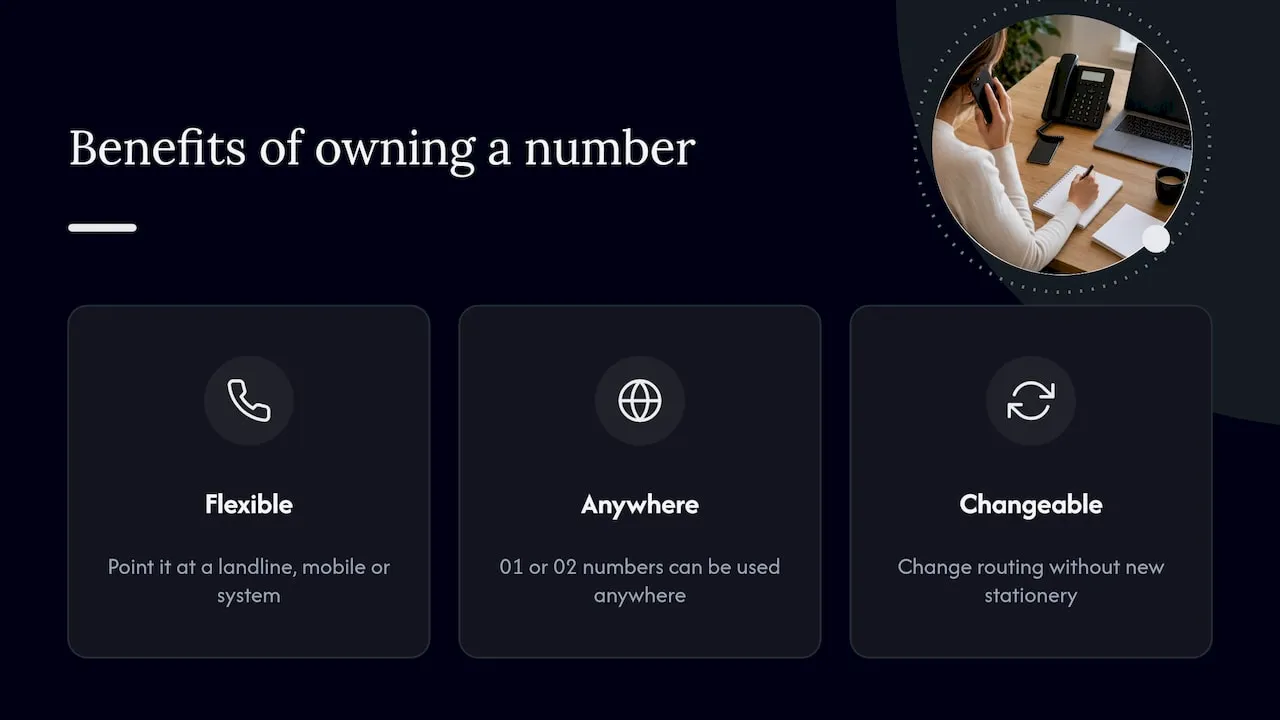
That is why we think of forwarding as something you do with a number you control, not instead of one. A number you own is not tied to a single line or to a local area, so you can point it at a landline, a mobile or a telephony system and change your mind later without printing new stationery. Numbers are no longer tied to local areas, so a 01 or 02 number can be used anywhere, and a plumber in one town can still carry the local area code customers trust.
If you are choosing between forwarding a hard-to-remember number and getting a memorable one, our honest advice is to do the second. Forward it if you need to, but let the number carry the brand. And whatever you set up, test it from another phone before you tell customers about it.
— Rob
Putting it into practice with a memorable number
If you want a number that forwards cleanly and is easy to remember, you can search our database for a number, sequence, area code or town and hold your pick with a 30 day reservation for £10, one-off. Landline (01 and 02), mobile (07) and non-geographic (03 and 08) numbers are all available, and you can browse alphanumeric numbers too.
What you pair the number with depends on how you work:
- XL Premier Service: £9.60 per month, with a one-off set-up of £14.40.
- XL Hosted Voice Service with a VoIP phone (XLHV): £7.86 per month, with a one-off set-up charge of £30.
- XL-IP, for keeping your BT phone number and phone and using them via your broadband router: £8 per month, with a one-off router and set-up cost of £99. Call bundles of 250, 500, 1000 or 5000 minutes to 01/02/03 numbers and top 4 mobile numbers cost £3.50, £7.00, £12.00 and £24.00 per month respectively.
- XL Mobile SIM: £27.24 per month, for taking your number on the road.
If you are weighing up the total cost, our piece on why the 24 month cost matters more than a cheap upfront fee is a good place to start. For callers’ costs, see landline versus mobile business numbers.
Quick checklist before you switch it on
- Confirm your tariff allows diverting to the destination you want (Pay as you go often does not).
- Check whether call barring is active on the line, and turn it off first if so.
- Ask your provider how the forwarded leg is charged.
- Dial the code with the full destination number, then
#. - Ring from another phone and check the answer, the greeting and the number displayed.
- Write down how to cancel (
#21#) where everyone who uses the line can see it.
For a wider overview of the topic, our guide to seven quick setup codes and UK scam checks and our explainer on the five types of call divert cover the neighbouring ground.
FAQ
What does “call forwarding unconditional” mean on my phone?
It means every incoming call is sent to another number you have chosen, regardless of whether your phone is busy, off or unanswered. Your own phone does not ring. On Android it is usually the “Always forward” option, and in the UK it is also called call diversion.
What is the difference between unconditional and conditional call forwarding?
Unconditional forwarding diverts all calls, all the time. Conditional forwarding only acts in set circumstances: when you are busy, do not answer or cannot be reached. Choose conditional if you want your phone to ring first.
How do I turn off unconditional call forwarding?
Dial #21# and press call, from the line that is being diverted. To cancel all diverts of any type on a mobile, dial ##002#. If it does not work, check with your provider, as some plans and hosted systems manage forwarding in an online account instead.
Does unconditional call forwarding cost money?
It can. Some business line products charge a monthly rental for the feature, and the forwarded leg of the call is often billed to the account holder at standard rates. Check your tariff and ask your provider before relying on it for a busy line.
How do I know if my calls are being forwarded?
Symptoms include callers saying they went to voicemail or reached someone else, and your phone never ringing. On a mobile you can dial *#21# to see the status, or simply cancel with #21# to be sure.
Sources
- Call Diversion, BT Help
- A guide to using call forwarding, BT Business
- How do I set up call divert on my mobile?, BT Business
- How to use call divert on your business phone, Vodafone UK
- Manage call diverts and call forwarding, Vodafone Help
- Vodafone calls and lines price guide
- Managing landline costs, Ofcom
- Guidelines for Calling Line Identification facilities, Ofcom